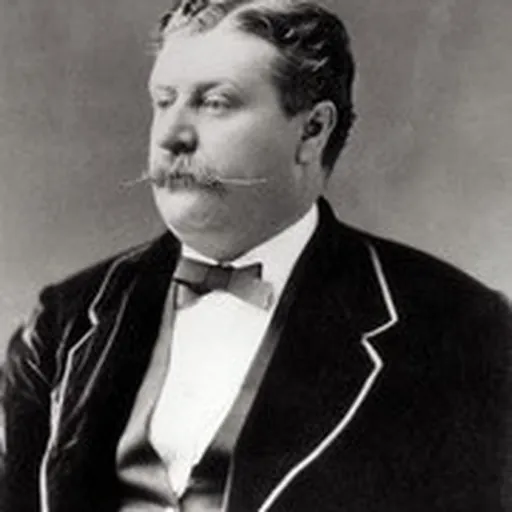
James Fisk
American businessman
About James Fisk
Lived 1835 – 1872 (aged 36). James Fisk was an American stockbroker and corporate executive.
James Fisk Jr. (April 1, 1835 – January 7, 1872) was an American stockbroker and corporate executive who was one of the robber barons of the Gilded Age. He achieved much ill-fame for his role in Black Friday in 1869, where he and his partner Jay Gould befriended the unsuspecting President Ulysses S. Grant in an attempt to use the President's good name in a scheme to corner the gold market in New York City. On January 7, 1872, Fisk was assassinated in New York City by his former mistress's new lover, Edward Stiles Stokes, who was attempting to blackmail him.
Financial buccaneer In 1864 Fisk became a stockbroker in New York City, and was employed by railroad robber baron Daniel Drew as a buyer. He aided Drew in the Erie War against Cornelius Vanderbilt for control of the Erie Railroad. This resulted in Fisk and Jay Gould becoming members of the Erie directorate, and subsequently, a well-planned raid netted Fisk and Gould control of the railroad. The association with Gould continued until Fisk's death.
Fisk and Gould carried financial buccaneering to extremes: their program included an open alliance with New York politician Boss Tweed, the wholesale bribery of legislatures, and the buying of judges. Their attempt to corner the gold market culminated in the fateful Black Friday of September 24, 1869. Though many investors were ruined, Fisk and Gould escaped both punishment and significant financial harm.
Personal life
Fisk married Lucy Moore in 1854, when he was 19 and she was 15. Lucy was an orphan, raised by an uncle from Springfield, Massachusetts. She tolerated Fisk's many extramarital affairs, perhaps because she was happy living with her "childhood friend and inseparable companion," Fanny Harrod, in Boston. Regardless, they remained close, with Fisk visiting her every few weeks and spending summers and vacations with her every chance he could.
In New York, Fisk had a relationship with Josie Mansfield. Mansfield was considered by some a voluptuous beauty by Victorian standards of female desirability. Fisk housed Mansfield in an apartment a few doors down from the Erie Railroad headquarters on West 23rd Street and had a covered passage built linking the back doors of the headquarters and her apartment building. Fisk's relationship with Mansfield scandalized New York society.
Mansfield eventually fell in love with Fisk's business associate Edward Stiles Stokes, a man noted for his good looks. Stokes left his wife and family, and Mansfield left Fisk.
Death In a bid for money, Mansfield and Stokes tried to extort Fisk by threatening the publication of letters written by Fisk to Mansfield that allegedly proved Fisk's legal wrongdoings. A legal and public relations battle followed, but Fisk refused to pay Mansfield anything. Increasingly frustrated and flirting with bankruptcy, Stokes confronted Fisk in New York City on January 6, 1872, in the Grand Central Hotel and shot him twice, in the arm and abdomen. A relatively young man of 36, Fisk died of the abdominal wound the next morning after giving a dying declaration identifying Stokes as the killer.
Stokes pleaded self-defense, using a wildly incongruent set of mitigating circumstances. He claimed to have been suffering from emotional turmoil at the time he committed the act. Fisk's death was blamed on medical malpractice by those who treated his mortal wound. Stokes was subsequently tried three times for the Fisk homicide. The first trial where he was charged with first degree murder ended in a hung jury, and rumors of jury members bribed. The second trial found him guilty of first degree murder and he was sentenced to death, a verdict overturned by appeal. The third trial concluded with a conviction for manslaughter, and Stokes served four years of a six-year prison sentence in Sing Sing Penitentiary.
Fisk's body was laid out for public view in the Grand Opera House, which he had owned. Some twenty thousand people came to pay their respects, with five times as many more individuals waiting in the streets to gain entrance. The 39 letters Fisk had written to Mansfield were published in the New York Herald one week after his death. The letters were commonplace communications between a man and the woman he loved.
In popular culture
Fisk's life was broadly fictionalized in the biopic The Toast of New York (1937), starring Edward Arnold as Fisk.
The Colt House Revolver is known among collectors as the Jim Fisk model or the Jim Fisk pistol, as it was used by Edward Stiles Stokes (Ned Stokes) in his murder.
The circumstances surrounding his murder were dramatized in the CBS radio program Crime Classics on June 29, 1953, in the episode entitled "The Checkered Life and Sudden Death of Colonel James Fisk". A portrayal of Fisk is featured in the History Channel's 2012 miniseries docudrama The Men Who Built America.
Rumors in Finland about Fisk's legacy After Fisk's death, rumors began circulating in Finland that he had left part of his enormous inheritance to "relatives living in Finland". These rumors are believed to have originated in the town of Porvoo, where the local newspaper, Borgåbladet, published a report in June 1872. The rumor quickly spread to Helsinki, the capital of the Grand Duchy of Finland at the time, and then to Turku, reaching these cities through newspapers in July 1872.
Several people in Finland believed they were Fisk's heirs and began claiming a share of the inheritance. The attempts were apparently unsuccessful and the story of the inheritance gradually faded. However, it resurfaced in the early 20th century when a family in Suodenniemi hired an agent to collect the supposed inheritance.
The Fisk inheritance story is now considered one of the many inheritance myths of the period.
Don’t just read it —
keep it.
Full-length biographies made to live with: read them, listen on the way to work, watch them tonight.
- E-book
- Audio
- Video
Instant download · yours to keep · every purchase keeps this site free
Important facts
Family & relationships
People in James Fisk's life
Named in this biography and alive at the same time

Related people
Same field, nearest in time




Contemporaries
People whose lives overlapped James Fisk's





Frequently asked questions
Who was James Fisk?
American businessman (1835–1872)
When was James Fisk born?
James Fisk was born on 1 April 1835 in Bennington.
When did James Fisk die?
James Fisk died on 6 January 1872 in New York City.
What was James Fisk's occupation?
James Fisk was a stockbroker and corporate executive.
What nationality was James Fisk?
James Fisk was American.
Sources & further reading
· DBpedia: James Fisk (financier)
Cite this page
APA: Biography.guide. (2026). James Fisk. https://biography.guide/james-fisk/
MLA: "James Fisk." Biography.guide, https://biography.guide/james-fisk/.
Chicago: "James Fisk." Biography.guide. https://biography.guide/james-fisk/.
Data last updated: 2026-09-22 · Spot an error? Report a correction.
Portrait: Wikimedia Commons · author & licence
Page generated 2026-09-27 04:58 UTC