
About James Dickson Innes
Lived 1887 – 1914 (aged 27). James Dickson Innes was a British painter.
James Dickson Innes (27 February 1887 – 22 August 1914) was a Welsh painter, mainly of mountain landscapes but occasionally of figure subjects. He worked in both oils and watercolours.
Style Of his style, art historian David Fraser Jenkins wrote: "Like that of the fauves in France and the expressionists in Germany, the style of his work is primitive: it is child-like in technique and is associated with the landscape of remote places."
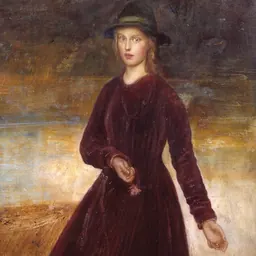
Biography Girl Standing by a Lake, oil on panel, 1911/12. Possibly depicting Euphemia Lamb. James Dickson Innes was born on 27 February 1887 in Llanelli, in south Wales. His father, John Innes, who had come from Scotland, was an historian and had an interest in a local brass and copper works; his mother was of Catalan descent. He had two brothers, Alfred and Jack.
His parents sent him to be educated at Christ College, Brecon. Afterwards he studied at the Carmarthen School of Art (1904–05), from where he won a scholarship to the Slade School of Art in London (1905–1908). His teachers at the Slade included Henry Tonks and P. Wilson Steer.
From 1907 he exhibited with the New English Art Club; and in 1911 he became a member of the Camden Town Group. The Camden Town Group included Walter Sickert who was an influence on Innes's art, and Augustus John with whom Innes became friends. Innes also exhibited in the influential Armory Show in New York City, Chicago and Boston.
He himself cut an arresting figure: a Quaker hat, a coloured silk scarf, and a long black overcoat, set off features of a slightly cadaverous cast, with glittering black eyes, a wide sardonic mouth, a prominent nose and a large bony forehead, invaded by streaks of thin black hair. He carried an ebony cane with a gold top, and spoke with a heavy English accent, which had been imposed on an agreeable Welsh sub-stratum.
Much of his work was done overseas, mainly in France (1908–1913), notably at Collioure, but also in Spain (1913) and Morocco (1913) – foreign travel having been prescribed after he was diagnosed with tuberculosis. On 22 August 1914, at the age of twenty-seven, he died of the disease at a nursing home in Swanley, Kent.
Legacy Innes was unusual for a British artist of that time, because of his bold painting style, more attuned to the French Post-Impressionists. It has been argued his unusual style led the way for British artists such as David Hockney.
In 2014 an exhibition of Innes' works was staged at the National Museum of Wales, Cardiff.
Don’t just read it —
keep it.
Full-length biographies made to live with: read them, listen on the way to work, watch them tonight.
- E-book
- Audio
- Video
Instant download · yours to keep · every purchase keeps this site free
Important facts
People in James Dickson Innes's life
Named in this biography and alive at the same time




Related people
Same field, nearest in time


Contemporaries
People whose lives overlapped James Dickson Innes's






Frequently asked questions
Who was James Dickson Innes?
British painter (1887-1914)
When was James Dickson Innes born?
James Dickson Innes was born on 27 February 1887 in Llanelli.
When did James Dickson Innes die?
James Dickson Innes died on 22 August 1914 in Kent, Swanley.
What was James Dickson Innes's occupation?
James Dickson Innes was a painter.
What nationality was James Dickson Innes?
James Dickson Innes was British.
Sources & further reading
· Wikipedia: James Dickson Innes
· DBpedia: James Dickson Innes
Cite this page
APA: Biography.guide. (2026). James Dickson Innes. https://biography.guide/james-dickson-innes/
MLA: "James Dickson Innes." Biography.guide, https://biography.guide/james-dickson-innes/.
Chicago: "James Dickson Innes." Biography.guide. https://biography.guide/james-dickson-innes/.
Data last updated: 2026-09-26 · Spot an error? Report a correction.
Page generated 2026-09-27 05:14 UTC