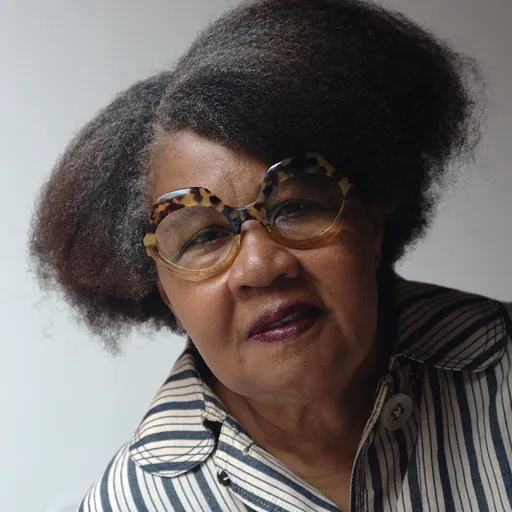
Jamaica Kincaid
Antiguan-American novelist, essayist, gardener, and gardening writer (born 1949)
About Jamaica Kincaid
Born 1949. Jamaica Kincaid is an American writer, novelist, playwright, university teacher, essayist and gardener.
Jamaica Kincaid (; born Elaine Cynthia Potter Richardson on May 25, 1949) is an Antiguan–American novelist, essayist, gardener, and gardening writer. Born in St. John's, the capital of Antigua and Barbuda, she lives in North Bennington, Vermont, and is Professor of African and African American Studies in Residence Emerita at Harvard University.
Biography Kincaid was born on 25 May 1949 in St. John's, on Antigua. She grew up in relative poverty with her mother, Annie Richardson Drew, a literate, cultured woman and homemaker who also worked as an assistant to a local physician, and her stepfather, David Drew, a carpenter. She was very close to her mother until her three brothers were born in quick succession, starting when Kincaid was nine years old. After her brothers' births, she resented her mother, who thereafter focused primarily on the brothers' needs. Kincaid later recalled:
Our family money remained the same, but there were more people to feed and to clothe, and so everything got sort of shortened, not only material things but emotional things. The good emotional things, I got a short end of that. But then I got more of things I didn't have, like a certain kind of cruelty and neglect.
Kincaid received a British education, as Antigua did not gain independence from the United Kingdom until 1981. Kincaid attended the Princess Margaret School and the Antiguan Girls School, and apprenticed as a seamstress. Although Kincaid was intelligent and frequently tested at the top of her class, her mother removed her from school at 16 to help support the family when her third brother was born, because her stepfather was ill and could no longer provide for the family. After that, Kincaid refused to send money home; "she left no forwarding address and was cut off from her family until her return to Antigua 20 years later".
Career overview While working as an au pair, Kincaid enrolled in evening classes at a community college. After three years, she resigned from her job to attend Franconia College in New Hampshire on a full scholarship. She also attended the New School for Social Research, studying photography. She dropped out after a year and returned to New York, She got her first assignment at Ingenue by walking in off the street and proposing an interview with Gloria Steinem, which became "When I was Seventeen", her first published article. She changed her name to Jamaica Kincaid in 1973, when her writing was first published. Her friend and author Guy Trebay suggested the name from his "little satirical playlet". She first dismissed it as "too stupid", but adopted it a week later. She called the name change "a way for me to do things without being the same person who couldn't do them—the same person who had all these weights". She said that "Jamaica" is an English corruption of what Christopher Columbus called Xaymaca, the part of the world she comes from, and that "Kincaid" seemed to go well with "Jamaica". Her short fiction appeared in The Paris Review and in The New Yorker, where her 1990 novel Lucy was serialized.
Kincaid's work has been both praised and criticized for its subject matter because it largely draws upon her own life and because her tone is often perceived as angry.
Kincaid was the 50th commencement speaker at Bard College at Simon's Rock in 2019.
The New Yorker As a result of her budding writing career and friendship with George W. S. Trow, who wrote many pieces for The New Yorker column "Talk of the Town", Kincaid became acquainted with New Yorker editor William Shawn, who was impressed with her writing. She resigned in 1996, when then editor Tina Brown chose actress Roseanne Barr to guest-edit an issue. Though circulation rose under Brown, Kincaid was critical of Brown for making the magazine less literary and more celebrity-oriented.
Recognition Kincaid received the 2022 Paris Review Hadada Prize, the magazine's annual lifetime achievement award.
Writing Her novels are loosely autobiographical, though Kincaid has warned against interpreting their autobiographical elements too literally: "Everything I say is true, and everything I say is not true. You couldn't admit any of it to a court of law. It would not be good evidence." Her work often prioritizes "impressions and feelings over plot development" Excerpts from her nonfiction book A Small Place were used as part of the narrative for Stephanie Black's 2001 documentary Life and Debt.
African-American literary critic, scholar, writer, and public intellectual Henry Louis Gates Jr. has said of Kincaid:
She never feels the necessity of claiming the existence of a black world or a female sensibility. She assumes them both. I think it's a distinct departure that she's making, and I think that more and more black American writers will assume their world the way that she does so that we can get beyond the large theme of racism and get to the deeper themes of how black people love and cry and live and die—which, after all, is what art is all about. As works such as At the Bottom of the River and The Autobiography of My Mother use Antiguan cultural practices, some critics say they employ magical realism. "The author claims, however, that [her work] is 'magic' and 'real,' but not necessarily [work] of 'magical realism'." Other critics call her style modernist because much of it is "culturally specific and experimental". It has also been praised for its keen observation of character, curtness, wit, Giovanna Covi wrote: "The tremendous strength of Kincaid's stories lies in their capacity to resist all canons. They move at the beat of a drum and the rhythm of jazz". In The New York Times, Dwight Garner called See Now Then (2013) "bipolar", "half séance, half ambush", and "the kind of lumpy exorcism that many writers would have composed and then allowed to remain unpublished. It picks up no moral weight as it rolls along. It asks little of us, and gives little in return." Another New York Times review called it "not an easy book to stomach" but added, "Kincaid's force and originality lie in her refusal to curb her tongue, in an insistence on home truths that spare herself least of all." A review of Mr Potter (2002) said: "It wouldn't be so hard if the repetition weren't coupled, here and everywhere it occurs, with a stern rebuff to any idea that it might be meaningful." Another critic wrote, "The superb precision of Kincaid's style makes it a paradigm of how to avoid lots of novelistic pitfalls."
In 2022, Kincaid was one of 38 Harvard faculty members to sign a letter to The Harvard Crimson defending Professor John Comaroff, who had been found to have violated the university's sexual and professional conduct policies. The letter called Comaroff "an excellent colleague, advisor and committed university citizen" and expressed dismay over his being sanctioned by the university. After students filed a lawsuit with detailed allegations of Comaroff's actions and Harvard did not respond, Kincaid was one of several signatories to say she wished to retract her signature.
Don’t just read it —
keep it.
Full-length biographies made to live with: read them, listen on the way to work, watch them tonight.
- E-book
- Audio
- Video
Instant download · yours to keep · every purchase keeps this site free
Important facts
Family & relationships
People in Jamaica Kincaid's life
Named in this biography and alive at the same time








Related people
Same field, nearest in time


Contemporaries
People whose lives overlapped Jamaica Kincaid's


Frequently asked questions
Who is Jamaica Kincaid?
Antiguan-American novelist, essayist, gardener, and gardening writer (born 1949)
When was Jamaica Kincaid born?
Jamaica Kincaid was born on 25 May 1949 in St. John's, Antigua and Barbuda.
What is Jamaica Kincaid's occupation?
Jamaica Kincaid is a writer, novelist, playwright, university teacher, essayist and gardener.
What nationality is Jamaica Kincaid?
Jamaica Kincaid is American.
Sources & further reading
Cite this page
APA: Biography.guide. (2026). Jamaica Kincaid. https://biography.guide/jamaica-kincaid/
MLA: "Jamaica Kincaid." Biography.guide, https://biography.guide/jamaica-kincaid/.
Chicago: "Jamaica Kincaid." Biography.guide. https://biography.guide/jamaica-kincaid/.
Data last updated: 2026-09-24 · Spot an error? Report a correction.
Portrait: Wikimedia Commons · author & licence
Page generated 2026-09-27 05:08 UTC