
Jacob Nix
German revolutionary
About Jacob Nix
Lived 1822 – 1897 (aged 74).
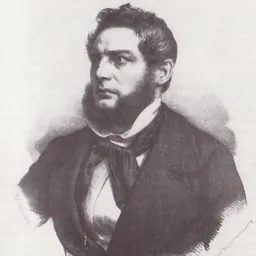
Jacob Nix (July 17, 1822 - January 13, 1897) was a German revolutionary, German Turner, assessor, and municipal clerk of the city of New Ulm, Minnesota. Nix was one of the commanders of the militia forces alongside Charles Eugene Flandrau during the Battles of New Ulm during the Dakota War of 1862 where he was severely wounded.
Early life German Revolutionary Franz Heinrich Zitz, Nix was a member of Zit's Freikorps during the Palatine uprising. Nix was born in Bingen am Rhein on July 17, 1822, the history of his family before 1849 is scarce. Nix was a participant in the Revolutions of 1848, specifically the Palatine uprising, where he fought in the Third Company of Franz Heinrich Zitz's Rhenish Hesse Freischar against the German Confederation. Nix was captured during the failed uprising and was tried with high treason by the German government, however, Nix was able to escape to Antwerp. Like many Germans at the time, Nix fled to the United States due to what he perceived as political persecution from the German government becoming what German-Americans referred to as Forty-eighters. When Nix immigrated to the United States around 1852 he ended up residing in Columbus, Ohio which, at the time, had a large German population. Pfaender eventually founded the Chicago Land Association which speculated Dakota land which had been ceded to the United States Government during the Treaty of Traverse des Sioux in the Minnesota River Valley in 1854 where New Ulm was eventually platted. The Chicago Land Association eventually merged with the German Land Association of Minnesota and formally started to sell land in 1857 to prospective Germans moving to Minnesota Territory. The German Land Association was eventually dissolved in 1859 after Minnesota was granted statehood. Nix, Pfaender, and Julius Berndt among others were prominent leaders of the local Turner Hall which housed the town's first school as well as many social and athletic activities. Nix was one of several men who joined Sheriff Charles L. Roos in organizing the Brown County militia for the defense of New Ulm following the Attack at the Lower Sioux Agency. During the First Battle of New Ulm Nix and Sheriff Roos were the two commanders of the militia. During the battle Nix was severely wounded in the shoulder and had his finger shot off but continued to lead the militia alongside Roos.
Nix's command was eventually replaced with the arrival of Nicollet County Judge Charles Eugene Flandrau who was the local militia commander at Traverse des Sioux. The militia and civilian populace of New Ulm eventually abandoned the city and fled to Mankato, Minnesota where they sought refuge following the two battles which destroyed much of the city. Indian Attack on New Ulm. Nix's militia can be seen behind the barricades on the left.
Military service against the Dakota When Nix's service in the militia was ended following the defeat of the Dakota at the Battle of Wood Lake he enlisted into the 1st Minnesota Cavalry Regiment and was made Captain of Company L on December 28, 1862. Many other prominent New Ulm citizens joined the 1st Minnesota Cavalry including John Hauenstein, a local brewer who served as Nix's Lieutenant. William Pfaender also served in the 1st Minnesota Cavalry Regiment as the regiments Lieutenant Colonel and would fight with the regiment before being transferred to the 2nd Minnesota Cavalry Regiment.
Duel in St. Cloud During his military service as the Captain of Company G, 2nd Minnesota Cavalry Nix was involved in a bar fight which turned into a duel in St. Cloud, Minnesota which was started by one of the patrons after Nix called them a "damned Copperhead". The patron and Nix fought with one another until the fight was broken up by Nix's cavalry squadron who joined in the fight. The fight was stopped by Charles Lueg, a fellow German American and the Captain of Company G, 4th Minnesota Infantry Regiment. Lueg persuaded Nix's men and the patrons of the bar to stop fighting as it was not a fair fight. In the postwar era Nix was an active member in the community. Nix was a member of the Hecker Post No. 48 of the Grand Army of the Republic in New Ulm, the local Turnverein, and reunion groups for the First and Second Minnesota Cavalry. Nix was later a contributor and promoter of the Hermann Heights Monument built by local architect and sculptor Julius Berndt.
Nix died on January 13, 1897 in New Ulm, he was survived by his wife Margaretha, his son Robert Peter Andrew Nix, and two daughters Amalie Nix and Emmy Steinhauser. Nix is featured prominently throughout the exhibit "Never Shall I Forget – A New Look At Brown County and the U.S.-Dakota War" at the Brown County Museum.
Don’t just read it —
keep it.
Full-length biographies made to live with: read them, listen on the way to work, watch them tonight.
- E-book
- Audio
- Video
Instant download · yours to keep · every purchase keeps this site free
Important facts
People in Jacob Nix's life
Named in this biography and alive at the same time

Contemporaries
People whose lives overlapped Jacob Nix's





Frequently asked questions
Who was Jacob Nix?
German revolutionary (1822-1897)
When was Jacob Nix born?
Jacob Nix was born on 17 July 1822.
When did Jacob Nix die?
Jacob Nix died on 13 January 1897.
Sources & further reading
Cite this page
APA: Biography.guide. (2026). Jacob Nix. https://biography.guide/jacob-nix-1822/
MLA: "Jacob Nix." Biography.guide, https://biography.guide/jacob-nix-1822/.
Chicago: "Jacob Nix." Biography.guide. https://biography.guide/jacob-nix-1822/.
Data last updated: 2026-09-20 · Spot an error? Report a correction.
Page generated 2026-09-27 05:07 UTC