
About Jack Pollock
Lived 1930 – 1992 (aged 62). Jack Pollock was a Canadian painter, art dealer and artist.
Jack Henry Pollock (1 August 1930 – 10 December 1992) was an author, painter, art educator, and art dealer who was a fixture on the Toronto art scene for over 3 decades. Pollock was the flamboyant founder and owner of The Pollock Gallery in Toronto. He was widely reputed to have a skilled eye for identifying talent in young artists and was instrumental in the careers of many notable artists that he represented including David Hockney, Susan Ross, Ken Danby, Norval Morrisseau, Roy Thomas, Catherine Senitt, Arnold Shives, Charles Pachter, Robert Bateman, Robert Kost, and Willem de Kooning.
Professional life Pollock graduated from the Ontario College of Art (OCAD) in 1954 and subsequently studied at the prestigious Slade School of Fine Art in London, England. Afterwards, he returned to Canada and was employed as a colour consultant for a paint company. Pollock's employment was terminated after he had a psychological breakdown requiring hospitalization. During his time in hospital, Pollock experienced the benefits of art therapy which led him to open the Pollock Gallery in 1960.
In 1962, while teaching art classes in Northern Ontario funded by the Ontario Government, Pollock met Norval Morrisseau, a local Ojibwa artist. Pollock immediately recognized the artist's genius and arranged for a solo exhibition at his gallery in Toronto. The response was a sold-out show and brilliant reviews declaring Morrisseau a "genius." Morrisseau went on to become arguably Canada's most important indigenous artist.
In 1966, the National Gallery of Canada acquired a print of Pollock's Remembered Image No.82 for its permanent collection. Pollock had become well respected as an artist despite the overshadowing talent of Morrisseau. Pollock's painting styles were abstract and expressionistic. His later works were highly colourful, simple studies of scenes from his everyday life.
"I'm sure that, if I were to die tomorrow, the single most important thing people would remember me for is, damn it, the discovery of Norval Morrisseau. I'd like to think that I've done other equally important things. However, that's the way it is." Jack Pollock (May 20, 1984)
Although Morrisseau made Pollock famous, the artist proved troublesome at times. In 1973, Pollock found himself accused of theft by Indian Affairs of Canada employee Bob Fox who was "managing" Morrisseau on the side while the artist was incarcerated. Morrisseau had instructed Pollock to take several paintings to Toronto to be sold; Fox accused Pollock of stealing the paintings. Pollock was found not guilty of the charge and in an unusual occurrence, he was complimented at length in the resulting judgement issued by the Court.
In 1979, with Canadian Broadcasting Corporation personality Lister Sinclair, Pollock wrote one of Canada's more notable art books: The Art of Norval Morrisseau. Pollock figures prominently in Derek May's 1981 documentary film on the Toronto art scene, Off the Wall.
Drug addiction and recovery Some time around this period, Pollock developed an addiction to cocaine, which exacerbated his financial difficulties. Worse still, his relationship with Norval Morrisseau appeared to be undermined by Morrisseau's involvement with alleged mafioso Albert Volpe.
In April 1984, Pollock was exhausted, depressed and attempting to break free of his addiction to cocaine. He had considered suicide and had himself committed under psychiatric care. Afterwards, Pollock fled to a residence he partially owned with friends located in Gordes, southeastern France. During this time period, he began recuperating and trying to come to terms with his life, his relationships and his failures. He concentrated his efforts on personal recovery and rediscovered art therapy. ) and was well received by critics and the public alike. It was shortlisted for the City of Toronto's Toronto Book Awards in 1990. Although the identity of "Dear M" was not acknowledged in the media, his identity was well known within Toronto's gay community. "Dr M" was, in fact, Dr. Murray Wilson (1924–2010), an openly gay senior staff psychiatrist at Toronto's Wellesley Hospital from 1969 to 1985 and a former teacher of psychiatry at University of Ottawa and University of Toronto. Dr. Wilson was also a serious artist.
Death Jack Pollock was openly gay, writing about his homosexuality in both The Art of Norval Morrisseau and Dear M: Letters from a Gentleman of Excess. He eventually was diagnosed with AIDS and became a vocal advocate for AIDS research and for those suffering from the disease. He spoke openly about his diagnosis and its impact on his life:
"Because my immune system is gone, I was given very potent antibiotics that saved my life but destroyed my middle ear. Now I have no sense of balance, need to walk with a cane and can't go out alone. I miss my old mobility. It's extremely frustrating to wither away." "It didn't seem fair that after I'd gotten my life together, I was hit by AIDS, so I decided to paint my rage. You can lash out on paper, violate it, and it just absorbs the anger. No one gets hurt."
A day before his death, Pollock was scheduled to speak at a benefit for an AIDS hospice at what was billed to be his last public appearance, but Pollock was too ill to leave the hospital and died the next evening, on December 10, 1992. As Pollock himself had predicted in 1984, he is still mostly recognized for his association with Norval Morrisseau.
Pollock Gallery locations One - 205 Elizabeth Street, 1960-1961 Two - 201 Elizabeth Street, 1961-1963 Three - 599 Markham Street, 1963-1971 Four - Phase II, Portland Street 1966-1968 Five - 356 Dundas Street West, 1972-1975 Six - Toronto Dominion Centre, 1972-1973 Seven - 122 Scollard Street, 1975-1982 Eight - 209 Adelaide Street East, 1980-1983
Don’t just read it —
keep it.
Full-length biographies made to live with: read them, listen on the way to work, watch them tonight.
- E-book
- Audio
- Video
Instant download · yours to keep · every purchase keeps this site free
Important facts
People in Jack Pollock's life
Named in this biography and alive at the same time


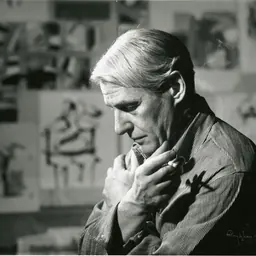





Related people
Same field, nearest in time



Contemporaries
People whose lives overlapped Jack Pollock's

Frequently asked questions
Who was Jack Pollock?
Canadian artist, gallery owner (1930-1992)
When was Jack Pollock born?
Jack Pollock was born on 1 August 1930.
When did Jack Pollock die?
Jack Pollock died on 10 December 1992.
What was Jack Pollock's occupation?
Jack Pollock was a painter, art dealer and artist.
What nationality was Jack Pollock?
Jack Pollock was Canadian.
Sources & further reading
Cite this page
APA: Biography.guide. (2026). Jack Pollock. https://biography.guide/jack-pollock/
MLA: "Jack Pollock." Biography.guide, https://biography.guide/jack-pollock/.
Chicago: "Jack Pollock." Biography.guide. https://biography.guide/jack-pollock/.
Data last updated: 2026-09-20 · Spot an error? Report a correction.
Page generated 2026-09-27 05:03 UTC