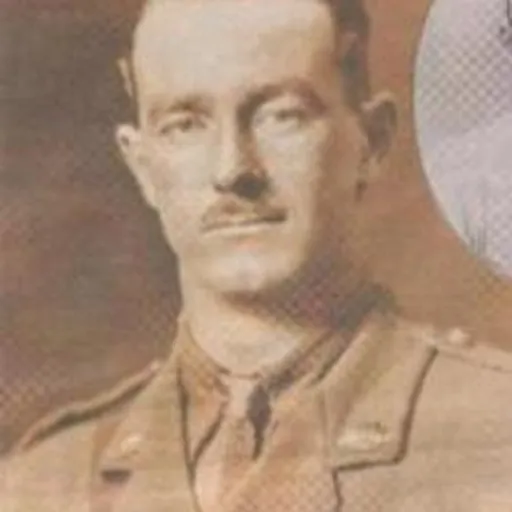
Jack Massie
Australian cricketer and rugby union player
About Jack Massie
Lived 1890 – 1966 (aged 75). Jack Massie was an Australian cricketer, rugby union player and businessperson.
Robert John Allwright Massie (8 July 1890 – 14 February 1966) was an Australian first-class cricketer who played with New South Wales and represented them in the Sheffield Shield.
Massie also served in World War I as an officer in the Australian Imperial Force, seeing action at Gallipoli and on the Western Front in France. Injuries sustained in the war ended his cricket career, but he had a successful business career, principally with British American Tobacco.
Early sporting achievements Massie was a gifted sportsman, representing New South Wales at numerous sports. As a rugby union footballer he played in the position of second-rower for Sydney University while studying Civil Engineering and represented New South Wales four times. He was picked in the Australian rugby squad to tour New Zealand in 1913 but had to withdraw due to study commitments.
In 1913 he won the NSW Amateur Boxing Heavy Weight Championship and the following year was state champion in the 120-yard hurdles. He also excelled at rifle-shooting and rowing.
First-class cricketer A tall left-arm fast bowler, Massie came close to playing Test cricket in 1914 when he was named in the squad to tour South Africa but the series did not go ahead. He had been playing regular first-class cricket for just two seasons but had proved to be a handful for Australian batsmen, taking 59 wickets at 18.66 in the 1912–13 summer and then 37 wickets at 16.32 in 1913–14.
Massie's best performance in a match came in a Sheffield Shield encounter in 1912/13, with New South Wales taking on Victoria. His second innings figures of 7 for 110 gave him 11 wickets for the match and included the scalps of Warwick Armstrong and Jack Ryder.
He was generally an ineffective batsman but did manage a half century against Western Australia in 1912 at the Sydney Cricket Ground. New South Wales declared their second innings at 8/375 once he reached the milestone and went on to win the match.
World War I campaign Massie, who enlisted in the Australian Imperial Force on 17 August 1914, was commissioned as a second lieutenant in the 4th Battalion on 14 September, served with distinction during the war. His battalion embarked for Egypt in October, and he was promoted lieutenant on 1 February 1915. He took part in Australia's campaign at Gallipoli and in just his second day in the conflict was fortunate to survive a suicidal advance towards the Turkish lines, resulting from orders that were misunderstood by his battalion, when his commanding officer was killed, Massie tried to recover his body.
Massie received slight wounds on 25 June, and 20 July, he was seriously injured on the night of 6–7 August 1915, during the Battle of Lone Pine by shrapnel. The shrapnel lodged into the back of his left shoulder and he also suffered a punctured lung and broken ribs. The injury was serious enough for him to be repatriated to Australia, he was promoted to captain during the journey, on 1 December. and awarded the French Croix de Guerre. He was promoted major on 1 May, and appointed second in command of the newly raised 33rd Battalion, which he had previously been involved in training. The battalion departed Sydney on the transport Marathon on 4 May, and arrived at Devonport on 9 July. The battalion was sent to France with the 3rd Division on 21 November. He was attached to the divisional HQ during May and June 1917. From October to December he was a student on a higher command course. and he then received the Distinguished Service Order on 3 June 1918.
After Massie's initial recuperation he trained with the Machine Gun Corps at Grantham, passing the tests to command a machine gun battalion. He was attached to the Australian Corps School on 12 September, appointed commandant on 24 September, and promoted to lieutenant colonel on 21 October. He was demobilised on 16 August 1919.
Personal life Massie's father Hugh had also been a cricketer and appeared in nine Tests for Australia in the 1880s. Massie's grandfather, on his mother's side, Thomas Allwright Dibbs, was an eminent banker in Sydney.
Massie married Phyllis Wood Lang at Holy Trinity Brompton, London, on 3 June 1919. They had a son named John who was killed in action during World War II; Phyllis died soon after. On 20 September 1947, Massie married a widow, Elizabeth Emily Squire (née Crosse) in Washington DC.
He died on 14 February 1966, at the age of 75, from cancer.
Don’t just read it —
keep it.
Full-length biographies made to live with: read them, listen on the way to work, watch them tonight.
- E-book
- Audio
- Video
Instant download · yours to keep · every purchase keeps this site free
Important facts
People in Jack Massie's life
Named in this biography and alive at the same time





Related people
Same field, nearest in time



Contemporaries
People whose lives overlapped Jack Massie's


Frequently asked questions
Who was Jack Massie?
Australian cricketer and rugby union player (1890-1966)
When was Jack Massie born?
Jack Massie was born on 8 July 1890 in North Sydney.
When did Jack Massie die?
Jack Massie died on 14 February 1966 in Mosman.
What was Jack Massie's occupation?
Jack Massie was a cricketer, rugby union player and businessperson.
What nationality was Jack Massie?
Jack Massie was Australian.
Sources & further reading
Cite this page
APA: Biography.guide. (2026). Jack Massie. https://biography.guide/jack-massie/
MLA: "Jack Massie." Biography.guide, https://biography.guide/jack-massie/.
Chicago: "Jack Massie." Biography.guide. https://biography.guide/jack-massie/.
Data last updated: 2026-09-23 · Spot an error? Report a correction.
Portrait: Wikimedia Commons · author & licence
Page generated 2026-09-27 05:06 UTC