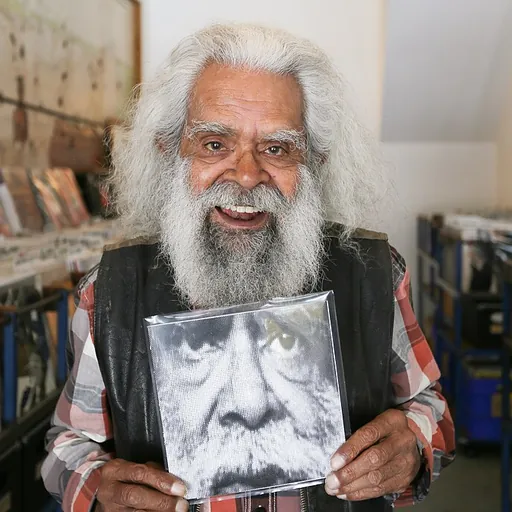
About Jack Charles
Lived 1943 – 2022 (aged 79). Jack Charles was an Australian actor, film actor, television actor and aboriginal elder.
Jack Charles (5 September 1943 – 13 September 2022), also known as Uncle Jack Charles, was an Australian stage and screen actor and activist, known for his advocacy for Aboriginal people. He was involved in establishing the first Indigenous theatre in Australia, co-founding Nindethana Theatre with Bob Maza in Melbourne in 1971. His film credits include the Australian film The Chant of Jimmie Blacksmith, among others, and more recently appeared in TV series Cleverman (2016) and Preppers (2021).
He spent many decades in and out of prison and as a heroin addict, which he ascribed largely to trauma that he experienced as a child, as one of the Stolen Generations. In later life he became a mentor for Aboriginal youth in the prison system along with musician Archie Roach, and was revered as an elder. As a gay man, Charles was considered a gay icon and role model for LGBTQI+ Indigenous youth.
Among other awards and honours, he was Victorian Senior Australian of the Year in 2015, and Male Elder of the Year in the 2022 National NAIDOC Week Awards.
Early life Jack Charles was born on 5 September 1943 at the Royal Women's Hospital, Carlton, in Melbourne, Victoria, and a Wiradjuri father, Hilton. Charles' great-great-grandfather was a Djadjawurrung man, among the activists who resisted government policy at the Coranderrk reserve in Victoria in 1881.
Charles was a victim of the Australian Government's forced assimilation program which took him from his mother as an infant, and which produced what is known as the Stolen Generations. He tells how his mother sneaked out of the Royal Women's Hospital and took him to a "blakfella camp" near Shepparton and Mooroopna (Daish's Paddock ), but the authorities came and took him when he was four months old.
After being moved to the Melbourne City Mission in Brunswick, and physical abuse "far worse than anything [he] later experienced in prison". First, he was invited by members of the New Theatre in Melbourne to audition for a production of A Raisin in the Sun, a play written by the African-American playwright Lorraine Hansberry. This was followed by a non-Aboriginal role in Rod Milgate's A Refined Look at Existence. He later said that the New Theatre, with whom he spent seven years, was his NIDA (National Institute of Dramatic Art), as well as like family to him.
Charles was involved in establishing Indigenous theatre in Australia. In 1971, he co-founded, with Bob Maza, Nindethana ("place for a corroboree") at The Pram Factory in Melbourne, Australia's first Indigenous theatre group. Their first hit play, in 1972, was called Jack Charles is Up and Fighting, and included music composed by him. He is often referred to as "the grandfather of Indigenous theatre" because of this early work. He also helped to develop the National Black Theatre in Redfern, Sydney. a cat burglar who was struggling to get over his drug habit, in a one-act play for four actors called Bastardy, written by John Romeril. The play was performed at the Pram Factory and directed by Bruce Spence. (The script of the play Bastardy was published in 1982.)
In 1974, Charles played Bennelong in the Old Tote Theatre production of Michael Boddy's Cradle of Hercules, which was presented at the Sydney Opera House as part of its opening season. Also in the cast was a young David Gulpilil.
In 2010, Ilbijerri Theatre staged Charles' one-man show called Jack Charles v The Crown at the Melbourne Festival. Bob Maza's daughter, Rachael Maza, as artistic director of Ilbijerri, was involved in the production, and playwright John Romeril co-wrote the script. In the show, Charles talks about his life, including his removal from his family and its consequences, his addiction to and recovery from heroin, and his crimes. Charles was nominated for a Helpmann Award for Best Male Actor in a Play for his performance in the play, which toured across Australia and internationally, including Japan, Canada, Britain and the United States, for ten years. and in the same year Ilbijerri was joint winner of a Drover Award from APACA.
In 2012, Charles performed in the Sydney Festival production I am Eora.
In August 2014, Charles performed in Ilbijerri Theatre and Belvoir Theatre's Coranderrk at Northcote Town Hall. It was partly due to this disappointment, that the white establishment was not yet ready to accept Aboriginal actors in major roles, that led to his co-founding of Nindethana and the development of black theatre for Indigenous people.
Charles was the subject of Amiel Courtin-Wilson's documentary film, Bastardy (its title taken from John Romeril's 1972 play based on Charles' character and others, and was nominated for numerous awards. The film won the Film Critics Circle of Australia Award for Best Documentary in 2009; Best Documentary Human Story at the 2009 ATOM Awards; and the Grand Jury Prize at the FIFO International Documentary Film Festival in 2010. The film was re-screened at MIFF in 2017, with Charles on the night crediting the film with having saved his life. The film brought affection from strangers who had seen the film, and it resuscitated his career as an actor.
Charles appeared in several episodes of the sketch comedy show, Black Comedy, between 2014 and 2020, his final role being that of a judge.
In 2016, Charles appeared in two episodes of the television horror drama series Wolf Creek. Also in 2016, he appeared in the television drama series Cleverman. Charles appeared in the 2021 television comedy series Preppers.
Radio Charles was interviewed on ABC Radio many times over the years, by Larissa Behrendt, Daniel Browning, among others.
Addiction and jail For a large part of his life, Charles was a petty thief and heroin addict. He was jailed 22 times,
Other activities and later life He developed an interest in pottery in prison in Castlemaine in the 1970s, and after developing his skills he taught other prisoners in what was a successful program. He enjoyed creating works through his lifetime, finding the practice meditative.
Charles received a Christian education from the Salvation Army, and continued to observe Christian values into his 70s, when he told Geraldine Doogue in 2017:I've employed my Aboriginality as my religion now ... instead of God, I've found that the Godhead is within me ... I'm solely directed towards making an accommodation between Black and White.
He told Benjamin Law in 2020 that his experience with Christianity and the Salvos had "proper buggered me up" because of the abuse he suffered, but he had never wanted to sue the Salvation Army, as they do much good. He liked to believe that Bundjil, the great wedge-tailed eagle, the ancestor spirit and creator of the Kulin land and its people, that had kept him alive through his darkest and riskiest moments in his life. He said that he had technically been dead medically before, and had also attempted suicide once. He also advocated for more Indigenous community centres in regional centres such as Horsham or Shepparton, for young people to gather in "a sanctuary for Aboriginal people where the community can get together and talk about our personal issues with each other...". He said that he had petitioned local councils and later the Victorian Minister for Aboriginal Affairs to create a community centre for people after their release from prison, but had not been listened to. However he found it gratifying that in later life young Indigenous men would come up to him in the street and excitedly tell him that they had come off heroin and methadone. In his work with youth in youth detention centres and in speaking about other young queer Indigenous people, he encouraged everyone to be true to themselves. When he had been refused twice in three days in 2015, it was reported in the international press as well as in Australia.
In 2017, Charles gave a talk about his passion for prison mentoring at TEDx in Sydney, and his work with Uncle Archie Roach at the Archie Roach Foundation, followed by a performance of Roach's song "We Won't Cry" by the two of them. was published on 18 August 2020 by Penguin. The memoir was shortlisted by the Australian Book Industry Awards for the 2020 Biography Book of the Year.
In April 2021, Charles was the first Aboriginal elder to speak at the Victorian truth-telling commission, the Yoorrook Justice Commission, which aims to establish an official public record of the experience of Aboriginal Victorians since the start of British colonisation in Victoria. Its findings, scheduled to be reported by June 2024, will inform Victoria's Treaty negotiations. He is remembered as "the grandfather of Indigenous theatre" because of this early work. and international press, with prime minister of Australia Anthony Albanese, musician and comic Adam Briggs, actor Meyne Wyatt, and Aboriginal senator Lidia Thorpe tweeting their respects,
There was a state memorial for Charles, provided by the Victorian government at Hamer Hall in Melbourne, held on 18 October 2022. Hundreds of mourners attended, and crowds gathered outside. Many speakers described Charles' legacy as giving back to the community, after enduring an extraordinarily hard life. Premier Daniel Andrews was unable to attend owing to the flood emergency, with Acting Aboriginal Affairs Minister Colin Brooks addressing the funeral instead. Others to address the funeral included theatre director Rachael Maza and film director Amiel Courtin-Wilson, both friends of Charles. There were stage performances inside and dancers outside.
Recognition, awards and honours Charles was the subject of Amiel Courtin-Wilson's 2008 documentary Bastardy. It won the National Photographic Portrait Prize in 2012. McNicol had met Charles in the early 1970s and created several portraits of him over the years.
A portrait of Charles by Anh Do was the People's Choice Award winner in the 2017 Archibald Prize.
Awards and honours include: 2009: Tudawali Award at the Message Sticks Festival, for his lifetime contribution to Indigenous media 2014: Lifetime Achievement award from Victoria's Green Room Awards; the first Indigenous recipient 2015: Named Victorian Senior Australian of the Year by the Victorian Government 2022: Male Elder of the Year, National NAIDOC Week Awards
Birth family and personal life Charles' fifth great-grandfather was Mannalargenna, who was a highly respected Aboriginal Tasmanian elder and leader, acting as emissary to surrounding clans in Tasmania. His fourth great-grandmother, Woretemoeteyenner (1797–1847), was a strong Aboriginal Tasmanian woman who stood up to the sealers who decimated the population of seals that they relied on for food. His grandmother, Annie Johnson, was an important person in the history of the Murray River region of Victoria. She was known for using her horse and dray for taking food to families when flu epidemics hit the local Aboriginal communities. 2015 Pan Chief Feature film 2021 Back to the Outback Frilled-Neck Lizard (voice) Animated feature film Television Year Film Role NotesRef. 2014 The Gods of Wheat Street Old Uncle 5 episodes 2016 Wolf Creek Uncle Paddy 2 episodes
Publications Jack Charles: Born-Again Blakfella (Penguin Books, 2020)
Footnotes
Don’t just read it —
keep it.
Full-length biographies made to live with: read them, listen on the way to work, watch them tonight.
- E-book
- Audio
- Video
Instant download · yours to keep · every purchase keeps this site free
Important facts
People in Jack Charles's life
Named in this biography and alive at the same time






Related people
Same field, nearest in time

Contemporaries
People whose lives overlapped Jack Charles's


Frequently asked questions
Who was Jack Charles?
Australian actor
When was Jack Charles born?
Jack Charles was born on 5 September 1943 in Melbourne.
When did Jack Charles die?
Jack Charles died on 13 September 2022 in Melbourne.
What was Jack Charles's occupation?
Jack Charles was an actor, film actor, television actor and aboriginal elder.
What nationality was Jack Charles?
Jack Charles was Australian.
Sources & further reading
Cite this page
APA: Biography.guide. (2026). Jack Charles. https://biography.guide/jack-charles/
MLA: "Jack Charles." Biography.guide, https://biography.guide/jack-charles/.
Chicago: "Jack Charles." Biography.guide. https://biography.guide/jack-charles/.
Data last updated: 2026-09-22 · Spot an error? Report a correction.
Portrait: Wikimedia Commons · author & licence
Page generated 2026-09-27 05:01 UTC