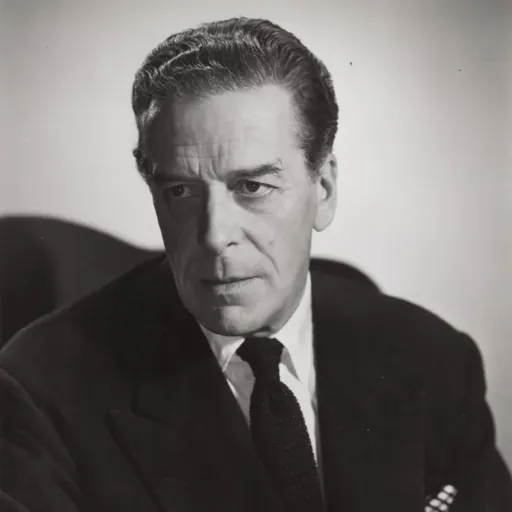
Jack Buchanan
British actor, singer, director and producer
About Jack Buchanan
Lived 1891 – 1957 (aged 66). Jack Buchanan was a British actor, film director, film producer, theatre director, singer and film actor.
Walter John Buchanan (2 April 1890 – 20 October 1957) was a British theatre and film actor, singer, dancer, producer and director.
Born to a comfortable middle-class family in Scotland, Buchanan attempted to follow his father into auctioneering, but conceived a strong desire to be a performer. After a calamitous début as a stand-up comic, he moved to London and between 1912 and 1917 built up a performing career in the chorus or small parts in musical comedies before achieving leading roles in West End shows and remaining at the top of his profession for the rest of his career.
He was known for more than three decades as the embodiment of the debonair man-about-town in the tradition of George Grossmith Jr., and was described by The Times as the last of the knuts. Among his leading ladies in West End, and, later, Broadway, shows were Binnie Hale, Gertrude Lawrence, Beatrice Lillie, Jessie Matthews, Phyllis Monkman and – the partner with whom he was most associated – Elsie Randolph.
Buchanan directed, choreographed, and produced many shows, and ran theatres and a film studio. He made several British films, often adaptations of his stage successes, but his best-known film was the Hollywood musical The Band Wagon in 1953.
Life and career Early years Buchanan was born on 2 April 1890 in Helensburgh, near Glasgow, the son of Walter John Buchanan, a prosperous auctioneer, and his wife, Patricia McWatt. He was intended for Edinburgh's leading private school, Fettes College, but his father's sudden death in 1902 left the family in reduced circumstances, and he was educated at a state school, the Glasgow Academy.
After a brief attempt to follow his father's profession once he left school, he appeared as a music hall comedian under the name of Chump Buchanan, making a disastrous début in 1911: he later recalled that he must have set "a world record in getting the bird" twenty-four times in his first week. After that he decided to pursue a career in London. but by the first night he had opted to appear as Jack Buchanan. His role was a minor one, but he attracted mild praise from the theatrical papers The Era and The Stage. The piece ran for only six weeks, after which Buchanan had only one brief engagement until April 1913, when he joined the chorus of a new revue, All the Winners at the Empire, Leicester Square as understudy to two of the principals. During this time he supplemented his income working as an extra in silent films. When the show closed after two months he was out of work for several months before securing a dancing role in a pantomime in Birmingham and then a principal part in a West End revue, A Mixed Grill, which opened in March 1914. George Grossmith, Jr as Dudley Mitton, with Julia James in To-Night's the Night. Grossmith cast Buchanan as Mitton for a British tour. Buchanan's health was not robust, and when he attempted to enlist for military service at the start of the First World War he failed his medical examination. He joined a touring production of The Cinema Star understudying Jack Hulbert and then auditioned for the actor-manager George Grossmith, Jr, who cast him in the leading role in a touring production of the highly successful musical comedy, To-Night's the Night. Grossmith himself had played the part on Broadway and in London, and gave Buchanan helpful advice about performing. The tour was successful and lasted for two years. A reviewer commented, "As Dudley Mitton, Mr Jack Buchanan plays with confidence and enthusiasm that is infectious, and his share in the popular 'They didn't believe me!' was valuable indeed, and the grimmer humour of 'Murders' was well handled".
In 1915 Buchanan married Saffo Arnau, a singer professionally known as Drageva. It may have been a marriage of convenience for her benefit: she was a Bulgarian national and therefore liable to internment as an enemy alien during the war if she did not acquire a British husband. She vanished from Buchanan's life while they were both on separate British tours and the marriage was annulled in 1920.
In Charlot's 1921 revue A to Z, Buchanan achieved front rank stardom. The theatre historian W. J. Macqueen-Pope writes that the show's title was appropriate:
For the rest of the 1920s and 1930s Buchanan was famous for, as The Times put it, "the seemingly lazy but most accomplished grace with which he sang, danced, flirted and joked his way through musical shows.... The tall figure, the elegant gestures, the friendly drawling voice, the general air of having a good time."
At the same time as establishing himself as a leading musical comedy star, Buchanan moved into management, which he pursued, with varying degrees of success, throughout the rest of his career. His first venture in that capacity was Battling Butler, which opened at the New Oxford Theatre in 1922. With music by Philip Braham and lyrics by Douglas Furber, it was billed as "a musical farce in three acts", and was co-directed by Dion Titheradge and Buchanan, who choreographed the dances. It ran for 243 performances in the West End, and then toured, with Arthur Riscoe taking over from Buchanan in the lead role. Buchanan followed this success with another musical farce, Toni, by Furber and Harry Graham (book and lyrics) and Hugo Hirsch (music), which opened in May 1924 and ran for 250 performances.
Broadway and West End, 1924–1939 Charlot revised A to Z for the Broadway stage as André Charlot's Revue of 1924, which opened at the Times Square Theatre in January of that year. Buchanan co-starred with Lawrence and Beatrice Lillie, and according to his biographer Andrew Lister, the show introduced the American public to "the distinctive charms of the intimate revue" as opposed to the Ziegfeld spectaculars. |group=n In December 1924 Buchanan played Lord Algernon Kenilworth in Boodle, in a pre-London try-out in Birmingham and then in the West End. In this piece, described by The Stage as "something more than a musical play ... in parts, really excellent farce", Buchanan's character was obliged to disguise himself as a clown and later as a barmaid: a reviewer in the Birmingham Daily Gazette commented, "Ah! if all barmaids were half as interesting, the whole country would take to drink". His leading lady in this production was June, but in a subsidiary role was Elsie Randolph, who became Buchanan's best-known stage partner in later productions.
Buchanan appeared in five British films made in 1924–25: The Audacious Mr Squire, The Happy Ending, Settled Out of Court, A Typical Budget and Bulldog Drummond's Third Round, and returning to stage revue he appeared, co-starring with Lawrence, in Charlot's 1925 production at the Prince of Wales's. He starred in, choreographed and directed an American production of the show at the Selwyn Theatre, New York. On his return to London he appeared at the Hippodrome in October 1926, when he produced Jerome Kern and Oscar Hammerstein's Sunny, which ran for 363 performances. Buchanan played Jim Demming, with Binnie Hale as Sunny and Elsie Randolph as Weenie Winters. He interpolated the hunting song sketch into the production. At the same theatre in June 1928, after a pre-London tour, he produced That's a Good Girl, in which he appeared as Bill Barrow with Randolph now in the leading female role. Their duet, "Fancy Our Meeting", was recorded by Columbia and became well known. In his 1978 biography of Buchanan, Michael Marshall comments, "this haunting tune is played and sung whenever Jack and Elsie's long partnership is recalled". In the words of Buchanan's biographer Andrew Spicer: blockindent|His throwaway nonchalance was complemented superbly by her spirited vivacity. Theirs was a world of light-hearted facetiousness played out in glamorous modern settings created by leading designers such as Ernst Stern. Buchanan rarely strayed from this milieu. In all these he was partnered by Randolph. He appeared on Broadway again in 1929 in C. B. Cochran's revue Wake Up and Dream, heading a cast that contained Tilly Losch and Jessie Matthews. "Fancy Our Meeting" was interpolated from There's a Good Girl, and as Buchanan and Matthews did not get on well, The performers won more praise than the material from reviewers but the show ran from October 1945 to July 1946. The following year he again acted in a non-musical play: a revival of Frederick Lonsdale's 1929 comedy Canaries Sometimes Sing, co-starring with Coral Browne, in the roles originally played by Ronald Squire and Yvonne Arnaud. The Stage commented, "It is a delight to see such brilliantly polished acting", but the critical and public consensus was that the play was outdated and it had only a short run. During this period Buchanan was struggling with business commitments. In Marshall's words, "He was tied to his desk at the Garrick Theatre trying to recoup – through the sale of his film studios – substantial losses on the King's Theatre, Hammersmith and his television business". (He jointly owned, with his schoolfriend John Logie Baird, Television Limited, a manufacturing and rental company, which though innovative was not commercially profitable.) – and again for the musical Don't Listen, Ladies, which was not a success, closing after fifteen performances. Despite predictions, Buchanan did not marry Coral Browne, although they remained close friends and continued to work together. In January 1949 he married a divorcée, Susan Bassett, whom he had met in the US two years earlier. The couple had no children, though Bassett had a daughter from her first marriage.
After playing alongside Browne in Castle in the Air, a non-musical comedy in late 1949, in 1951 Buchanan took over the leading role in Novello's King's Rhapsody after the author-star's sudden death. It is a musical comedy, but Novello, who did not sing, had as usual written a wholly spoken part for himself. The Stage commented:
The Band Wagon and last years
In 1953 Buchanan returned to Hollywood to appear in Vincente Minnelli's The Band Wagon. He played a highbrow actor-manager driven by financial necessity into more popular productions. His white-tie-and tails duet with Fred Astaire, "I Guess I'll Have to Change my Plan", shows, in Spicer's words, "the profound differences between American pep and English aristocratic nonchalance". and Astaire wrote, after Buchanan's death:
Buchanan's final stage appearances were in 1956, in a tour of major British cities in the comedy The French Mistress. He played the harassed headmaster of a boys' boarding school trying to cope with the consequences of the arrival of a new French teacher who turns out to be an extremely glamorous and alluring young Frenchwoman. An Edinburgh critic wrote, "Beneath his black scholastic gown, Jack Buchanan is still the debonair figure we remember so well, with, may it be said, admiration".
Buchanan died of spinal cancer, aged 67, in the Middlesex Hospital, London, on 20 October 1957.
Reputation Privately, Buchanan was known for his probity, generosity, and loyalty, and he was much loved in the theatrical world. Professionally, he was regarded as the personification of West End theatre. Macqueen-Pope describes "West End" as embodying "gloss and polish ... assurance and sophistication ... ease and lack of self-consciousness" and comments that Buchanan was the last exponent of West End glamour: "He left no successor as the personification of the West End he represented, for that West End had passed, too". In its obituary, The Times called Buchanan "the last of the knuts" – a term dating from the early years of the twentieth century, signifying a young man who is stylish and fashionable, although sometimes (not always) somewhat lacking in brains. Like his predecessor George Grossmith, Buchanan could play both romantic leads and "silly ass" parts, and they both embodied the urbane, fashionably elegant man-about-town.
Films Buchanan's characters in his early, silent films were in contrast with his stage persona: he appeared in dramatic roles in crime films such as Auld Lang Syne (1917) and Her Heritage (1919), starred as the hero in Bulldog Drummond’s Third Round (1925), and took the detective role in Toni (1928), his last silent film, heavily adapted from the 1924 stage musical of that name, in which he had starred. For some of his later films he participated off screen as well as on, co-directing Yes, Mr Brown, adapting and co-directing That's a Good Girl, co-directing The Sky's the Limit and co-producing The Gang's All Here. Marshall's biography of Buchanan lists the following films:
Auld Lang Syne (1917) Her Heritage (1919) The Audacious Mr. Squire (1923) The Happy Ending (1925) Settled Out of Court (1925) Bulldog Drummond's Third Round (1925) A Typical Budget (1925, Short) Confetti (1928) Toni (1928) Paris (1929) Monte Carlo (1930)
A Man of Mayfair (1931) Goodnight, Vienna (1932) Yes, Mr Brown (1933) That's a Good Girl (1933) Brewster's Millions (1935) Come Out of the Pantry (1935) When Knights Were Bold (1936) This'll Make You Whistle (1936) Smash and Grab (1937) Limelight (1937)
Break the News (1938) Sweet Devil (1938) The Sky's the Limit (1938) The Gang's All Here (1939) The Middle Watch (1940) Bulldog Sees It Through (1940) The Band Wagon (1953) As Long as They're Happy (1955) Josephine and Men (1955) The French, They Are a Funny Race (1955)
Notes, references and sources
Don’t just read it —
keep it.
Full-length biographies made to live with: read them, listen on the way to work, watch them tonight.
- E-book
- Audio
- Video
Instant download · yours to keep · every purchase keeps this site free
Important facts
People in Jack Buchanan's life
Named in this biography and alive at the same time





Related people
Same field, nearest in time

Contemporaries
People whose lives overlapped Jack Buchanan's


Frequently asked questions
Who was Jack Buchanan?
British actor, singer, director and producer (1891-1957)
When was Jack Buchanan born?
Jack Buchanan was born on 2 April 1891 in Helensburgh.
When did Jack Buchanan die?
Jack Buchanan died on 20 October 1957 in London.
What was Jack Buchanan's occupation?
Jack Buchanan was an actor, film director, film producer, theatre director, singer and film actor.
What nationality was Jack Buchanan?
Jack Buchanan was British.
Sources & further reading
Cite this page
APA: Biography.guide. (2026). Jack Buchanan. https://biography.guide/jack-buchanan/
MLA: "Jack Buchanan." Biography.guide, https://biography.guide/jack-buchanan/.
Chicago: "Jack Buchanan." Biography.guide. https://biography.guide/jack-buchanan/.
Data last updated: 2026-09-21 · Spot an error? Report a correction.
Portrait: Wikimedia Commons · author & licence
Page generated 2026-09-27 04:59 UTC