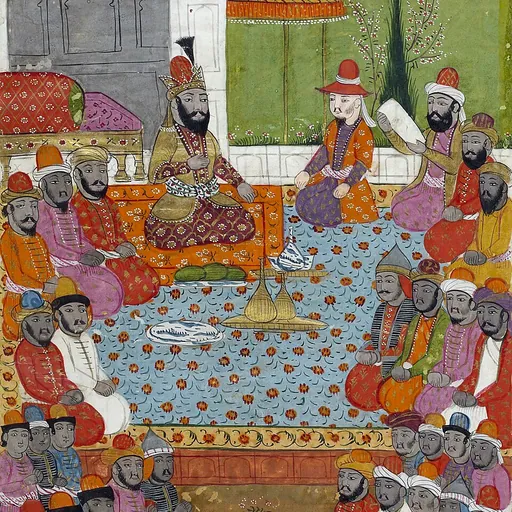
About Ja'far ibn Abī Tālib
Lived 589 – 629 (aged 39–40). Ja'far ibn Abī Tālib was a military leader, known for Banu Hashim and Companions of the Prophet.
Early life Ja'far was the third son of Abu Talib ibn Abd al-Muttalib and Fatimah bint Asad, hence a paternal cousin of Muhammad. His older brothers were Talib and Aqil, his younger brothers were Ali and Tulayq, and his sisters were Fakhitah, Jumanah and Raytah.
As per Arabic tradition, his uncle 'Abbas had the privilege of raising Ja'far. He married Asma bint Umais, who converted to Islam in 614–615.
Migration to Abyssinia When the Muslims were harassed in Mecca, several of them migrated to Abyssinia. Ja'far joined the second flight in 616. There they obtained the protection of the Negus (An-Najashi), and could worship Allah unhindered.
Ja'far and Asma lived in Abyssinia for about twelve years. Three sons were born to them there: Abd Allah, Muhammad, and Awn. The Negus replied that he had promised protection to the Muslims and therefore could not hand them over without hearing their side of the story. When the Muslims were called to answer to the Negus, Ja’far was their spokesman.
The Negus asked them what was the religion for which they had forsaken their people, without entering into his religion or any other.
The Quraish said to Negus that Muslims did not respect Jesus or the Virgin Mary. He was enraged and asked Ja'far to reply to Amr's claim. So he recited the first verses of Surah Maryam in the Quran, which narrates the story of 'Isa (Jesus) and his mother Maryam (Mary). On hearing these words, "the Negus wept until his beard was wet and the bishops wept until their scrolls were wet." The Negus said that he would never harm the Muslims. The two Quraysh delegates alleged that the Muslims called Jesus a created being, so the Negus asked Ja'far what he thought of Jesus. Ja'far answered: "Our prophet says he is God's slave, apostle, spirit and word, which he cast into Mary the blessed virgin."
At this the Negus (al-nejashi) returned the gifts of the Quraysh, calling them "bribes," and "they left his presence crestfallen." The Muslims continued to live with the Negus, "comfortably in the best security".
Overseas preaching It is said that Ja'far left Abyssinia to preach in other countries. He accompanied Sa'd ibn Abi Waqqas and others in their mission to the region of Chittagong, Manipur, Tibet, Khotan and China. The Muslims of the oasis-city of Khotan (in the Xinjiang Province, south of the Taklamakan Desert, west of Tibet) trace their origin to Ja'far. Thereafter Ja'far returned to Abyssinia.
Return to Arabia In summer 628, the last of the Muslim immigrants departed from Abyssinia to join the Muslim community in Medina. Ja'far and his family were among them.
On arriving at Medina, Ja'far heard that Muhammad was in Khaybar. Ja'far immediately set out to join the army, and arrived just as Muhammad had won the battle. Muhammad greeted him with the words: "I do not know which event makes me happier – the arrival of Ja'far or the conquest of Khaybar!"
Ja'far was famous for his acts of charity in Medina. Abu Hurairah recalled: "The most generous of all the people to the poor was Ja'far ibn Abi Talib. He used to take us to his home and offer us what was available therein. He would even offer us an empty folded leather container (of butter), which we would split and lick whatever was in it."
The Battle of Mu'tah
In September 629, Muhammad mobilized an army to confront Byzantine forces in Syria, because a Byzantine governor had killed one of his emissaries. He appointed Ja'far as commander of the army and instructed:"If Ja'far is wounded or killed, Zayd ibn Harithah will take over the command. If Zayd ibn Harithah is killed or wounded, Abdullah ibn Rawaha will take his place. If Abdullah is killed, then let the Muslims appoint themselves a commander." where they were heavily outnumbered. Once the battle had started, Ja'far mounted on his horse, he penetrated deep into the Byzantine ranks and killed hundreds of Byzantine soldiers. Anyone who come in front of him was slaughtered. As Ja'far spurred his horse on, he called out: "How wonderful is Paradise as it draws near! How pleasant and cool is its drink! Punishment for the Byzantines is not far away!" Ja'far fought until both his arms were cut off, but he was eventually killed.
Aftermath When the news reached Muhammad, he wept and prayed for Ja'far's soul. He later reported that the angel Jibril (Gabriel) came down to console him, saying: "Jafar was a brave and loyal soldier. God has given him everlasting life, and in place of his arms which were cut off in the battle, the Lord has given him a pair of wings. The Prophet (s) prayed for him and said, "May God give you two wings, with which to fly in the company of the angels."
Thereafter Ja'far had the byname Dhul-Janāḥīn (, "The Winged").
Ja'far's widow Asma recalled: "God's Messenger came to me and asked, 'Where are Jafar's children?' I brought them to him and he embraced them and smelled them, then his eyes welled up and he cried. 'O God's Messenger,' I asked, 'Have you heard something about Jafar?' 'Yes,' he replied. 'He was martyred today.' I stood up and screamed, and the women came to me. The Prophet began to say, 'O Asma, do not speak obscene words or beat your chest!'" Her son Abd Allah remembered: "He said, 'O Asma, will you not rejoice? Indeed, God most high has made two wings for Ja'far, that he may fly with them in Paradise!'" Then Muhammad told his daughter Fatimah, "Prepare food for the family of Ja'far, for they are preoccupied today."
Shrine
Ja'far's tomb is located in Al-Mazar al-Janubi in Kerak, Jordan. It is enclosed in an ornate zarih of gold and silver made by the 52nd Da'i al-Mutlaq of the Dawoodi Bohra, Mohammed Burhanuddin.
During the civilian unrest in the Levant, in 2013, several Shi'ite shrines were desecrated, including that of Ja'far.
Descendants Abd Allah, who married Zaynab bint Ali; their sons Awn and Muhammad were killed in the Battle of Karbala Yahya ibn Umar – a descendant who led a rebellion Abd Allah ibn Mu'awiya – a descendant whom the Shia in Kufa set up as Imam and led a rebellion Muhammad Munib Hashem Ja'fari, the final Mufti of Ottoman Nablus
Photo gallery
Don’t just read it —
keep it.
Full-length biographies made to live with: read them, listen on the way to work, watch them tonight.
- E-book
- Audio
- Video
Instant download · yours to keep · every purchase keeps this site free
Important facts
Family & relationships
People in Ja'far ibn Abī Tālib's life
Named in this biography and alive at the same time


Related people
Same field, nearest in time

Contemporaries
People whose lives overlapped Ja'far ibn Abī Tālib's


Frequently asked questions
Who was Ja'far ibn Abī Tālib?
Companion (Sahabi) and cousin of Muhammad (c. 590–629)
When was Ja'far ibn Abī Tālib born?
Ja'far ibn Abī Tālib was born in 589 in Mecca.
When did Ja'far ibn Abī Tālib die?
Ja'far ibn Abī Tālib died in 629 in Mu'tah.
What was Ja'far ibn Abī Tālib's occupation?
Ja'far ibn Abī Tālib was a military leader.
What was Ja'far ibn Abī Tālib known for?
Ja'far ibn Abī Tālib was known for Banu Hashim and Companions of the Prophet.
Sources & further reading
· Wikipedia: Ja'far ibn Abī Tālib
· DBpedia: Ja'far ibn Abi Talib
Cite this page
APA: Biography.guide. (2026). Ja'far ibn Abī Tālib. https://biography.guide/ja-far-ibn-abi-talib/
MLA: "Ja'far ibn Abī Tālib." Biography.guide, https://biography.guide/ja-far-ibn-abi-talib/.
Chicago: "Ja'far ibn Abī Tālib." Biography.guide. https://biography.guide/ja-far-ibn-abi-talib/.
Data last updated: 2026-09-23 · Spot an error? Report a correction.
Portrait: Wikimedia Commons · author & licence
Page generated 2026-09-27 05:05 UTC