
About J. R. Tucker
Lived 1946 – 2014 (aged 67–68). J. R. Tucker was a physicist, known for Submillimeter astronomy.
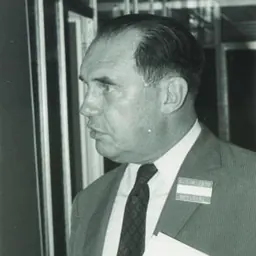
John R. Tucker (1946 – April 12, 2014) was an American physicist who made several contributions to the fields of electronics, physics and microwave theory, known for generalizing the microwave mixer theory and presenting the body of work, known as the "Tucker theory", and for his fundamental theoretical contributions which resulted into various advancements in experimental Submillimeter astronomy. He is also credited with laying down some of the technological foundations (a number of novel semiconductor devices and fabrication techniques) for making practical Quantum computing possible.
Biography Tucker was born in 1946 in Seattle, Washington,
Bardeen gives several accounts of Tucker and his work.
Noteworthy scientific contributions Fascinated by the possibility of using quantum phenomena in amplification of weak microwave signals, Tucker developed the quantum generalization of microwave mixer theory based on the quantum mechanical effect of photon-assisted tunneling (Superconducting tunnel junctions), which finally got to be known as the "Tucker Theory" (1975–85). The effects as predicted by this theory permitted noiseless amplification of incoming signals. This was an important discovery and it resulted into revolutionary advancements in the millimeter and submillimeter astronomy through the development of "Superconductor-Insulator-Superconductor (SIS)" receivers operating at around the fundamental limit for sensitivity (As restricted by the Heisenberg Uncertainty principle). These receivers found their way on all major (sub) millimeter telescopes at high altitudes.
James J. Coleman, a colleague of Tucker at UIUC said "He revolutionized space science. His predictions allowed others to build the hardware that helped dramatically change our understanding of the universe.”
Other than his theoretical pursuits, Tucker initiated atom-scale STM e-beam Lithography (as based on selective desorption of hydrogen from H-passivated silicon surfaces in ultra-high vacuum, with Dr. T.-C. Shen (1992–98)), as well as suggested techniques like gate-induced tunneling (field emission) as a new way for fabricating Metal Silicide Source/Drain MOS transistors.
In parallel to his groundbreaking work on tunneling junctions and the Tucker theory, he demonstrated an avid interest in the theoretical and practical development of quantum computers. Working towards his that vision, Tucker laid down the foundations of the Center for Quantum Computers at Illinois in 1981.
Honors
As enumerated on the UIUC Dept. of Electrical and Computer Engineering website, Tucker was a recipient of following honors and awards and fellowships at various points of his career; IEEE Microwave Pioneer Award 2002 "for generalizing microwave mixer theory to include photon-assisted tunneling, and discovering new effects leading to quantum-noise-limited millimeter wave receivers." Fellow, American Physical Society 2002 Visiting professor, Technical University of Delft, 1999. NRC Senior Fellow, NASA Institute for Space Studies, New York, 1980. Chairman, MicroDevices Laboratory Visiting Committee, Jet Propulsion Laboratory, NASA/Caltech, 2008-2009 Review Panel, Laboratory Directed Research and Development Programs, Los Alamos National Laboratory, May 2001 and 2002. Tau Kappa Nu Faculty Initiate (for excellence in teaching), Fall 1995 NSF Fellow, Harvard University - 1967 to 1971 President, Caltech Chapter of Tau Beta Pi - 1965
Don’t just read it —
keep it.
Full-length biographies made to live with: read them, listen on the way to work, watch them tonight.
- E-book
- Audio
- Video
Instant download · yours to keep · every purchase keeps this site free
Important facts
People in J. R. Tucker's life
Named in this biography and alive at the same time

Related people
Same field, nearest in time



Contemporaries
People whose lives overlapped J. R. Tucker's


Frequently asked questions
Who was J. R. Tucker?
American physicist (1946–2014)
When was J. R. Tucker born?
J. R. Tucker was born in 1946.
When did J. R. Tucker die?
J. R. Tucker died on 12 April 2014 in Evanston.
What was J. R. Tucker's occupation?
J. R. Tucker was a physicist.
What was J. R. Tucker known for?
J. R. Tucker was known for Submillimeter astronomy.
Sources & further reading
Cite this page
APA: Biography.guide. (2026). J. R. Tucker. https://biography.guide/j-r-tucker/
MLA: "J. R. Tucker." Biography.guide, https://biography.guide/j-r-tucker/.
Chicago: "J. R. Tucker." Biography.guide. https://biography.guide/j-r-tucker/.
Data last updated: 2026-09-20 · Spot an error? Report a correction.
Page generated 2026-09-27 05:05 UTC