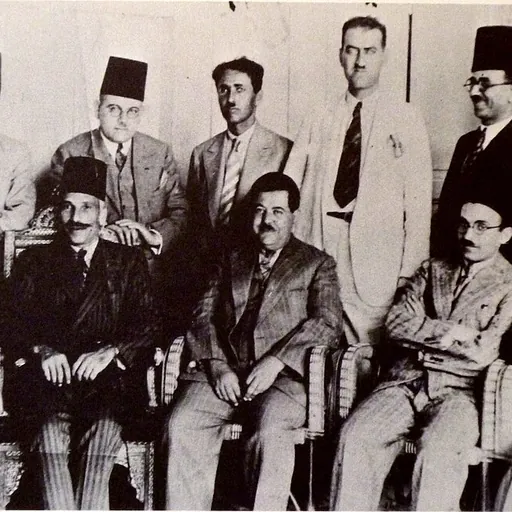
About Izzat Darwaza
Lived 1888 – 1984 (aged 96). Izzat Darwaza was a Turkish historian, politician, qur'anic exegete, intellectual and arab nationalist.
Muhammad 'Izzat Darwaza (; 1888–1984 Izzat's father, 'Abd al-Hadi Darwaza and his paternal grandfather Darwish Darwaza, owned a store in the Khan al-Tujjar of Nablus.
Izzat received elementary and preparatory education in Ottoman government-run schools in the city. Darwaza left school without going to Istanbul or Beirut to finish his education as was the custom of his generation.
Loyalty to dissidence toward the Ottoman Empire Originally, Darwaza supported the Ottoman Empire based on his feelings of identification with Islam and of belonging to the larger Ottoman Muslim ummah ("nation"). In 1906, he served in the local Ottoman administration as a clerk in the Department of Telegraphic and Postal Services (DTPS) in Nablus. In 1908, he joined the Committee of Union and Progress (CUP), but withdrew soon after because of its Turkish nationalist political agenda. In 1916, while serving with the Ottoman army in the Sinai Peninsula, In the wake of the Arab Revolt of 1916, Darwaza left the Ottoman civil service to serve in King Faisal's provisional government in Damascus. Ideologically, Darwaza became an Arab nationalist endorsing the concept of a Greater Syrian Arab state. When the commission arrived in Jaffa, it concluded on 27 June that it was in favor of Syro-Palestinian unity under a British Mandate.
In the first week of July 1919, the General Syrian Congress (GSC) held its first meeting in Damascus and Darwaza was its secretary. The GSC called for the immediate independence of Syria as a sovereign state under a constitutional monarchy and underlined its opposition to the establishment of Zionism in southern Syria (Palestine). Along with Haj Amin al-Husseini and Aref al-Aref, Darwaza founded and became an officer of the Palestinian Society in Damascus. The organization urged all societies and clubs in Palestine to cooperate and condemn the San Remo Conference's decision to grant Great Britain a mandate over Palestine and Transjordan.
The hope of Darwaza and the Younger Politicians for unity with Syria were curtailed when it became known that King Faisal was aligning himself with the leaders of the Zionist movement because "they [the Zionists] were helping us [the Arabs] in the [Paris Peace] conference." Afterward, Darwaza believed King Faisal did not devote to the Palestine issue its deserved attention. Faisal was deposed by the French in July 1920. An event that further deteriorated Darwaza's ambitions of Arab unity was the confirmation of the British Mandate over Palestine at the San Remo Conference on 24 April 1920. His experience in Damascus revealed to him that the universalism of Arab nationalism was not as concrete as its advocates had thought, and the military might of the European powers—France and Great Britain—were an overwhelming force to contend with.
In 1927, Rashid al-Haj Ibrahim, the leader of the Young Men's Muslim Association of Haifa, a prominent merchant, and future associate of Darwaza, invited him to his home to speak to a large group of students and notables about nationalist (qawmiyya) and patriotic (wataniyya) education. This was recognition that Darwaza's contribution to the spread of Arab nationalist sentiments gained influence not only in an-Najah School, but throughout Palestine.
Fight against the British Mandate
Darwaza became a member of the Arab Executive Committee and in 1930 was appointed by rival nationalist Haj Amin al-Husseini (then the Grand Mufti of Jerusalem) as the General Administrator of the Waqf (Islamic religious trust) under the Supreme Muslim Council. In 1931, he convinced his city's MCA to change its name to the Patriotic Arab Association. Unlike other Arab politicians at the time, Darwaza supported a combination of pan-Arabism, Islamism, and dedication to the Palestinian nationalist ideal. In August 1932, he along with Awni Abd al-Hadi and others founded the Istiqlal (Independence) party in Palestine, an offshoot of al-Fatat. Originally, the Istiqlal operated in Syria, then Transjordan, but reassembled in Palestine after facing disappointing circumstances in both those territories. The party coaxed Palestinians towards defying British rule by staging demonstrations and political and social boycotts. Darwaza refused to allow the Istiqlal to participate in meetings between local Palestinian political parties and the British high-commissioner. Darwaza wrote an article on 21 June 1933, vehemently attacking Palestinian "vested interests". He argued that the wealthy Arab notables of Palestine were subservient to the British and the Zionists and would willingly leave Palestine for other countries, while the poor and middle-class Arabs were forced by economic circumstances to remain in Palestine during their political struggles. Darwaza helped instigate and organize the 1933 demonstrations in Jaffa which protested British policies in Palestine and continued allowances of Jewish immigration. The Mufti sent a delegation consisting of Darwaza, Mu'in al-Madi, and Abd al-Hadi to Baghdad, then to Riyadh to discuss the situation and upon their return on 6 January 1937, they revealed that the advice given to them was to cease hostilities. During the revolt, in 1937, Darwaza was exiled from Palestine by British authorities to Damascus. Later in that year, Darwaza held several meetings with Nuri al-Sa'id of Iraq to explore various solutions to help the Arabs avoid appearing intransigent.
Despite attempts to calm the situation, in Damascus, Darwaza established and headed the Central Committee for National Jihad in Palestine which echoed Izz al-Din al-Qassam's call for a "holy war" against the British and Zionism. Darwaza had many encounters with al-Qassam, describing him as "a man lacking in arrogance or self-love. He was open and available to all of the people and the people loved him. And he lived the life of a mujahid." Darwaza worked closely with the Mufti, who was now under house arrest in Beirut, to garner support and supplies for the revolt and supervise the Arab rebels in Palestine. He was released in November 1944. After his release, Darwaza was unable to return to Nablus because British authorities had issued an order preventing him from entering Palestine. As a result, he left for Turkey, mostly staying in Bursa until the end of 1945. Darwaza, along with Emil Ghuri and Mu'in al-Madi, served as the AHC's delegates to the September 1947 convention of the Arab League's Political Committee in Lebanon. With support from the Transjordanian representative, Salih Jaber, the Prime Minister of Iraq, openly criticized the delegates and questioned the AHC's right to even send delegates to the convention. Later that year, Darwaza resigned from the AHC due to the Mufti's unbending attitude towards wider representation.
Later life After resigning from the AHC, Darwaza spent the rest of his life in the modern state of Syria where he left politics to concentrate on literature. Although he did much of his writing in the 1930s and 1940s, he did not have any of his works published until the 1960s. When unity negotiations underwent, he suggested several forms of federation, such as the American, Soviet, and Indian models, but did not recommend any specific model for an Arab state. Darwaza did, however, suggest that the institution of a federation between Egypt and Syria would be the first step towards the realization of a comprehensive union.
In 1983 Darwaza granted Palestinian historian Muhammad Y. Muslih an eight-day interview and allowed him to photo-copy his memoirs in entirety. Muslih noted that Darwaza was failing in health at the time. He died in Damascus in 1984 at the age of 96. Darwaza had three daughters, Najah, Salma, and Rudaina and a son, Zuhair.
Literary works
One of the first modern histories of the Arab nation in contrast to a history of an individual Arab country was composed by Darwaza in the late 1920s under the title Lessons of Arab History: From Antiquity to Present Times. In the book, Darwaza begins by describing the origins of the Semitic peoples, the rise of Islam, the end of Arab rule in the Middle East by Turkic groups, and the foreign rule over the Arabs by Western powers. The book was intended to be used as a textbook in primary and secondary schools throughout the British Mandates of Palestine and later Iraq, hence its simplified and direct language. Nonetheless, it played a pioneering role in the development of pan-Arabism.
In 1934, Darwaza published a widely read story, The Angel and the Land Broker, reflecting popular Arab sentiments against the growing "Zionist threat" and attacking brokers who tempted Palestinian land owners to sell their land to Jews. The story describes methods used by Zionists to entice Arab landowners to sell their land and the main characters in the story are an illiterate farmer and a Jewish girl from Tel Aviv who encourages the former to spend himself deep into debt, forcing him to sell his land at a price far below its value.
Later in his lifetime after leaving politics, Darwaza published memoirs that discussed in detail the city of Nablus in the late 19th and early 20th centuries. According to Youssef Choueiri, "he gives a graphic and almost exhaustive description of his hometown... its mosques, residential quarters, orchards, industries, and inhabitants. Moreover, he dwells at length of the social composition of the town endeavoring to reveal the open conflict between 'feudal families' and the new generation of middle traders, functionaries, civil servants, and teachers." Darwaza stresses a close connection between the Quran and the biography of the Muhammad (sira) and states that the Quran fully reflects various stages between the Quran and the career of Muhammad. He also emphasizes that both the angels and the jinn are spoken in the Quran not for their own sake, but to reinforce Muhammad's missions and goals.
He contends that the presentation of the Quran and its suras was dictated by Muhammad and that the task of Abu Bakr was to collect the Quran between its two covers and transcribe it into one copy, while Uthman's task was to fix the transcription and unify it to prevent variant readings. He also expresses doubts that Ali, as it is alleged, had made a chronologically arranged collection. Darwaza was very critical of other modern interpreters who used certain verses of the Quran to deduce and support scientific theories. He argues that those people have done harm to Islam by trivializing the sacred character of the Quran.
Legacy Throughout his life, Darwaza was an Arab nationalist and supported the unity of Syria and Palestine. His particular brand of Arab nationalism was influenced by Islam, his belief in Arab unity, and the oneness of Arabic culture. According to his perspective, the ideology's main points were the Arabic language, the Arab homeland, a shared Arab history and common Arab interests. Although Darwaza believed that Arab nationalism pre-dated Islam, he also maintained that Islam expanded Arab territory and "stamped them with the eternal mark of Arab nationalism." According to Muhammad Y. Muslih, this meant that Islam had provided Arabs with "spiritual, cultural, and legal unity and within the framework of that unity the Arab individual formed his moral and social beliefs, irrespective of where he lived and through it the Arabs were able to preserve national identity and maintain their culture in the face of foreign invaders, including the Ottomans".
His ideas helped the spread the word of secular pan-Arabism against religious nationalists and those who believed in separate Syrian, Lebanese, and Palestinian destinies. He believed that Egypt's capabilities and human resources compelled it to fill the role of an Arab "Prussia".
List of works
History
Islamic
Don’t just read it —
keep it.
Full-length biographies made to live with: read them, listen on the way to work, watch them tonight.
- E-book
- Audio
- Video
Instant download · yours to keep · every purchase keeps this site free
Important facts
People in Izzat Darwaza's life
Named in this biography and alive at the same time


Related people
Same field, nearest in time

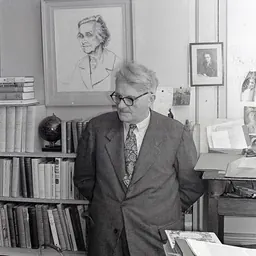
Contemporaries
People whose lives overlapped Izzat Darwaza's



Frequently asked questions
Who was Izzat Darwaza?
Palestinian politician and historian (1888–1984)
When was Izzat Darwaza born?
Izzat Darwaza was born on 21 June 1888 in Nablus.
When did Izzat Darwaza die?
Izzat Darwaza died on 26 July 1984 in Damascus.
What was Izzat Darwaza's occupation?
Izzat Darwaza was a historian, politician, qur'anic exegete, intellectual and arab nationalist.
What nationality was Izzat Darwaza?
Izzat Darwaza was Turkish.
Sources & further reading
Cite this page
APA: Biography.guide. (2026). Izzat Darwaza. https://biography.guide/izzat-darwaza/
MLA: "Izzat Darwaza." Biography.guide, https://biography.guide/izzat-darwaza/.
Chicago: "Izzat Darwaza." Biography.guide. https://biography.guide/izzat-darwaza/.
Data last updated: 2026-09-22 · Spot an error? Report a correction.
Portrait: Wikimedia Commons · author & licence
Page generated 2026-09-27 05:04 UTC