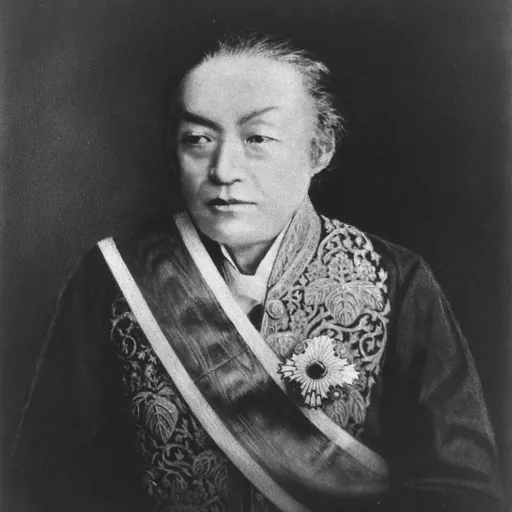
About Iwakura Tomomi
Lived 1825 – 1883 (aged 57). Iwakura Tomomi was a Japanese politician and diplomat, known for Meiji Revolution.
was a Japanese statesman during the Bakumatsu and Meiji period. He was one of the leading figures of the Meiji Restoration, which saw the overthrow of the Tokugawa shogunate, the restoration of Japan's monarchy, and the abolition of feudalism, the domain system, and the samurai class.
Born to a lesser noble family, he was adopted by leading court noble Tomoyasu Iwakura (岩倉 具康) in 1838. In 1854, he became Imperial Chamberlain. Intending to bridge the divide between the shogunate and the imperial court, Iwakura openly supported marriage between Tokugawa Iemochi and Emperor Komei’s younger sister Princess Kazunomiya. This earned him derision as a shogunate supporter and in 1862, he was exiled.
Early life Iwakura was born in Kyoto, the second son of low-ranking courtier and nobleman. Through his mother, he was a first cousin of Emperor Ninkō His childhood name was Kanemaru but fellow court nobles called him Iwakichi (typically thought of as a commoner's name). Confucian scholar Fusehara Nobuharu taught him Confucianism from childhood and suggested that adopt Kanemaru as his child. Tomoyasu did this In 1836, giving Kanemaru his own family name. In 1838, the boy changed his name from Kanemaru to Tomomi. In bakumatsu, most of the 137 court nobles had a long tradition. In contrast, the Iwakura house had only become independent from the Koga house in the early Edo period. This newness gave the Iwakura house lower status. It did not have a family business, so they also had little money. The idea for this arrangement had originated with the Kanpaku, Kujō Hisatada in 1858 and was heavily negotiated until it was formally proposed to the imperial court by Kujō on 19 June 1860. In this situation, Ōkubo was assassinated in 1878, and Iwakura had to choose Itō Hirobumi or Ōkuma Shigenobu as a successor of Ōkubo. Itō wanted an absolute monarchy as in Germany while Ōkuma favored a constitutional monarchy as exemplified by the United Kingdom. Ultimately, Iwakura chose Itō and the German model as the basis for Japan's constitution.
Death and Legacy
Iwakura was unable to witness Itō Hirobumi's return to Japan or the enactment of the Constitution of the Empire of Japan.
On 12 June 1883, Iwakura experienced sudden chest pain and could no longer eat. Advanced esophageal cancer had narrowed his airway to the point that food could not pass through. The Meiji Emperor sent his personal physician, Erwin Bälz, to examine Iwakura. The doctor remained by Iwakura's side, recording the progress of his cancer.
Together, Balz and Iwakura boarded a ship from Kyoto to Tokyo. During the journey, Iwakura, understanding the hopelessness of his situation, requested that the doctor keep him alive long enough for Ito Hirobumi to return from Berlin with a new constitution for Japan. Iwakura wished to communicate his will to Ito in person. Unfortunately, he soon became completely unable to eat and was consequently wasting away.
Iwakura was a lifelong patron of Noh theater. In 1876, he organized the first tenran-no (a performance in the presence of the emperor) of the Meiji era at his private residence. Iwakura's daughter-in-law, Iwakura Chisako (1861 - 1922), was among the first female amateur practitioners of Noh as the artform gained popularity in Tokyo at the end of the century.
He had a wife, named Mineko, but she died on 24 October 1874. After Mineko's death, he remarried Makiko Noguchi. He is an ancestor to actor Ken Uehara, singer Yūzō Kayama, and actress Emi Ikehata.
Don’t just read it —
keep it.
Full-length biographies made to live with: read them, listen on the way to work, watch them tonight.
- E-book
- Audio
- Video
Instant download · yours to keep · every purchase keeps this site free
Important facts
People in Iwakura Tomomi's life
Named in this biography and alive at the same time


Related people
Same field, nearest in time




Contemporaries
People whose lives overlapped Iwakura Tomomi's





Frequently asked questions
Who was Iwakura Tomomi?
Japanese politician (1825-1883)
When was Iwakura Tomomi born?
Iwakura Tomomi was born on 26 October 1825 in Kyoto.
When did Iwakura Tomomi die?
Iwakura Tomomi died on 20 July 1883 in Tokyo.
What was Iwakura Tomomi's occupation?
Iwakura Tomomi was a politician and diplomat.
What was Iwakura Tomomi known for?
Iwakura Tomomi was known for Meiji Revolution.
What nationality was Iwakura Tomomi?
Iwakura Tomomi was Japanese.
Sources & further reading
Cite this page
APA: Biography.guide. (2026). Iwakura Tomomi. https://biography.guide/iwakura-tomomi/
MLA: "Iwakura Tomomi." Biography.guide, https://biography.guide/iwakura-tomomi/.
Chicago: "Iwakura Tomomi." Biography.guide. https://biography.guide/iwakura-tomomi/.
Data last updated: 2026-09-22 · Spot an error? Report a correction.
Portrait: Wikimedia Commons · author & licence
Page generated 2026-09-27 05:02 UTC