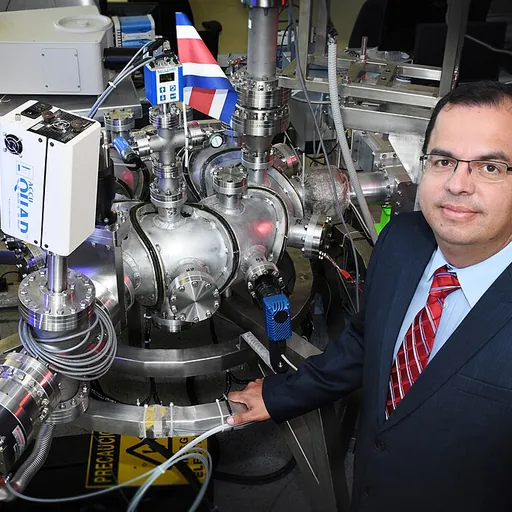
About Ivan Vargas-Blanco
Born 1973. Ivan Vargas-Blanco is a Costa Rican scientist, professor and researcher.
Víctor Iván Vargas Blanco (born March 24, 1973) is a Costa Rican plasma and nuclear fusion physicist. He is renowned for his work in plasma physics and nuclear fusion. Currently, as a professor and tenured researcher at the Costa Rica Institute of Technology, he heads the Plasma Laboratory for Fusion Energy and Applications that he founded in 2011.
On August 11, 2016, Legislative Assembly of Costa Rica recognized the contributions and leadership of Vargas-Blanco in the design, construction, and implementation of the first high temperature plasma magnetic confinement Stellarator type device to be built in Latin America. This fact made Costa Rica one of only eight countries in the world to possess this type of technology for nuclear fusion research. He is a promoter of plasma physics applications for medical, agricultural, and industrial uses in his countries. A few days later, on December 4, the Costa Rican newspaper La Nación chose Vargas-Blanco as one "News Character of The Year" in their Sunday Magazine edition.
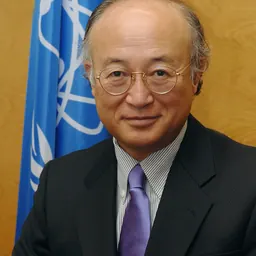
On June 4, 2018, the Director General of the International Atomic Energy Agency (IAEA), Yukiya Amano appointed Vargas-Blanco a member of the International Fusion Research Council (IFRC), to actively work on the development of the international cooperation in research on controlled nuclear fusion and its applications, as well as advising the IAEA on the activities of the nuclear fusion research and technology program. In October 2018, the Costa Rica Foreign Trade Promotion (Procomer) chose him as one of the ambassadors of the "Essential Costa Rica" Country Brand.
Early years and education
Vargas-Blanco is the second of five children born in the Canton Central de Alajuela to Susana Blanco Solis and Victor Manuel Vargas Rodriguez. The family were raised in "Concepcion de la Palmera" San Carlos de Alajuela, a rural north region of Costa Rica. His mother, Susana, is a housewife who worked daily in a family restaurant until 2018. His father, Victor, was a dairy farmer who later in life joined wife Susana managing the restaurant. Even as a child, Vargas-Blanco would compose notes on ideas about particle physics and nuclear fusion.Quote frame|I filled a notebook with my questions and leave a space to later come back and try to answer them. I would ask myself: what happens when a proton collides with a neutron or another proton? I came up with sketches of a nuclear fusion propulsion rocket that I was going to build and send into space, or so I believed.|Ivan Vargas-Blanco is carried out at the Centro de Investigaciones Energéticas, Medioambientales y Tecnológicas (CIEMAT) where the National Fusion Laboratory is located.
It presents the results of thermal transport characterization in plasmas of the Spanish Stellarator TJ-II and its dependence on density, rotational transformation and heating power. Additionally, it shows results of the study of particle transport in this device and its dependence on density. Vargas-Blanco's work represents one of the first scientific evidences of the influence and improvement of thermal confinement due to the rational surfaces in Stellarator devices.
During his doctoral studies, Vargas-Blanco participated in other scientific activities such as the calibration and maintenance of the electronic cyclotron emission diagnosis for the measurement of plasma temperature and activities within the electronic cyclotron resonance heating group of the Stellarator TJ-II. Stellarator of Costa Rica 1 (SCR-1). Photo Ruth Garita, OCM-TEC. Prior to his return to Costa Rica, Vargas-Blanco succeeded in having the CIEMAT and the Costa Rica Institute of Technology sign a collaboration agreement to promote research in nuclear fusion plasmas between the two institutions. This allowed him in 2009 to continue conducting research in the field of nuclear fusion in Costa Rica These projects got the attention of the University of Wisconsin-Madison in the United States compelling them to donate a spherical tokamak, known as a MEDUSA (Madison Education Small Aspect Ratio, now known as MEDUSA-CR), to the Costa Rica Institute of Technology, thus turning the university into one of the few in the world boasting both a Stellarator and a spherical tokamak.
Vargas-Blanco has consolidated his research group, which has gained international recognition for work in plasma physics and fusion-related applications, contributing to Costa Rica’s visibility within the Latin American scientific community in this field..
From 20 to 31 January 2014, Vargas-Blanco organized in Costa Rica three international Plasma Physics and Nuclear Fusion conferences and one Plasma Physics Workshop. Vargas-Blanco is a representative of Costa Rica in the International Scientific Committee of the Latin American Workshop on Plasma Physics, and the Conference from the International Atomic Energy Agency in the topics of exploring practical applications for small nuclear fusion devices. He has participated as a consultant of the International Atomic Energy Agency in the subject of research in nuclear fusion media, and he is also a member of good standing in the American Physical Society (APS), and a member of The Society of Plasma and Nuclear Sciences of the IEEE (NPSS).
University teaching Due to his interest to establish new generations of scientists in the field of plasmas and fusion, Vargas-Blanco has taught the course "Plasma Physics and Applications I" for more than eight years at the Costa Rica Institute of Technology. This is a course that covers the introduction to the plasmas physics, charged particles in magnetic and electric fields, plasma as fluids, waves in plasmas, collisions, conductivity and diffusion, and the discharges types. In 2018, he taught the second course "Plasma Physics for Engineering II", adding topics as: plasma generation, introduction to plasma diagnosis, computational plasma physics, and plasma for nuclear fusion and surface treatment by plasma. Vargas is also a professor of general physics courses and general physics laboratories at the TEC School of Physics.
Scientific labor
Vargas-Blanco's scientific and technological contribution has focused on the physics and engineering of Stellarators. In physics, he has contributed to the characterization and understanding of thermal and particle transportation in helical magnetic confinement devices. which makes Costa Rica one of the eight countries in the world to have this technology for the research on nuclear fusion. Likewise, he has participated as a co-author in scientific articles on the use of plasma in medicine, agriculture and industry.
First plasma discharge in a Stellarator in Latin America
Event of the First plasma discharge in a Stellarator in Latin America. Photo Ruth Garita, OCM-TEC.
On 29 June 2016, Vargas-Blanco and his research team set a scientific and technological milestone in Costa Rica. After six years of design, construction and implementation, they started operations of the first Stellarator-type high temperature plasma magnetic confinement device in Latin America, The ceremony included recorded congratulatory messages from Stewart Prager, director from Princeton Plasma Physics Lab (PPPL); Michael Zarnstorff, deputy director of research at PPPL; Hutch Neilson, head of advanced PPPL projects; and David Gates, physics leader of PPPL Stellarators. In addition, there was a congratulatory note from Robert Wolf, Stellarator-Heliotron Executive Committee President who belongs to the Technological Collaboration Program in the Stellarator-Heliotron Concept of the International Energy Agency. The milestone was widely disseminated in the national and international news press, such as CNN en español, and Scientific American, as well as research centers such as Max Planck Institute for Plasma Physics (IPP) in Germany and PPPL recognized him, as did the Chamber of Commerce, Industry, Tourism, and Services of Cartago in December. Constructing and implementing the first Stellarator Type plasma confinement device was a milestone for the country.
Recognition from the Legislative Assembly of Costa Rica. Photo Ruth Garita, OCM-TEC. The government of Costa Rica awarded Vargas-Blanco with the Clodomiro Picado Twight National Prize for Science and Technology Clodomiro Picado Twight National Prize for Science and Technology event. Photo Ruth Garita, OCM-TEC. On June 4, 2018, the Director General of the International Atomic Energy Agency (IAEA), Yukiya Amano appointed Vargas-Blanco a member of the International Fusion Research Council (IFRC), to actively work on the development of the international cooperation in research on controlled nuclear fusion and its applications, as well as advising the IAEA on the activities of the nuclear fusion research and technology program. for an insightful interview with Vargas-Blanco about the world of the new plasma physics. Again in 2017, journalist Andrea Solano, scored an Honorable Mention of the same Journalism Award in Science, Technology, and Innovation sponsored by CONICIT promoting the dissemination of cutting-edge scientific research. Her biographical essay for the Journal La Nación was titled, 'The Country Boy Who Became a Scientist", recounting the exceptional life and times of Ivan Vargas-Blanco, a true Costa Rican success story. With his popularity soaring, Vargas-Blanco was asked to join the promotional campaign for the 'Essential Costa Rica' Country Brand of the Promotors of External Commerce of Costa Rica (Procomer).
Don’t just read it —
keep it.
Full-length biographies made to live with: read them, listen on the way to work, watch them tonight.
- E-book
- Audio
- Video
Instant download · yours to keep · every purchase keeps this site free
Important facts
People in Ivan Vargas-Blanco's life
Named in this biography and alive at the same time






Related people
Same field, nearest in time

Contemporaries
People whose lives overlapped Ivan Vargas-Blanco's

Frequently asked questions
Who is Ivan Vargas-Blanco?
Costa Rican scientist
When was Ivan Vargas-Blanco born?
Ivan Vargas-Blanco was born on 24 March 1973 in Alajuela Province.
What is Ivan Vargas-Blanco's occupation?
Ivan Vargas-Blanco is a scientist, professor and researcher.
What nationality is Ivan Vargas-Blanco?
Ivan Vargas-Blanco is Costa Rican.
Sources & further reading
· Wikipedia: Ivan Vargas-Blanco
Cite this page
APA: Biography.guide. (2026). Ivan Vargas-Blanco. https://biography.guide/ivan-vargas-blanco/
MLA: "Ivan Vargas-Blanco." Biography.guide, https://biography.guide/ivan-vargas-blanco/.
Chicago: "Ivan Vargas-Blanco." Biography.guide. https://biography.guide/ivan-vargas-blanco/.
Data last updated: 2026-09-22 · Spot an error? Report a correction.
Page generated 2026-09-27 05:10 UTC