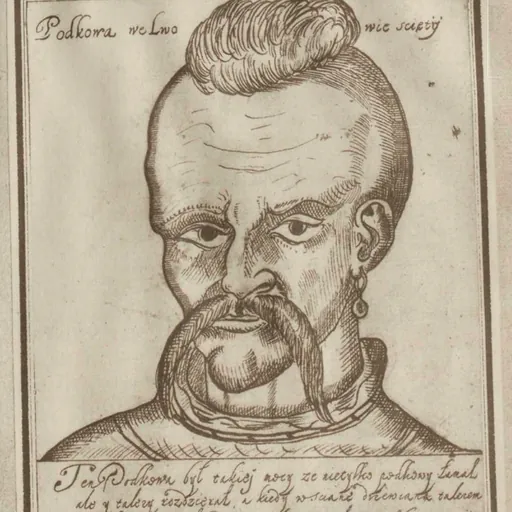
Ivan Pidkova
Hetman of Ukraine
About Ivan Pidkova
Ivan Pidkova was a pretender.
Ivan Pidkova or Ioan Potcoavă (died 16 June 1578), also known as Ioan Crețul, and Nicoară Potcoavă among Romanians, was a prominent Cossack ataman, and short-time ruler of Moldavia (November–December 1577). His moniker ("pidkova" in Ukrainian/"potcoavă" in Romanian – "horseshoe") is said to originate in the fact that he used to ride his stallions to the point of breaking off their horseshoes; another version says that he could break and unbend both horseshoes and coins with his fists. He is perhaps best known as the protagonist of Taras Shevchenko's poem Ivan Pidkova. Celebrated as a Ukrainian hero he led the Moldavian and Ukrainian struggle against Turkish domination. However, Paul Robert Magocsi states he was a Ukrainian Cossack of Romanian origin. More broadly, Pidkova was a "Kozak otaman who led the Moldavian and Ukrainian struggle against the Turks." After rising to prominence as a successful soldier, he became a leader (Otaman) and the sworn brother of hetman Yakiv Shah, elected by the Cossacks of the Registered Zaporozhian Host from Ukraine neighbouring Moldavia. In 1574, Ioan Vodă cel Cumplit, whose brother Pidkova claimed to be, had named the territory "Our Country from over the Dniester". Other Moldavian Atamans and Hetmans of the Cossacks were Grigore Lobodă (Hryhoriy Loboda; 1593–1596) and Dănilă Apostol (Danylo Apostol; 1727–1734).
Pidkova was one of the so-called Domnișori ("Little Princes"), named so because of a more or less based claims of belonging to Moldavian ruling families, thus exercising demands of the throne. Claiming to be Ioan III Vodă's half-brother, he together with Hetman Yakiv Shah chased Peter the Lame from the throne and resisted the first wave of violent Ottoman reaction. The Turks, their Wallachian vassal Mihnea Turcitul and their Transylvania vassal and Polish partner, King Stefan Báthory, managed to remove him. In the end, Pidkova was taken prisoner by Poles and decapitated in Lviv.
Legacy He is the hero of Taras Shevchenko's romantic 1839 poem Ivan Pidkova, in which, Shevchenko "lets his mind travel over the Ukrainian past," expressing his admiration for the Ukrainian Cossacks. Among other works dedicated to the otaman is Romanian writer Mihail Sadoveanu's socialist realist 1952 novel Nicoară Potcoavă, as well as several Cossack ballads. His monument is placed on one of the small central squares in Lviv, Ukraine.
Don’t just read it —
keep it.
Full-length biographies made to live with: read them, listen on the way to work, watch them tonight.
- E-book
- Audio
- Video
Instant download · yours to keep · every purchase keeps this site free
Important facts
Related people
Same field, nearest in time



Frequently asked questions
Who was Ivan Pidkova?
Hetman of Ukraine
When did Ivan Pidkova die?
Ivan Pidkova died on 16 June 1578 in Lviv.
What was Ivan Pidkova's occupation?
Ivan Pidkova was a pretender.
What nationality was Ivan Pidkova?
Ivan Pidkova's recorded nationality: Principality of Moldavia.
Sources & further reading
Cite this page
APA: Biography.guide. (2026). Ivan Pidkova. https://biography.guide/ivan-pidkova/
MLA: "Ivan Pidkova." Biography.guide, https://biography.guide/ivan-pidkova/.
Chicago: "Ivan Pidkova." Biography.guide. https://biography.guide/ivan-pidkova/.
Data last updated: 2026-09-21 · Spot an error? Report a correction.
Portrait: Wikimedia Commons · author & licence
Page generated 2026-09-27 05:00 UTC