
About Isham G. Harris
Lived 1818 – 1897 (aged 79). Isham G. Harris was an American politician, lawyer, governor and jurist.
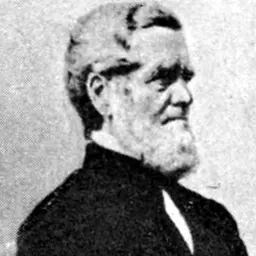
Isham Green Harris (February 10, 1818 – July 8, 1897) was an American and Confederate politician who served as the 16th governor of Tennessee from 1857 to 1862, and as a U.S. senator from 1877 until his death. He was the state's first governor from West Tennessee. A pivotal figure in the state's history, Harris was considered by his contemporaries the person most responsible for leading Tennessee out of the Union and aligning it with the Confederacy during the Civil War.
Harris rose to prominence in state politics in the late 1840s when he campaigned against the anti-slavery initiatives of northern Whigs. He was elected governor amidst rising sectional strife in the late 1850s, and following the election of Abraham Lincoln in 1860 he persistently sought to sever the state's ties with the Union. His war-time efforts raised over 100,000 soldiers for the Confederate cause. After the Union Army gained control of Middle and West Tennessee in 1862, Harris spent the remainder of the war on the staffs of various Confederate generals. Following the war, he spent several years in exile in Mexico and England.
After returning to Tennessee, Harris became a leader of the state's Bourbon Democrats. During his tenure in the U.S. Senate, he championed states' rights and currency expansion. As the Senate's president pro tempore in the 1890s, Harris led the charge against President Grover Cleveland's attempts to repeal the Sherman Silver Purchase Act.
Early life and career Harris was born in Franklin County, Tennessee, near Tullahoma. He was the ninth child of Isham Green Harris, a farmer and Methodist minister, and his wife Lucy Davidson Harris. His parents had moved from North Carolina to Middle Tennessee in 1806. He was educated at Carrick Academy in Winchester until he was 14. He moved to Paris, Tennessee, where he joined up with his brother William R. Harris, an attorney, and became a store clerk. In 1838, with funds provided by his brother, Harris established his own business in Ripley, Mississippi, an area that had only been recently opened to settlers after a treaty with the Chickasaw Indians.
While in Ripley, Harris studied law. He sold his successful business three years later for $7,000 and returned to Paris where he continued studying law under Judge Andrew McCampbell. On May 3, 1841, he was admitted to the bar in Henry County and began a lucrative practice in Paris. He was considered one of the leading criminal attorneys in the state.
On July 6, 1843, Harris married Martha Mariah Travis (nicknamed "Crockett"), the daughter of Major Edward Travis, a War of 1812 veteran. The couple had seven sons. By 1850 the family had a farm and a home in Paris. By 1860 their total property was worth $45,000 (~$ in ) and included 20 slaves and a plantation in Shelby County.
In 1847, Henry County Democrats convinced Harris to run for the district's Tennessee Senate seat in hopes of countering a strong campaign by local Whig politician William Hubbard. Anti-war comments made in August by the district's Whig congressional candidate William T. Haskell damaged Hubbard's campaign, and he quit the race. Harris easily defeated the last minute Whig replacement, Joseph Roerlhoe. In 1848, Harris was an elector for unsuccessful presidential candidate Lewis Cass. In May 1848 he engaged in a six-hour debate in Clarksville with Aaron Goodrich, elector for Zachary Taylor. Harris was re-elected to a second term, but after Whigs gained control of the state legislature in 1851 his district was gerrymandered, and he did not seek a third term. This campaign elevated Harris to statewide prominence.
In 1857, Tennessee's Democratic Governor Andrew Johnson was seriously injured in a train accident and was unable to run for reelection. Harris was nominated as his replacement and embarked on a campaign that included a series of debates with his opponent, Robert H. Hatton. With sectional strife in Congress fueling both campaigns, these debates were often heated, and fights frequently broke out among spectators (and in one instance between Harris and Hatton). Hatton was unable to distance himself from northern abolitionists, and Harris won the election by a vote of 71,178 to 59,807. who had briefly risen to prominence following the collapse of the national Whig Party, but also represented a shift in Tennessee politics toward the Democratic Party. During the previous two decades, Whigs and Democrats had been evenly matched statewide, with Whigs controlling East Tennessee, Democrats controlling Middle Tennessee, and the two parties evenly split in West Tennessee. The nationwide debate over the Kansas–Nebraska Act and the Dred Scott case pushed the issue of slavery to the forefront in the mid-1850s, and the balance in West Tennessee was tipped in favor of the Democrats. When the referendum was held in February, Tennesseans rejected secession by a vote of 68,000 to 59,000. After the war, the United States Congress passed a joint resolution allowing the governor of Tennessee to offer a reward for the apprehension of Harris because he was "guilty of treason, perjury and theft". Brownlow, who had become governor, issued a warrant for the arrest of Harris and placed a $5,000 bounty on him. After Maximilian's fall in 1867, however, Harris was again forced to flee, this time to England. Additionally, Harris chaired the Select Committee on Epidemic Diseases from its formation on December 4, 1878 to its transformation into a Standing Committee on December 12, 1893.
During his first term in the Senate, Harris became the leader of Tennessee's Bourbon Democrats, He is interred at Elmwood Cemetery in Memphis.
Don’t just read it —
keep it.
Full-length biographies made to live with: read them, listen on the way to work, watch them tonight.
- E-book
- Audio
- Video
Instant download · yours to keep · every purchase keeps this site free
Important facts
People in Isham G. Harris's life
Named in this biography and alive at the same time





Related people
Same field, nearest in time




Contemporaries
People whose lives overlapped Isham G. Harris's


Frequently asked questions
Who was Isham G. Harris?
American politician (1818–1897)
When was Isham G. Harris born?
Isham G. Harris was born on 10 February 1818 in Franklin County.
When did Isham G. Harris die?
Isham G. Harris died on 8 July 1897 in Washington, D.C..
What was Isham G. Harris's occupation?
Isham G. Harris was a politician, lawyer, governor and jurist.
What nationality was Isham G. Harris?
Isham G. Harris was American.
Sources & further reading
Cite this page
APA: Biography.guide. (2026). Isham G. Harris. https://biography.guide/isham-g-harris/
MLA: "Isham G. Harris." Biography.guide, https://biography.guide/isham-g-harris/.
Chicago: "Isham G. Harris." Biography.guide. https://biography.guide/isham-g-harris/.
Data last updated: 2026-09-20 · Spot an error? Report a correction.
Page generated 2026-09-27 05:19 UTC