
About Isetnofret
Born 1250 BC. Isetnofret was a politician.
Isetnofret (or Isis-nofret or Isitnofret) (Ancient Egyptian: "the beautiful/good Isis" or "Isis is beautiful/good") was one of the Great Royal Wives of Pharaoh Ramesses II and was the mother of his successor, Merneptah. She may have become, around the same time as Nefertari, one of the many wives of Ramesses II before he was crown prince (In the first year of his tenure as crown prince, Ramesses II was granted an entire harem by his father, Seti I). All evidence confirming Isetnofret's title of Chief Queen comes from after her death, suggesting that she was likely posthumously granted the title, around the 30th to 33rd/34th year of Ramesses II's reign.
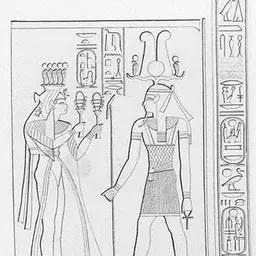
Family The parents of Isetnofret are not known. There is substantial evidence suggesting that she had blood relationship with Pharaoh Horemheb. The stela was created by and centers on Khaemwaset. On this stela, Isetnofret is depicted as a woman holding the Ankh symbol, which may indicate that she had already died at the time of its creation. ). Here, only her title of King's Wife can be confirmed: "...the Horus, master of the palace, she who fills the audience hall with her mere fragrance. Her scents are like those of Punt when its limbs are anointed (?), the Royal Wife [...].[...] the sanctuary of Néséret, her perfection envelops the private chambers, the audience hall is under the influence of her pleasant perfumes, beside her father who rejoices at seeing her, the Royal Wife [...]." and his mother may have been able to step out of the harem to assist him in his duties. A naophorous Statue of Prince Khaemwaset mentions his mother. On the dorsal pillar it reads: "Iunmutef-priest, born of the Great Royal Wife Isetnofret, the Sem-priest of Ptah Khaemwaset." West Silsila: Rock shrine of Merneptah. A scene depicts Pharaoh, Queen Isetnofret with sistra before Taweret (as a hippopotamus), Thoth and Nut. However, the individuals depicted here are actually Merneptah and his wife. The pharaoh is Merneptah, and the queen named Isetnofret does not bear the title of King's Mother. Moreover, in the first year of Merneptah’s reign, Isetnofret had already been deceased for several decades. This stela commemorates the pharaoh’s celebration of the Nile festival in honor of the gods, with no indication that the royal woman depicted was a deceased person. It would be extremely bizarre for a deceased individual to be imagined as participating in such an important state ritual, offering to the gods, and being portrayed on an official commemorative stela. Merneptah was not without a Great Royal Wife, his Great Royal Wife was the mother of his crown prince. The queen Isetnofret here is, in fact, his wife rather than his mother. At a Ramesses II-era tomb site near the Saint-Jeremiah monastery in Saqqara, Memphis, two stelae believed to be funerary equipment of Isetnofret were unearthed, each bearing her name. One of the stelae depicts the queen standing between two now-lost deities, wearing a tall feathered crown, holding a floral scepter in one hand, while the object in her other hand is damaged. An accompanying inscription refers to her as "Mistress of Upper and Lower Egypt" and "Great Royal Wife," indicating that this is her posthumous image. This provides the clearest evidence to date and suggests that, perhaps one day, Isetnofret's tomb may be discovered in the Saqqara region.
In private monuments, Isetnofret is attested in both Upper and Lower Egypt. Her two most notable records, namely the family stelae of Khaemwaset, are located at Aswan and Silsila in Upper Egypt, while funerary-related records and other mentions concerning her and her sons are found at Memphis in Lower Egypt. There is evidence that she participated in the administration of the temple where her son served and held a priestly role. However, she did not appear in any of Ramesses II's official monuments. Given the complete absence of Isetnofret from the official artistic program of Ramesses II, any specific interpretation of a singular omission—such as attempting to explain her absence from the Great Temple of Abu Simbel or from the official art related to Ramesses II’s Sed festival and there is no evidence that she held the title of Great King's Wife during her lifetime, despite assertions by some scholars. All evidence indicates that Isetnofret was simply an ordinary King's Wife. She was respected due to her possible confirmed familial connection to Pharaoh Horemheb and as the mother of several older princes and princesses. That she has emerged from historical obscurity to be known to modern audiences is entirely thanks to her son, especially Khaemwaset. As the Belgian Egyptologist Claude Obsomer note:
Don’t just read it —
keep it.
Full-length biographies made to live with: read them, listen on the way to work, watch them tonight.
- E-book
- Audio
- Video
Instant download · yours to keep · every purchase keeps this site free
Important facts
Family & relationships
Related people
Same field, nearest in time




Frequently asked questions
Who was Isetnofret?
ancient Egyptian queen consort
When was Isetnofret born?
Isetnofret was born in 1250 BC in Egypt.
When did Isetnofret die?
Isetnofret died in Faiyum.
What was Isetnofret's occupation?
Isetnofret was a politician.
Sources & further reading
Cite this page
APA: Biography.guide. (2026). Isetnofret. https://biography.guide/isetnofret/
MLA: "Isetnofret." Biography.guide, https://biography.guide/isetnofret/.
Chicago: "Isetnofret." Biography.guide. https://biography.guide/isetnofret/.
Data last updated: 2026-09-20 · Spot an error? Report a correction.
Page generated 2026-09-27 05:29 UTC