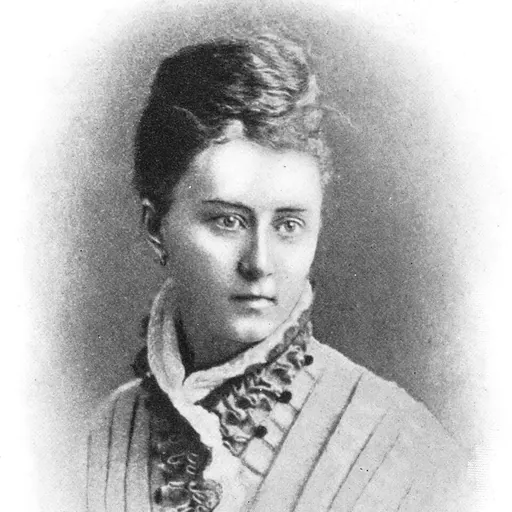
About Isabella Valancy Crawford
Lived 1850 – 1887 (aged 36). Isabella Valancy Crawford was a Canadian poet, writer and novelist.
Isabella Valancy Crawford (25 December 1846 – 12 February 1887) was an Irish-born Canadian writer and poet. She was one of the first Canadians to make a living as a freelance writer.
"Crawford is increasingly being viewed as Canada's first major poet." She is the author of "Malcolm's Katie," a poem that has achieved "a central place in the canon of nineteenth-century Canadian poetry."
Life
Isabella Valancy Crawford was the last surviving daughter of Dr. Stephen Crawford. She was born in Dublin, Ireland, on Christmas Day 1846. The family emigrated to Canada when she was ten years of age.
Much of Isabella Crawford's early life is unknown. By her own account she was born in Dublin, Ireland, the sixth daughter of Dr. Stephen Dennis Crawford and Sydney Scott; but "No record has been found of the birthdates and birthplaces of at least six children, of whom Isabella wrote that she was the sixth."
The family was in Canada by 1857; in that year, Dr. Crawford applied for a licence to practise medicine in Canada West and started to practise in Paisley, Canada West. Her first published poem, "A Vesper Star", She was buried in Peterborough's Little Lake Cemetery near the Otonabee River. She had died in poverty and for years her body lay in an unmarked grave. A fundraising campaign was begun in 1899, and on 2 November 1900, a six-foot Celtic Cross was raised above her grave, inscribed: "Isabella Valancy Crawford / Poet / By the Gift of God."
Writing Isabella Valancy Crawford plaque in Paisley, Ontario. Photo by Alan L. Brown, June 2005. Photo used with permission from the website Ontario Plaques. Crawford was a prolific writer. "For the most part Crawford's prose followed the fashion of the feuilleton of the day." Poet Katherine Hale, Garvin's wife, published a volume on Isabella Valancy Crawford in the 1920s Makers of Canada series. to the eroticism of The Lily Bed.
But it is mainly Crawford's "long narrative poems [that] have received particular attention." is a dialect poem, set in the Rocky Mountains, concerning a dream vision of a midnight cattle stampede towards a black abyss that is stilled by a whirling lariat; "The helot" makes use of the Spartans' practice of intoxicating their helots to teach their own children not to drink, as the starting-point for a highly incantatory and hypnotic poem that ends in Bacchic possession and death; and "Gisli the Chieftain" fuses mythic elements, such as the Russian spring goddess Lada and the Icelandic Brynhild, into a narrative of love, betrayal, murder, and reconciliation. These poems follow a pattern of depicting the world as a battleground of opposites – light and dark, good and evil – reconciled by sacrificial love."
Malcolm's Katie The bulk of critical attention has gone to "Malcolm's Katie." That poem is a long narrative in blank verse, dealing mainly with the love and trials of young Max and Katie in the 19th-century Canadian bush, but containing a second running narrative recounting the war between the North and South Winds (Winter and Summer personified as First Nations warriors), and also a collection of love songs in different stanza forms.
Many of those lauding the poem have seen their own interests reflected in it. For instance, socialist Livesay gave a reading that made the poem sound like a manifesto of Utopian socialism:
Crawford presents a new myth of great significance to Canadian literature: the Canadian frontier as creating 'the conditions for a new Eden,' not a golden age or a millennium, but 'a harmonious community, here and now.' Crawford's social consciousness and concern for humanity's future committed her, far ahead of her time and milieu, to write passionate pleas for brotherhood, pacifism, and the preservation of a green world. Her deeply felt belief in a just society wherein men and women would have equal status in a world free from war, class hatred, and racial prejudice dominates all her finest poetry." "In 'Malcolm's Katie' Crawford adapted to the setting of pioneer Canada the domestic idyll as she learned it from Tennyson. Striking and new, however, is Crawford's location of Max and Katie's conventional love story within a context of Native legends — Indian Summer and the battle of the North and South Winds."
This myth telling (however accurate it was as a portrayal of First Nations beliefs) is what many of its supporters see as giving the poem its power. For instance, writing about "Malcolm's Katie, critic Northrop Frye pronounced Crawford "the most remarkable mythopoeic imagination in Canadian poetry":
Frye believed, and thought Crawford's "poetic sense" told her "that the most obvious development in the romantic landscape is toward the mythological"; and he saw Crawford's attempt at an indigenous Canadian myth as the intellectual equivalent of the simultaneous pioneer exploration and settlement: "In the long mythopoeic passage from Isabella Crawford's Malcolm's Katie, beginning 'The South Wind laid his moccasins aside,' we see how the poet is, first, taming the landscape imaginatively, as settlement tames it physically, by animating the lifeless scene with humanized figures, and, second, integrating the literary tradition of the country by deliberately re-establishing the broken cultural link with Indian civilization."
Hugh and Ion Dorothy Livesay, researching Crawford's life for the Dictionary of Canadian Biography in 1977, discovered the manuscript of an uncompleted narrative poem in the Crawford fonds at Kingston, Ontario's Queen's University. Called Hugh and Ion, it deals with "Hugh and Ion, two friends who have fled the noxious city—probably contemporary Toronto—for purification in the primal wilderness [and] carry on a sustained dialogue, Hugh arguing for hope, light, and redemption and Ion pointing out despair, darkness, and intractable human perversity." Perhaps due to Crawford's Toronto experiences, this last poem marked a significant change in her views, showing the city as "a demonic, urban world of isolation and blindness which has wilfully cut itself off from the regenerative power of the wildernese. The confident innocence and romantic idealism, which account for much of the inner fire of Malcolm's Katie, have simply ceased to be operative.... Nowhere else in nineteenth-century Canadian literature, with the exception of Lampman's "the End of Things", is there another example of the creative imagination being brought to bear, in so Blakean a manner, on the nascent social evils of the 'infant city.'"
A small garden park in downtown Toronto, at Front and John Streets (near the CN Tower), has been named Isabella Valancy Crawford Park.
Publications Old Spookses' Pass, Malcolm's Katie and Other Poems. Toronto, 1884. The Collected Poems of Isabella Valancy Crawford, ed. John Garvin. Toronto: William Briggs, 1905. Isabella Valancy Crawford. Katherine Hale, ed. Toronto: Ryerson, 1923. Hugh and Ion. Glenn Clever ed. Ottawa: Borealis P, 1977. Malcolm's Katie: A Love Story. D.M.R. Bentley ed. London, ON: Canadian Poetry Press, 1987.
Prose collections Selected Stories of Isabella Valancy Crawford. Penny Petrone ed. Ottawa: U of Ottawa P, 1975. Fairy Tales of Isabella Valancy Crawford. Penny Petrone ed. Ottawa: Borealis P, 1977. Collected Short Stories of Isabella Valancy Crawford. Len Early & Michel Peterman, ed. London, ON: Canadian Poetry Press, 2006. Winona; or, The Foster-Sisters. Peterborough, ON: Broadview Press, 2006.
Except where noted, bibliographical information from Open Library.
Don’t just read it —
keep it.
Full-length biographies made to live with: read them, listen on the way to work, watch them tonight.
- E-book
- Audio
- Video
Instant download · yours to keep · every purchase keeps this site free
Important facts
People in Isabella Valancy Crawford's life
Named in this biography and alive at the same time


Related people
Same field, nearest in time

Contemporaries
People whose lives overlapped Isabella Valancy Crawford's


Frequently asked questions
Who was Isabella Valancy Crawford?
Canadian writer (1850-1887)
When was Isabella Valancy Crawford born?
Isabella Valancy Crawford was born on 25 December 1850 in Dublin.
When did Isabella Valancy Crawford die?
Isabella Valancy Crawford died on 12 February 1887 in Toronto.
What was Isabella Valancy Crawford's occupation?
Isabella Valancy Crawford was a poet, writer and novelist.
What nationality was Isabella Valancy Crawford?
Isabella Valancy Crawford was Canadian.
Sources & further reading
· Wikipedia: Isabella Valancy Crawford
· DBpedia: Isabella Valancy Crawford
Cite this page
APA: Biography.guide. (2026). Isabella Valancy Crawford. https://biography.guide/isabella-valancy-crawford/
MLA: "Isabella Valancy Crawford." Biography.guide, https://biography.guide/isabella-valancy-crawford/.
Chicago: "Isabella Valancy Crawford." Biography.guide. https://biography.guide/isabella-valancy-crawford/.
Data last updated: 2026-09-22 · Spot an error? Report a correction.
Portrait: Wikimedia Commons · author & licence
Page generated 2026-09-27 05:03 UTC