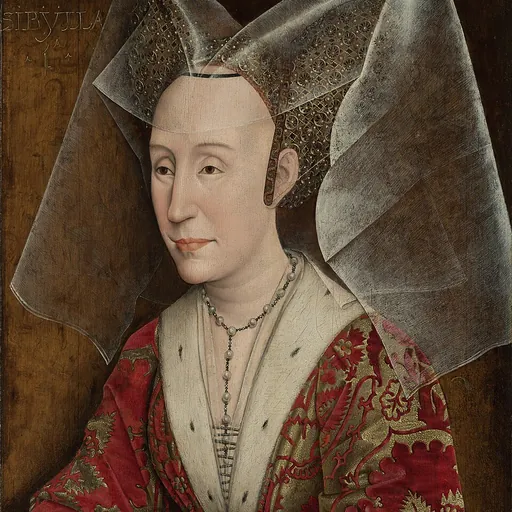
Isabella of Portugal
Queen of Castile
About Isabella of Portugal
Lived 1428 – 1496 (aged 67–68). Isabella of Portugal was a royal consort of Castile.
Isabella of Portugal (Isabel in Portuguese and Spanish) (1428 – 15 August 1496) was Queen of Castile and León between 1447 and 1454 as the second wife of King John II.
A granddaughter of John I of Portugal and Philippa of Lancaster, Isabella married John at age 19. They had two children that survived infancy: Isabella, who became Isabella I of Castile, and Alfonso, who died young.
Early life and background Isabella was born in the Kingdom of Portugal.
The first successful negotiations took place at Ávila on 2 April 1446, when agreements concerning Isabella's dowry were signed. On 9 October, the formal betrothal was concluded at Évora. In addition to defining the terms of the marriage, the agreement addressed the considerable age difference between the couple—John was forty-one and Isabella eighteen—and specified the arrangements that would apply should she become a widow. She would be free to return to Portugal and remarry without forfeiting either the lifetime revenues assigned to her or the three million maravedís granted to her by the Crown of Castile upon her marriage. She was also guaranteed complete authority over the administration of her own household. The ceremony was officiated by Pedro of Castile, the king's uncle and Bishop of Palencia. One of the witnesses to the marriage was Íñigo López de Mendoza, Marquis of Santillana, who later dedicated to the queen a poem beginning, "May God make you virtuous, blessed Queen, as much as He has made you beautiful," in which he also mentions the painter Giotto.
Life as queen King Afonso V of Portugal provided Isabella with a dowry consisting of the 45,000 florins owed to Portugal by Castile, together with an additional 60,000 florins representing her inheritance, which was to be paid upon her mother's death. In return, John II granted her three million maravedís, an annual income of 1,350,000 maravedís, and the lordships of Soria, Arévalo, and Madrigal. Although Ciudad Real was also included among her grants, she appears never to have taken possession of it. She formally took possession of Madrigal on 2 August and of Soria on 14 August.
Isabella arrived in Castile from Portugal in the same month as her marriage, accompanied by a large retinue of ladies-in-waiting, including Beatrice of Silva, who became renowned at the Castilian court for her beauty and later founded the Order of the Immaculate Conception and was canonized by the Catholic Church. Also among her attendants was Catalina Franca de Castro, daughter of the knight Juan de Franca y Alarzón, who served as her menina, lady-in-waiting, and chief lady of the household. Catalina became the queen's closest confidante following her arrival in Castile. Together with her husband, Gutierre Velázquez de Cuéllar (1430–1492), she managed the queen's household until the king's death.
During her early years as queen consort, court life revolved around hunting, banquets, and dances. Contemporary sources portray her as a politically capable figure. Her library included a copy of the Memorial de Virtudes by Alonso de Cartagena, a treatise dedicated to her by its author that emphasized the ruler's responsibility to make just decisions for the benefit of his subjects.
Following the birth of her daughter in 1451, Isabella's her mental health began to deteriorate, and contemporaries considered her to be suffering from mental illness. Her condition reportedly worsened after the birth of her second child and deteriorated further following her husband's death. Modern medical interpretations have identified her symptoms as consistent with postpartum depression. Her mental illness has also been attributed to hereditary factors within the Portuguese royal house.
Contemporary chronicles describe her marriage as a close and affectionate one. According to Cañas Gálvez, John II found in her the beauty and affection that he had not experienced in his marriage to Maria of Aragon. Chroniclers also recorded public displays of affection between the royal couple, crediting her with rejuvenating the king's spirits. When she began to show signs of emotional instability, the king attempted to lift her spirits with gifts, including "a gold chain fashioned in the form of tree trunks, with fifty-eight links enamelled in white, grey, and rose, weighing six marks and one ounce", as well as an annual income of 6,000 maravedís.
Conflict with de Luna Isabella played a significant role in the downfall of Constable Álvaro de Luna. Luna was deeply unpopular at court and especially loathed by Isabella because of the influence he exercised over John II.
In 1453, de Luna had John's chief auditor thrown out of a window. John was convinced by Isabella to have de Luna arrested and executed. Although her marriage capitulations had allowed her to return to Portugal and remarry, they made no provision regarding any future children, and she never returned to live in Portugal.
The chronicles report that Isabella's mental health deteriorated further after John II's death, from which she never recovered. Velázquez became her most trusted servant and remained in her service until his death in 1492. Another lady in her household was María de Guevara, daughter of Ladrón de Guevara y Quesada, lord of Escalante and Treceño, and wife of Arnao de Velasco, brother of Juan de Velasco, 1st Count of Siruela.
Although she has traditionally been portrayed as living in seclusion at Arévalo with little public activity, surviving documentation shows that she actively administered her estates and, whenever permitted, oversaw the upbringing of her children, with assistance from her mother. or during a further pillaging in 1821. Because so few remains survive, it was not possible to determine the cause of her death, although it may have resulted from a brief illness associated with old age.
In addition to the tomb, Isabella's daughter commissioned the church's high altarpiece from Gil de Siloé and Diego de la Cruz, who produced it between 1496 and 1499. Both of her parents are represented in the composition. John II appears on the Gospel side, while Queen Isabella is shown on the Epistle side in one of the few surviving contemporary representations of her. She is depicted in prayer beside her patron saint, Saint Elizabeth, and Saint Elizabeth's son, John the Baptist, to whom the queen was especially devoted. Above her, two angels hold a shield bearing the arms of Castile and León and those of Portugal. Busts of John II and Isabella of Portugal also appear in the spandrels of the chapel of the Virgin of Valvanera at the charterhouse.
Like her husband, Isabella used the emblem of the ristre, created by Álvaro de Luna in 1428 as an anti-Aragonese symbol. Six ristres therefore support her coat of arms on the façade of the Miraflores Charterhouse. Under the settlement reached between John II and Alfonso V of Aragon in 1453, the Castilian monarchs and the Infantes Isabella and Alfonso agreed to wear the Aragonese emblem of the Order of the Jar. In exchange, Alfonso V adopted the Order of the Scale, John II's personal emblem.
Issue Her children were:
Isabella I of Castile. Married Ferdinand II of Aragon, she became Queen of Castile and united Aragon with Castile. Alfonso, Prince of Asturias who rebelled against his half-brother, Henry IV of Castile. He died of a sudden fever, either from plague or poisoning.
Don’t just read it —
keep it.
Full-length biographies made to live with: read them, listen on the way to work, watch them tonight.
- E-book
- Audio
- Video
Instant download · yours to keep · every purchase keeps this site free
Important facts
Family & relationships
People in Isabella of Portugal's life
Named in this biography and alive at the same time

Related people
Same field, nearest in time
Contemporaries
People whose lives overlapped Isabella of Portugal's
Frequently asked questions
Who was Isabella of Portugal?
Queen of Castile
When was Isabella of Portugal born?
Isabella of Portugal was born in 1428 in Kingdom of Portugal.
When did Isabella of Portugal die?
Isabella of Portugal died on 15 August 1496 in Arévalo.
What was Isabella of Portugal's occupation?
Isabella of Portugal was a royal consort of Castile.
What nationality was Isabella of Portugal?
Isabella of Portugal's recorded nationality: Kingdom of Portugal.
Sources & further reading
· Wikipedia: Isabella of Portugal
· DBpedia: Isabella of Portugal, Queen of Castile
Cite this page
APA: Biography.guide. (2026). Isabella of Portugal. https://biography.guide/isabella-of-portugal-royal-consort-of-castile/
MLA: "Isabella of Portugal." Biography.guide, https://biography.guide/isabella-of-portugal-royal-consort-of-castile/.
Chicago: "Isabella of Portugal." Biography.guide. https://biography.guide/isabella-of-portugal-royal-consort-of-castile/.
Data last updated: 2026-09-26 · Spot an error? Report a correction.
Portrait: Wikimedia Commons · author & licence
Page generated 2026-10-04 10:49 UTC