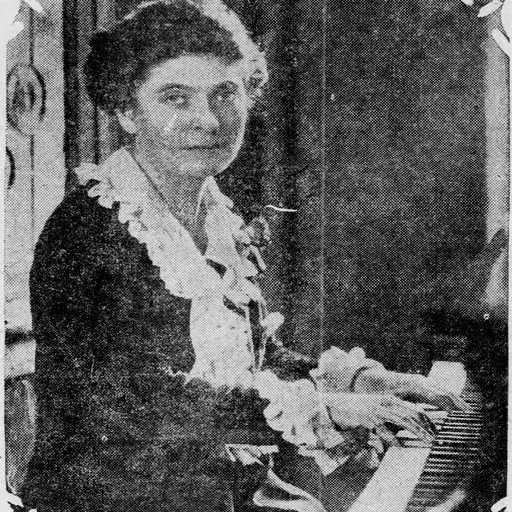
About Irma Hopper
Lived 1890 – 1963 (aged 72). Irma Hopper was an American fencer.
Hennetta Irma Prichard Hopper (July 14, 1890 – January 29, 1963) was an American fencer, singer, and songwriter. She competed in the women's individual foil events at the 1924 and 1928 Summer Olympics.
Early life and education Irma Prichard was born in Galesburg, Illinois, the daughter of James R. Prichard and stepdaughter of Etta Stephens Prichard. Her father was a judge. She was a singer, and trained for a stage career, earning her diploma at the American Academy of Dramatic Arts in 1917.
Career
Wartime service Hopper served in the Women's Motor Corps during World War I. She was one of the first relief workers on the scene at a munitions plant explosion in Morgan, New Jersey, in 1918.
Music and writing Hopper wrote music and lyrics for songs, often for stage use. Among her songs were "Just Like a Violin" (1922), "Rose of the Cabaret" (1923), "Under a Thousand Eyes" (1923), and "Somebody You'll Pass This Way Again" (1928). Her song "Paris" was in a musical comedy, Say When (1928), but cut before the show appeared on Broadway.
Hopper wrote and recited a poem at a 1919 event at the Plaza Hotel, to benefit the American Committee for Armenian and Syrian Relief. She performed her songs on radio programs in 1924. In 1925, she went to Paris as "envoy" of the Metropolitan Opera Company, to secure several noted singers for the opera's new season.
Sports Hopper was a competitive golfer as a young woman, and was the United States women's champion in fencing in 1924. She represented the United States at two Summer Olympics events, in 1924 and 1928. She also won a tournament in 1926. "I believe that every woman, be she housekeeper, business woman or society leader, should have some form of exercise that she enjoys and engages in regularly," she said in a 1924 interview. "Exercise done to music is most valuable, since rhythm and concentration go hand in hand." She was still fencing competitively in Europe in 1931, but she did not qualify for the United States team for the 1932 Summer Olympics. thumb
Legal issues In 1920, Hopper and socialite Grace Carley Harriman testified in a lawsuit against Pierce-Arrow Renting Company after an acquaintance was struck by a car. In the 1920s she was the plaintiff in an Ohio lawsuit concerning her husband's estate. She was arrested and convicted of conspiracy in 1940, in a case involving Grace Carley Harriman and a fraudulent charity sweepstakes. She was sentenced to a year and a day in prison.
Personal life Prichard married an actor, Charles H. Hopper, in 1911; he died in 1916. She died in 1963, at the age of 72, in New York City.
Don’t just read it —
keep it.
Full-length biographies made to live with: read them, listen on the way to work, watch them tonight.
- E-book
- Audio
- Video
Instant download · yours to keep · every purchase keeps this site free
Important facts
People in Irma Hopper's life
Named in this biography and alive at the same time
Related people
Same field, nearest in time



Contemporaries
People whose lives overlapped Irma Hopper's



Frequently asked questions
Who was Irma Hopper?
American fencer
When was Irma Hopper born?
Irma Hopper was born on 14 July 1890 in Galesburg.
When did Irma Hopper die?
Irma Hopper died on 29 January 1963 in New York City.
What was Irma Hopper's occupation?
Irma Hopper was a fencer.
What nationality was Irma Hopper?
Irma Hopper was American.
Sources & further reading
Cite this page
APA: Biography.guide. (2026). Irma Hopper. https://biography.guide/irma-hopper/
MLA: "Irma Hopper." Biography.guide, https://biography.guide/irma-hopper/.
Chicago: "Irma Hopper." Biography.guide. https://biography.guide/irma-hopper/.
Data last updated: 2026-09-23 · Spot an error? Report a correction.
Portrait: Wikimedia Commons · author & licence
Page generated 2026-09-27 05:05 UTC