About Inykhnum
Inykhnum was an Egyptian priest and chinovnik.
Inykhnum (also read as Khnum-Iny) was an ancient Egyptian high-ranking official who worked and lived during the transition time between Second and Third Dynasty of Egypt. The king(s) under which he served are not known for certain, the subject being currently highly disputed.
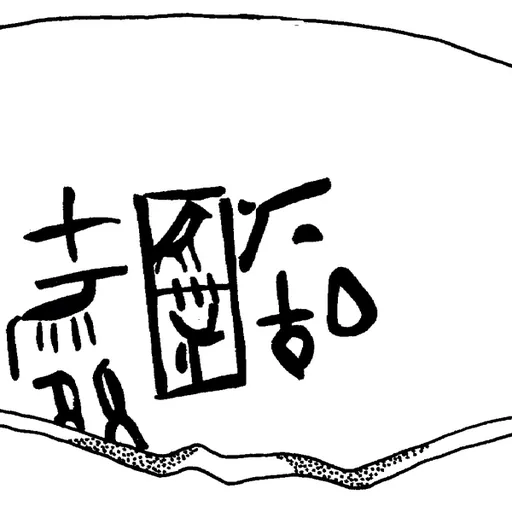
Attestations Inykhnum's name appears exclusively in black ink inscriptions on alabaster shards and vessel fragments as well as on a few limestone shards. These artifacts were found beneath the step pyramid in the eastern galleries of the necropolis of pharaoh Djoser (3rd dynasty) at Saqqara and in the great fort Shunet el-Zebib of king Khasekhemwy (end of 2nd dynasty) at Abydos.
Identity Name Inykhnum's name is connected to the deity Khnum. Toby A. H. Wilkinson translates the name with "Khnum is my father" and evaluates this as a proof for an upcoming cult of Khnum during the reign of king Nynetjer.
Titles As a high-ranking official and priest, Inykhnum owned elite and pious titles:
Career Ilona Regulski and Peter Kaplony are convinced that Inykhnum held his office some time between the end of Khasekhemwy's and the beginning of Sekhemkhet's reigns. Earlier assumptions made by Wolfgang Helck, who dated Inykhnum's ink inscriptions to the time of Nynetjer (3rd ruler of 2nd dynasty), are questioned by Ilona Regulski. She points to comparisons between the ink inscriptions from Abydos and findings from Saqqara with contemporary cursive writings from the 2nd and early 3rd dynasties. First, Regulski remarks that the "17th time of the cattle count" appearing alongside the official's name, is a way of writing which was not common until the reign of Djoser. Additionally, if the cattle count was celebrated every second year as was the case during the Old Kingdom, Inykhnum must have served a king reigning for at least 34 years. Such a long reign is only attested for king Nynetjer of the early 2nd dynasty. However, Regulski suspects that Khasekhemwy or Djoser may have ruled longer than thought.
Furthermore, special font designs appearing together with Inykhnum's name were not yet common during Nynetjer's time on the throne. In particular, Regulski points to special hieroglyphs and their spellings within the hieratic writing: the zigzag-shaped hieroglyph N35 (water line; value "n") was still visibly jagged when written cursively under king Nynetjer, but from the reign of king Peribsen onwards it was written as a simple horizontal line with thickened ends. This is precisely the writing form that appears in the ink inscriptions of Inykhnum. Another hieroglyph, the sign Aa1 (human placenta; value "kh") was depicted as a simple ring or circle during Ninetjer's lifetime, while from king Sekhemib onwards it was written with the familiar horizontal hashing inside the circle. In cursive hieratic writings this sign appears as a circle with one or two fattened, horizontal or diagonal lines. This is also the case in the ink inscriptions of Inykhnum. Thus, according to Regulski, the typographics of the ink inscriptions lead to a secure datation of Inykhnum's life some time between the end of Khasekhemwy's reign and the very beginning of king Sekhemkhet's reign.
Evaluation of Inykhnum's ink inscriptions Inykhnum's ink inscriptions are of great importance to egyptologists and historians alike. Not only do they show the development of the hieratic writing, but also they mention a special building alongside Inykhnum's name: it is a Ka-house, the forerunner of the later mortuary temple. The writings inside the Ka-house point to an obscure king of 2nd dynasty: Horus Za. The existence and identity of this king are highly disputed, in particular because his name never appears inside a royal serekh. Therefore, it is unknown, when and for how long did king Za ruled.
Burial Inykhnum's burial is unknown, W. Helck and J. Spencer list mastaba tombs S2429 and S3009 at Saqqara as possible burial sites.
Don’t just read it —
keep it.
Full-length biographies made to live with: read them, listen on the way to work, watch them tonight.
- E-book
- Audio
- Video
Instant download · yours to keep · every purchase keeps this site free
Important facts
Related people
Same field, nearest in time




Frequently asked questions
Who was Inykhnum?
Egyptian high-ranking official
When was Inykhnum born?
Inykhnum was born in Ancient Egypt.
When did Inykhnum die?
Inykhnum died in Ancient Egypt.
What was Inykhnum's occupation?
Inykhnum was a priest and chinovnik.
What nationality was Inykhnum?
Inykhnum was Egyptian.
Sources & further reading
Cite this page
APA: Biography.guide. (2026). Inykhnum. https://biography.guide/inykhnum/
MLA: "Inykhnum." Biography.guide, https://biography.guide/inykhnum/.
Chicago: "Inykhnum." Biography.guide. https://biography.guide/inykhnum/.
Data last updated: 2026-09-22 · Spot an error? Report a correction.
Portrait: Wikimedia Commons · author & licence
Page generated 2026-09-27 05:04 UTC