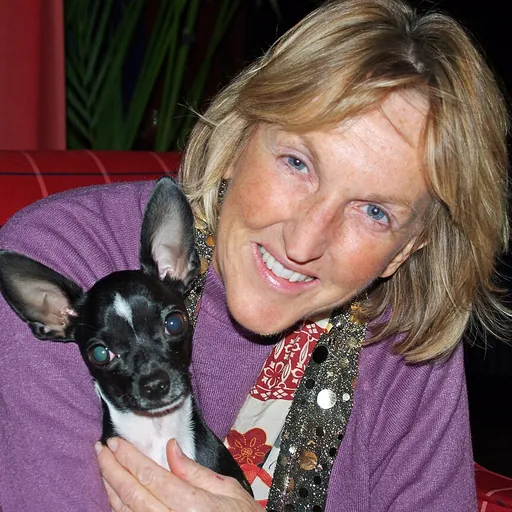
Ingrid Newkirk
British-American animal rights advocate, author & activist
About Ingrid Newkirk
Born 1949. Ingrid Newkirk is a British activist, film director and people for the Ethical Treatment of Animals.
Ingrid Elizabeth Newkirk (; born June 11, 1949) is a British and American animal rights activist, author and the co-founder of People for the Ethical Treatment of Animals (PETA), the world's largest animal rights organization.
Newkirk founded PETA in March 1980 with fellow animal rights activist Alex Pacheco. They came to public attention in 1981, during what became known as the Silver Spring monkeys case, when Pacheco photographed 17 macaque monkeys being experimented on inside the Institute of Behavioral Research in Silver Spring, Maryland. The case led to the first police raid in the United States on an animal research laboratory and to an amendment in 1985 to the Animal Welfare Act. Since then, Newkirk has led campaigns to stop the use of animals in crash tests, convinced companies to stop testing cosmetics on animals, organized undercover investigations that have led to government sanctions against companies, universities, and entertainers who use animals.
Newkirk has been criticized for her support of actions carried out in the name of the Animal Liberation Front. Newkirk and PETA have also been criticized for euthanizing many of the animals taken into PETA's shelters, PETA has responded to this line of criticism.
Biography Early life
Born in Kingston upon Thames, England, in 1949, Newkirk was the only child of Noel Oswald Wodehouse Ward (1917–2000) and Mary Patricia Ward (née Dudley, 1921–2013). Newkirk spent her early years in the Orkney Islands, Scotland and in Ware, Hertfordshire. Her father was a navigational engineer, and when she was seven, the family moved to New Delhi, India, where her father worked for the government, while her mother volunteered for Mother Teresa in a leper colony and a home for unwed mothers. Newkirk attended a convent boarding school in the Himalayas for well-to-do Indian nationals and non-natives. "It was the done thing for a British girl in India", she told Michael Specter for The New Yorker. "But I was the only British girl in this school. I was hit constantly by nuns, starved by nuns. The whole God thing was shoved right down my throat." She tells the story of an early experience of trying to rescue an animal, when she heard laughter in the alleyway behind the family home in New Delhi. A group of people had bound a dog's legs, muzzled him, then lowered him into a muddy ditch, laughing as they watched him try to escape. Newkirk asked her servant to bring the dog to her, and tried to get him to drink some water, but someone had packed his throat with mud, and he died in her arms. She told the Financial Times that it was a turning point. (For what happened to the dog, see.)
When she was eighteen, the family moved to Florida, where her father worked on designing bombing systems for the United States Air Force. It was there that she met her husband, Steve Newkirk; the couple married in 1968 and divorced in 1980. He introduced her to Formula One racing, which—along with sumo wrestling—remains one of her great passions, according to The New Yorker: "It's sex. The first time you hear them rev their engines, my God! That noise goes straight up my spine." By 1976, she was head of the animal-disease-control division of the District of Columbia Commission on Public Health. In March 1980, Newkirk and Pacheco decided to form a group to educate the American public about these ideas, at first consisting of what Newkirk called "five people in a basement". The couple also fell in love and began living together, although they were very different. Newkirk was older, practical, and very organized, whereas Pacheco spent his time in white painter's overalls eating vegetarian hot dogs straight from the can.
Silver Spring monkeys
The case of the Silver Spring monkeys, an animal-research controversy that lasted ten years, transformed PETA from just Newkirk, Pacheco, and a small group of friends into an international movement.
Pacheco repeatedly went into the lab at night to take photographs and to escort scientists, including veterinarians and a primatologist, through it to secure their testimony. Newkirk lay crouched on the back seat of a car outside, hidden under a large cardboard box with holes for her eyes, using a walkie-talkie from a toy store to alert Pacheco if anyone else entered the building. The monkeys' living conditions documented by Pacheco were graphically disturbing. Having collected the evidence, Newkirk and Pacheco alerted the police, who raided the lab, removed the monkeys, and charged Taub with 113 counts of cruelty to animals and six counts of failing to provide adequate veterinary care. Taub maintained that he had been set up by Newkirk and Pacheco while he was on vacation and that several of the photographs had been staged. The judge found Taub guilty of six counts of cruelty to animals for failing to provide adequate veterinary care and fined him $3,000. A later jury trial saw five of these counts dismissed, and the sixth was overturned on appeal because of a technicality. The National Institutes of Health, which had funded Taub's research, was among the scientists and other professionals who criticized the conditions in which Taub had kept the monkeys, though the NIH later reversed its decision when the charges against Taub were overturned.
Newkirk and Pacheco found themselves thrust overnight into the public eye. The images of the restrained animals became iconic after The Washington Post published one of them on its front page. It was the first police raid on an animal-research facility in the U.S. and the first conviction (subsequently overturned) of an animal researcher. The controversy led to an amendment to the 1985 Animal Welfare Act, became the first animal-rights case to be heard before the United States Supreme Court, and established PETA as an internationally known animal-rights group, with Newkirk as its outspoken president.
She has been accused of having had advance knowledge of one ALF action. During the 1995 trial of Rod Coronado, in connection with an arson attack at Michigan State University (MSU), U.S. Attorney Michael Dettmer alleged that Newkirk had arranged, in advance of the attack, to have Coronado send her stolen documents from the university and a videotape of the action.
Public image
Newkirk is known, in particular, for the media stunts that she organizes to draw attention to animal-protection issues. In her will, for example, she has asked that her skin be turned into wallets, her feet into umbrella stands, and her flesh into "Newkirk Nuggets", then grilled on a barbecue. "We are complete press sluts", she told The New Yorker in 2003: "It is our obligation. We would be worthless if we were just polite and didn't make any waves."
Newkirks' actions have caused strong feelings, both positive and negative. Michael Specter, who did not see eye to eye with her, wrote:
Newkirk is well read, and she can be witty. When she is not proselytizing, denouncing, or attacking the ninety-nine per cent of humanity that sees the world differently from the way she does, she is good company. After years of detestable public behavior, however, she has the popular image of a monster. Whenever I mentioned her name to friends, they would recoil. And she becomes more disliked with every peta [ sic] stunt; she can't walk through an airport without accosting any woman who is wearing fur. She no longer takes vacations in tropical or poor countries like Mexico, because "I spend the whole time rescuing animals from their horrid owners." Also, Alec Baldwin contributed the following blurb to Newkirk's book Making Kind Choices: "Ingrid Newkirk is not only a thoughtful animal rights and environmental activist. She is an inspirational leader. A heroine. A woman upon whom so many depend, around the world, for information and guidance. In a world where all animals, everywhere, are more threatened than ever, Ingrid Newkirk is their champion."
Newkirk has been accused of employing a double standard for her organization's practice of euthanizing animals for which it has neither the space nor resources to shelter. Debra Saunders, a critic of Newkirk, argues that "PETA assails other parties for killing animals for food or research. Then it kills animals – but for really important reasons, such as running out of room". Newkirk explains on PETA's website that, "As long as animals are still purposely bred and people aren't spaying and neutering their companions, open-admission animal shelters and organizations like PETA must do society's dirty work. Euthanasia is not a solution to overpopulation but rather a tragic necessity given the present crisis."
Newkirk and PETA both oppose animal testing out of principle as well as on practical grounds. Specter asked whether she would be opposed to experiments on five thousand rats, or even chimpanzees, if it was needed to cure AIDS. She replied: "Would you be opposed to experiments on your daughter if you knew it would save fifty million people?" Courage of Conscience Award, 1995 Shining World Compassion Award, 2007 Ahimsa Award, 2014 Peter Singer Prize for Strategies to Reduce the Suffering of Animals, 2016
Works
Animalkind: Remarkable Discoveries About Animals and Revolutionary New Ways to Show Them Compassion. Co-author Gene Stone, Simon & Schuster (2020). The PETA Practical Guide to Animal Rights - Simple Acts of Kindness to Help Animals in Trouble. St. Martin's Griffin (2009). One Can Make a Difference: Original stories by the Dalai Lama, Paul McCartney, Willie Nelson, Dennis Kucinich, Russell Simmons, Brigitte Bardot ... . Co-author Jane Ratcliffe, Adams Media (2008). Let's Have a Dog Party!: 20 Tail-wagging Celebrations to Share With Your Best Friend. Adams Media Corporation (2007). 50 Awesome Ways Kids Can Help Animals. Warner Books (2006). Making Kind Choices: Everyday Ways to Enhance Your Life Through Earth- and Animal-Friendly Living. St. Martin's Griffin (2005). Peta 2005 Shopping Guide For Caring Consumers: A Guide To Products That Are Not Tested On Animals. Book Publishing Company (2004). Speaking Up For the Animals. DVD, PETA (2004). Animal Rights Weekend Warrior. Lantern Books (2003). Free the Animals: The Story of the Animal Liberation Front. Lantern Books (2000). You Can Save the Animals: 251 Simple Ways to Stop Thoughtless Cruelty. Prima Lifestyles (1999). 250 Things You Can Do to Make Your Cat Adore You. Fireside (1998). Compassionate Cook: Please don't Eat the Animals. Warner Books (1993). Kids Can Save the Animals: 101 Easy Things to Do. Warner Books (1991). A chapter of Lisa Kemmerer's anthology Sister Species: Women, Animals, and Social Justice (2011).
Don’t just read it —
keep it.
Full-length biographies made to live with: read them, listen on the way to work, watch them tonight.
- E-book
- Audio
- Video
Instant download · yours to keep · every purchase keeps this site free
Important facts
People in Ingrid Newkirk's life
Named in this biography and alive at the same time






Related people
Same field, nearest in time




Contemporaries
People whose lives overlapped Ingrid Newkirk's


Frequently asked questions
Who is Ingrid Newkirk?
British-American animal rights advocate, author & activist
When was Ingrid Newkirk born?
Ingrid Newkirk was born on 11 June 1949 in Kingston upon Thames.
What is Ingrid Newkirk's occupation?
Ingrid Newkirk is an activist, film director and people for the Ethical Treatment of Animals.
What nationality is Ingrid Newkirk?
Ingrid Newkirk is British.
Sources & further reading
Cite this page
APA: Biography.guide. (2026). Ingrid Newkirk. https://biography.guide/ingrid-newkirk/
MLA: "Ingrid Newkirk." Biography.guide, https://biography.guide/ingrid-newkirk/.
Chicago: "Ingrid Newkirk." Biography.guide. https://biography.guide/ingrid-newkirk/.
Data last updated: 2026-09-23 · Spot an error? Report a correction.
Portrait: Wikimedia Commons · author & licence
Page generated 2026-09-27 05:06 UTC