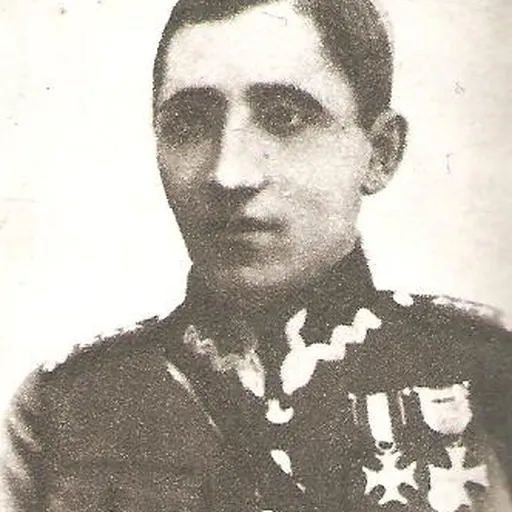
About Ignacy Misiąg
Lived 1891 – 1942 (aged 50). Ignacy Misiąg was a Polish military officer.
Ignacy Misiąg (July 30, 1891 – January 24, 1942) was a Polish infantry colonel who was most notable for his service in World War II.
Biography Early years and World War I Misiąg was the son of Jan Misiąg (1853–1927) and Franciszka née Krajnig who both were poor peasants. He attended a gymnasium in Jarosław, where he obtained his secondary school- leaving examination in 1910. After graduating from the gymnasium, he began law studies at the Jagiellonian University in Kraków, which he had to leave because he was drafted into the Austro-Hungarian Army. In the years 1910 to 1911 he completed a one-year volunteer military service in the independent battalion of the 90th Infantry Regiment. At that time, he was serving in Bosnia and Herzegovina. After fulfilling his military obligations, he returned to education, at the same time joining the .
After the outbreak of World War I, in 1914 he was mobilized into the Austro-Hungarian Army. After graduating from officer training, he was sent to the Serbian campaign as a reserve cadet. In 1915 he was promoted to the rank of second lieutenant in reserve with seniority on 1 July 1915. He fought in Montenegro and Italy where he underwent malaria. In 1918, Ignacy Misiąg was promoted to the rank of lieutenant with seniority on May 1, 1915.
Service in the Polish Armed Forces After the end of World War I, he returned from the front to Jičín. He became the organizer and the first commander of the 14th Kujavian Infantry Regiment, because at the turn of October and November 1918 he took command of the reserve battalion of the 90th Infantry Regiment, most of which consisted of Poles. On the basis of this battalion, he created a unit called the 9th Infantry Regiment. After the 9th infantry regiment was transported to Jarosław, Lieutenant Misiąg became actively involved in organizing the units of the Polish Armed Forces. In February 1919, the 9th Infantry Regiment was renamed the 14th infantry regiment, and on February 17, 1919, Ignacy Misiąg became adjutant to the commander of this regiment. At that time, on the basis of the decree of December 27, 1918 of the Commander-in-Chief Józef Piłsudski, he was admitted as a former Austro-Hungarian army officer to the Polish Armed Forces. In turn, on the basis of order No. 178 issued by the Chief of the General Staff Maj. Gen. Stanisław Szeptycki, on November 1, 1918, he was assigned (with the rank of lieutenant) to the Przemyśl Military District. In the ranks of the 14th infantry regiment he took part in the Polish-Ukrainian War as well as in the Polish-Soviet War, incl. in the offensive on the Volyn front (August 1919), the Kiev offensive, the fighting in Belarus in May 1920, the retreat in July 1920 and the counteroffensive in Eastern Lesser Poland. On July 8, 1919, he was appointed tactical adjutant of the regiment, in June 1920 he became the acting commander of the regiment, and on August 3, 1920, he took command of the 14th infantry regiment. Ignacy Misiąg was courageous, tactical and organizational, as evidenced by the award of the Silver Cross of the Virtuti Militari War Order (awarded by the decree of the Commander-in-Chief of April 13, 1921)
On May 1, 1921, he arrived with the regiment to Włocławek and at the same time took the position of the commander of the local garrison. On June 1, 1921, he served in the 14th Infantry Regiment with the rank of major. By the decree of the Chief of State and the Commander-in-Chief of May 3, 1922 (decree L. 19400 / OV), he was verified with seniority on June 1, 1919, and 205th position in the corps of infantry officers. In 1923 he was already on the 191st place among the majors of the infantry corps and he was the officer acting as the commander of the 14th infantry regiment. and at that time he was 83rd among infantry colonels in his seniority. By order of the Minister of Military Affairs, published on January 20, 1928, he was officially transferred on February 3, 1928, to the 3rd unification three-month course for regimental commanders at the Experimental Training Center in Rembertów.
By order of the President of the Republic, Ignacy Mościcki, he was promoted to the rank of colonel, with seniority on January 1, 1929, and 18th place in the corps of infantry officers. Also in 1932, as the commander of 14 infantry regiment, he was ranked 18 among the colonels of the infantry corps in his seniority. In turn, on June 5, 1935, it was already 67th among all colonels of the infantry corps (and at the same time 16th in its seniority). By order of March 19, 1937, he was awarded by the President of the Republic of Poland with the Commander's Cross of the Order of Polonia Restituta, with exceptional merits in military service. and still served as the 1st division commander of the 6th Infantry Division. After his death, an academy was held in the oflag, and as a sign of mourning, all camp events were suspended for two days.
For his participation in the defensive war of 1939, he was posthumously awarded the Gold Cross of the Virtuti Militari in 1967. Cross of Independence (December 19, 1933) Order of Polonia Restituta, Officer's Cross (1929) Cross of Merit (March 19, 1935) Medal of the Decade of Regained Independence
Don’t just read it —
keep it.
Full-length biographies made to live with: read them, listen on the way to work, watch them tonight.
- E-book
- Audio
- Video
Instant download · yours to keep · every purchase keeps this site free
Important facts
People in Ignacy Misiąg's life
Named in this biography and alive at the same time


Related people
Same field, nearest in time



Contemporaries
People whose lives overlapped Ignacy Misiąg's


Frequently asked questions
Who was Ignacy Misiąg?
Polish officer (1891-1942)
When was Ignacy Misiąg born?
Ignacy Misiąg was born on 30 July 1891 in Tywonia.
When did Ignacy Misiąg die?
Ignacy Misiąg died on 26 January 1942 in Stargard.
What was Ignacy Misiąg's occupation?
Ignacy Misiąg was a military officer.
What nationality was Ignacy Misiąg?
Ignacy Misiąg was Polish.
Sources & further reading
Cite this page
APA: Biography.guide. (2026). Ignacy Misiąg. https://biography.guide/ignacy-misiag/
MLA: "Ignacy Misiąg." Biography.guide, https://biography.guide/ignacy-misiag/.
Chicago: "Ignacy Misiąg." Biography.guide. https://biography.guide/ignacy-misiag/.
Data last updated: 2026-09-22 · Spot an error? Report a correction.
Portrait: Wikimedia Commons · author & licence
Page generated 2026-09-27 05:04 UTC