
About Ida Dehmel
Lived 1870 – 1942 (aged 72). Ida Dehmel was a writer and feminist.
Ida Dehmel (born Ida Coblenz: 14 January 1870 – 29 September 1942) was a German lyric poet and muse, a feminist, and a supporter of the arts.
After 1933 she was persecuted on account of her Jewishness: in 1942, large scale deportations of Jews began from the city where she had made her home. She committed suicide by taking an overdose of sleeping pills.
Life Provenance and early years Ida Coblenz was born in Bingen, along the left bank of the Rhine, into a prosperous well established Jewish family. There were five children. Their mother died while they were still small. Simon Zacharias Coblenz, their father, was a wine grower and leading member of the local business community who inflicted a strict rule based upbringing on his motherless children. Orthodox Judaism, its religious holidays, and precepts commanded respected. As a teenager, she attended a boarding school in Belgium in 1885/86 where, as she later recalled, she first experienced anti-Semitism.
First marriage When Ida married, however, in 1895, it was to Leopold Auerbach , a Jewish businessman and philanthropist from Berlin, who was her father's choice. The couple lived in a large town house at Lennéstrasse 5 in Berlin's Tiergarten quarter. Their son, Heinz-Lux Auerbach, was born in December 1895.
In what may have been a deliberate rebellion against her Orthodox Jewish upbringing, Ida "Isi" Auerbach combined the life of an Imperial German wife, mother, and polite society hostess with patronage of Berlin's Literary Bohemia; which is similar to upper class members of the Radical chic, Bionade-Biedermeier, and Bobo subcultures during the late 20th and early 21st-centuries. The Auerbachs' marriage was nevertheless a joyless one.
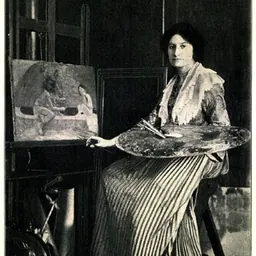
Second marriage Between the summer of 1899 and the end of 1900 Richard Dehmal and Ida travelled together. They went first to Munich and then undertook an extensive tour of Greece and Italy. On the way back they stopped off at Sirmione at the Italian end of Lake Garda. They would have stayed there longer, but Ida fell ill with Typhus and the local doctor recommended that she return to Germany to convalesce. They moved north to Heidelberg where their friend Alfred Mombert lived. Other neighbours were Peter and Lily Behrens. Ida's elder sister, Alice Bensheimer, lived in the Mannheim conurbation nearby. Heidelberg was also within easy reach by train of the Mathildenhöhe Artists' Colony at Darmstadt. A few years later the couple's friend, the Berlin artist Julie Wolfthorn, prepared two oil-paint portraits of the Dehmels, which were exhibited in 1906 at the third exhibition of the German Artists' Association, held in 1906 at the Grand Ducal Museum, Weimar.
After they married they settled not in Heidelberg but, further away from the disapproval of both their families, in Hamburg. Unable to know the nightmarish horrors that the new century would bring to Europe and indeed to her own family, Ida wrote of this time that she had wanted to create a new heaven and a new earth. ("Ich möchte einen neuen Himmel kreieren und eine neue Erde.").
Nazi years In January 1933 the Nazis took power and lost little time in transforming Germany into a one-party dictatorship. The party's popular support was built on the traditional populist themes of hope and hatred. The principal focus of their hatred was split between the Communists and the Jews. Ida Dehmel was no communist, but she was Jewish. On 20 April 1933 Nazi paramilitaries broke into the meeting room at the Hamburger Hof (hotel) where Dehmel was presiding over the monthly GEDOK meeting: they demanded her resignation. Three weeks later, because of her Jewish provenance, she did indeed resign from the organisation that she had herself set up. Through the intervention of her friend, Mary von Toll, with Prince Friedrich Christian of Schaumburg-Lippe, who had been working closely for many years with the Propaganda Minister, Joseph Goebbels, she was permitted to remain at the "Dehmel House" and spared the indignity of being forced to wear a "Jew star" sewn onto her outer garments. Her outlook became progressively more threatening, although there were still many friends and acquaintances, both in Germany and from overseas, intervening with the authorities to try and keep her away from the looming holocaust, which it was becoming impossible to overlook. In October 1941 she wrote a letter to her friend Mary Stern: "You write me a beautiful letter, not knowing that in the meantime I have come close not simply to Death but also to Hell. Since Wednesday it has been not just my life, but also that of thousands of others, that has been an unimaginable agony. On Wednesday 2,000 (it cannot actually have been more than 1,500) Hamburg Jews received the evacuation order. Provisionally. One knows everything that will follow. Cruel conditions. Things to be taken along: louse ointment, insect powder, dust comb. To Litzmanstadt. Here and there a complete family, but also father or mother, or daughter or son, separated out. The domestic servant of my Jewish tenant is there, so short of being there already, I have lived it all. An Aryan acquaintance of my tenant came to visit. I opened the door to her. A young woman. She said to me, "How good that you're still in: it means you can prepare better for the journey." and then her tongue seemed to become frozen in her mouth ....".
The deportations continued. In September 1942, aged 72, Ida Dehmel was still in her home, but she believed she was incurably ill, and even if she were to be spared deportation she feared becoming dependent on others. Her will to live was destroyed by her illness and by the grim circumstances of the time and place. On 29 September 1942 she took an overdose of sleeping pills and ended her life.
Don’t just read it —
keep it.
Full-length biographies made to live with: read them, listen on the way to work, watch them tonight.
- E-book
- Audio
- Video
Instant download · yours to keep · every purchase keeps this site free
Important facts
People in Ida Dehmel's life
Named in this biography and alive at the same time


Related people
Same field, nearest in time




Contemporaries
People whose lives overlapped Ida Dehmel's



Frequently asked questions
Who was Ida Dehmel?
German writer (1870–1942)
When was Ida Dehmel born?
Ida Dehmel was born on 14 January 1870 in Bingen am Rhein.
When did Ida Dehmel die?
Ida Dehmel died on 29 September 1942 in Hamburg.
What was Ida Dehmel's occupation?
Ida Dehmel was a writer and feminist.
What nationality was Ida Dehmel?
Ida Dehmel's recorded nationality: German Reich.
Sources & further reading
Cite this page
APA: Biography.guide. (2026). Ida Dehmel. https://biography.guide/ida-dehmel/
MLA: "Ida Dehmel." Biography.guide, https://biography.guide/ida-dehmel/.
Chicago: "Ida Dehmel." Biography.guide. https://biography.guide/ida-dehmel/.
Data last updated: 2026-09-20 · Spot an error? Report a correction.
Page generated 2026-09-27 05:23 UTC