
About Ibn Qutaybah
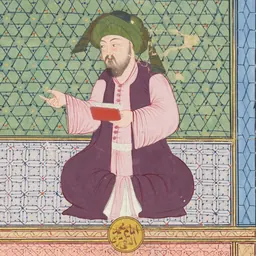
Lived 828 – 889 (aged 60–61). Ibn Qutaybah was an Arab theologian, historian, qur'anic exegete, muhaddith, islamic jurist and qadi.
Abū Muḥammad ʿAbd Allāh ibn Muslim ibn Qutayba al-Dīnawarī al-Marwazī (; c. 828 – 13 November 889 CE/213 – 15 Rajab 276 AH) , better known as Ibn Qutayba, was a Persian Islamic scholar. He served as a judge during the Abbasid Caliphate, but was prominent for his contributions to Arabic literature. He was an Athari theologian and polymath who wrote on diverse subjects, such as Qur'anic exegesis, hadith, theology, philosophy, law and jurisprudence, grammar, philology, history, astronomy, agriculture and botany.
Biography His full name is Abū Muḥammad ʿAbdullāh b. Muslim ibn Qutaybah ad-Dīnawarī. He was born in Kufa in what is now Iraq. He was of Persian descent; his father was from Merv, Khorasan. Having studied tradition and philology he became qadi in Dinawar during the reign of Al-Mutawakkil, He was known as a vocal opponent of "gentile" or shu'ubi Islam, i.e. openness to non-Islamic wisdom and values.
Legacy He was viewed by Sunni Muslims as a hadith master, foremost philologist, linguist, and man of letters. In addition to his literary criticism and anthologies, he was also known for his work on the problems of Tafsir or Qur'anic interpretation. His book Uyun al-Akhbar, along with the romantic literature of Muhammad bin Dawud al-Zahiri and Ibn Abi Tahir Tayfur, was considered by lexicographer Ibn Duraid to be the three most important works for those who wished to speak and write eloquently.
His work Taʾwīl Mukhtalif al-Hadīth was an influential early Atharite treatise that rebuked rationalists on the nature of tradition. In his treatise, Ibn Qutayba censures the mutakallimūn (scholastic theologians) for holding contradictory and differing views on the principles of religion.
Ibn Muṭarrif al-Ṭarafī (d. 1062 CE) gathered passages from Ibn Qutayba's Kitāb Mushkil al-Qurʾān and Kitāb Ghafīb al-Qurʾān and arranged them to be in the same order as the relevant Qurʾān chapters in a work called Kitāb al-Qurṭayn.
Works He wrote more than 60 books, including: Gharīb al-Qur'an, (var., Mushkil al-Qur'an), lexical complexities in the Qur'an. Ta’wīl Mukhtalif al-Hadīth, (The Interpretation of Conflicting Narrations), defence of hadiths against Mu'tazilite critics. Kitāb Adab al-Kātib (“Ibn Kutaiba’s Adab al-Kātib,” ed. Max Grünert, Leiden, 1900) Kitāb al-Anwā’ (Hyderabad, 1956) Kitāb al-Ma‘ānī al-Kabīr fī Abyāt al-Ma‘ānī. 2 vols. (Hyderabad, 1949) Kitāb al-Ma’ārif, short universal history, from Creation to the Jāhiliyya (pre-Islamic); with index of the Companions, famous jurists and masters of hadīth („Ibn Coteiba’s Handbuch de Geschichte“, ed., Ferdinand Wüstenfeld, Göttingen, 1850); (ed., Tharwat ‘Ukāshah, Cairo, 1960). Kitāb al-Shi‘r wa-al-Shu‘arā’ (“Liber Poësie et Poëtarum,” ed., M. J de Goeje, Leiden, 1904) Kitab ‘Uyūn al-Akhbār. 4 vols. (Cairo, 1925-30); biographic history of eminent figures. Kitāb al-Amwāl Kitāb al-‘Arab wa ‘Ulūmuhā; history of Arab scholars Kitāb al-Ashriba; alcoholic beverages. Kitāb Dalā’il al-Nubuwwa, or A‘lām al-Nubuwwa on the Proofs of the Prophets. Kitāb Fad.l al-‘Arab ‘alā al-‘Ajam, in praise of the Arabs over the Persians; translated into English as The Excellence of the Arabs (NYU Press, 2017) Kitāb I‘rāb al-Qur’ān, a philological commentary on the Qur'ān. Kitāb al-Ikhtilāf fī al-Lafz wa al-Radd ‘alā al-Jahmiyya wal-Mushabbiha, a refutation of the Allegorizers and Anthropomorphists. (Egypt, several editions) Kitāb al-Ishtiqāq Kitāb Is.lāh. Ghalat, corrections of Gharīb al-H.adīth by al-Qāsim ibn Salām. Kitāb Jāmi‘ al-Fiqh, jurisprudence, dispraised as unreliable by al-Tabarī and Ibn Surayj, as was Ibn Qutayba’s al-Amwāl. Kitāb Jāmi‘ al-Nah.w al-Kabīr and Jāmi‘ al-Nah.w al-S.aghīr Kitāb al-Jarāthīm, linguistics. Kitāb al-Jawābāt al-H.ād.ira. Kitāb al-Ma‘ānī al-Kabīr Kitāb al-Masā’il wal-Ajwiba. Kitāb al-Maysar wal-Qidāh, ('Dice and Lots'). Kitāb al-Na‘m wal-Bahā’im, cattle and livestock. Kitāb al-Nabāt, botany. Kitāb al-Qirā’āt, ('The Canonical Readings'). Kitāb al-Radd ‘alā al-Qā’il bi Khalq al-Qur’ān, ('Against the creationist claims about the Qur’an'). Kitāb al-Radd ‘alā al-Shu‘aybiyya, ('Refutation of a sub-sect of the ‘Ajārida ‘At.awiyya, itself a sub-sect of the Khawārij). Kitāb al-Rah.l wal-Manzil. Kitāb Ta‘bīr al-Ru’yā, ('Interpretation of Dreams'). Kitāb Talqīn al-Muta‘allim min al-Nah.w on grammar. Kitāb ‘Uyūn al-Shi‘r, on poetry.
Don’t just read it —
keep it.
Full-length biographies made to live with: read them, listen on the way to work, watch them tonight.
- E-book
- Audio
- Video
Instant download · yours to keep · every purchase keeps this site free
Important facts
People in Ibn Qutaybah's life
Named in this biography and alive at the same time



Related people
Same field, nearest in time




Contemporaries
People whose lives overlapped Ibn Qutaybah's





Frequently asked questions
Who was Ibn Qutaybah?
Persian jurist and scholar (c.828-889)
When was Ibn Qutaybah born?
Ibn Qutaybah was born in 828 in Kufa.
When did Ibn Qutaybah die?
Ibn Qutaybah died on 13 November 889 in Baghdad.
What was Ibn Qutaybah's occupation?
Ibn Qutaybah was a theologian, historian, qur'anic exegete, muhaddith, islamic jurist and qadi.
What nationality was Ibn Qutaybah?
Ibn Qutaybah was Arab.
Sources & further reading
Cite this page
APA: Biography.guide. (2026). Ibn Qutaybah. https://biography.guide/ibn-qutaybah/
MLA: "Ibn Qutaybah." Biography.guide, https://biography.guide/ibn-qutaybah/.
Chicago: "Ibn Qutaybah." Biography.guide. https://biography.guide/ibn-qutaybah/.
Data last updated: 2026-09-20 · Spot an error? Report a correction.
Page generated 2026-09-27 05:05 UTC