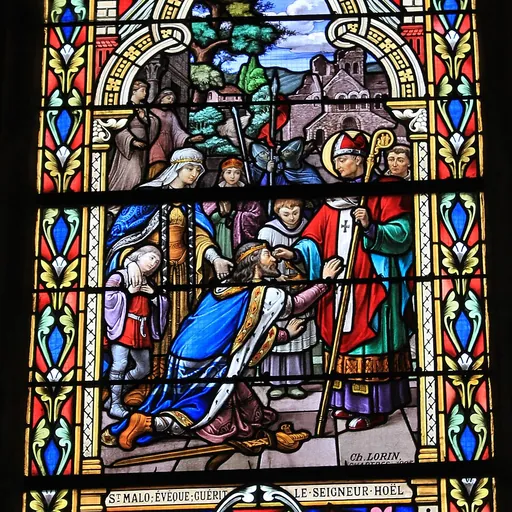
About Hywel the Great
Hywel the Great was a writer, priest and monarch.
King Hoel (, "Hoel the Great"; ), also known as Sir Howel, Saint Hywel and Hywel the Great, was a late 5th- and early 6th-century member of the ruling dynasty of Cornouaille. He may have ruled Cornouaille jointly after the restoration of his father, Budic II of Brittany, but he seems to have predeceased his father and left his young son, Tewdwr, as Budic's heir.
Hywel appears in Welsh mythology and the Matter of Britain as a "king of Brittany." A relative of Arthur, he was one of his most loyal allies (or, sometimes, a Knight of the Round Table) and was said to have helped him conquer "Gaul" (northern France).
As a son of Budic, he was recorded as a nephew of Arthur. He was said to have visited Arthur's court during his early exile and to have returned to help Arthur against the Saxons after the family's restoration in Brittany. Landing at Southampton, his army was credited with assisting Arthur at the Battle of Dubglas, the Siege of Caer Ebrauc (i.e. York), and the Battle of Cat Celidon Coit. It was then bottled up and besieged in turn at Dumbarton Castle ("Caer-Brithon"). Hoel was also said to have been at the Battle of Badon before conquering France for Arthur, who then moved his court to Paris. Finally returning to Brittany, he was aided by Tristram of Lyonesse in suppressing a civil war.
Hywel was later attached to the Tristan and Iseult legend by such poets as Béroul and Thomas of Britain. In these stories, Hywel is duke of Brittany and the father of Tristan's unloved wife, Iseult of the White Hands (Iseut aux Blanches Mains). Hywel takes Tristan in when the young knight has been banished from the kingdom of king Mark of Cornwall, and Tristan later helps him in battle and becomes fast friends with his son Kahedin and his daughter Iseult. Tristan convinces himself to marry this second Iseult, mostly because she shares the name of his first love, Iseult of Ireland. In early versions of the story, Tristan remains in Hywel's land until he dies of poison minutes before Iseult of Ireland, a great healer, arrives to cure him. The Prose Tristan has the hero returning to Britain and to his first love, never to see his wife again. This version was followed by the Post-Vulgate Cycle and by Thomas Malory's Death of Arthur.
Legacy
Llanhowell in Llanrhian, Pembrokeshire, Wales, is named in his honour. Llanllowell in Monmouthshire originally was as well, although it is now considered dedicated to Saint Llywel. The present parish church at Llanhowell was largely refurbished in the 1890s but includes sections dating as early as the 12th century. It is listed as a Grade II* protected building.
Don’t just read it —
keep it.
Full-length biographies made to live with: read them, listen on the way to work, watch them tonight.
- E-book
- Audio
- Video
Instant download · yours to keep · every purchase keeps this site free
Important facts
Related people
Same field, nearest in time




Frequently asked questions
Who was Hywel the Great?
legendary king of Brittany
When did Hywel the Great die?
Hywel the Great died in AD 6.
What was Hywel the Great's occupation?
Hywel the Great was a writer, priest and monarch.
Sources & further reading
Cite this page
APA: Biography.guide. (2026). Hywel the Great. https://biography.guide/hywel-the-great/
MLA: "Hywel the Great." Biography.guide, https://biography.guide/hywel-the-great/.
Chicago: "Hywel the Great." Biography.guide. https://biography.guide/hywel-the-great/.
Data last updated: 2026-09-23 · Spot an error? Report a correction.
Portrait: Wikimedia Commons · author & licence
Page generated 2026-09-27 05:04 UTC