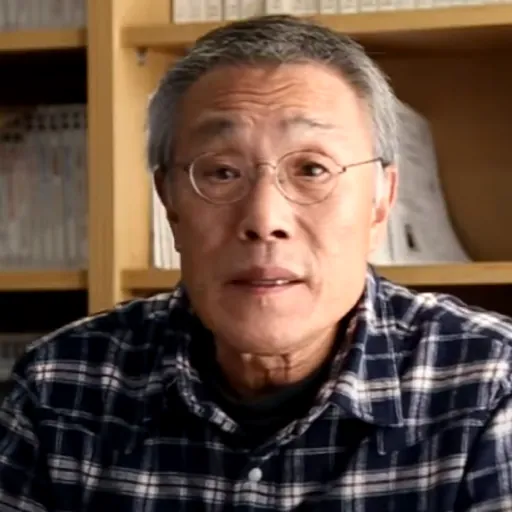
About Hwang Sok-yong
Born 1943. Hwang Sok-yong is a South Korean writer, journalist and novelist.
Hwang Sok-yong (born January 4, 1943) is a South Korean novelist.
Biography Hwang was born in Xinjing (today Changchun), Manchukuo, during the period of Japanese rule. His family returned to Korea after liberation in 1945. He later obtained a bachelor's degree in philosophy from Dongguk University.
Hwang has been an avid reader of a wide range of literature and he wanted to become a writer since childhood.
In 1964, he was jailed for political reasons and met labor activists. Upon his release he worked at a cigarette factory and at several construction sites around the country.
In 1966–1969, he was part of the Republic of Korea Marine Corps during the Vietnam War, reluctantly fighting for the American cause that he saw as an attack on a liberation struggle:
In Vietnam he was responsible for "clean-up", erasing the proof of civilian massacres and burying the dead. A gruesome experience in which he was constantly surrounded by corpses that were gnawed by rats and abuzz with flies. Based on these experiences he wrote the short story "The Pagoda" in 1970, which won the daily newspaper Chosun Ilbo's new year prize, and embarked on an adult literary career.
His first novel Mr. Han's Chronicle, the story of a family separated by the Korean War, was published in 1970. The novel is still relevant after Kim Dae-jung's visit to North Korea and meeting with Kim Jong Il led to reunions of separated families and talk of reunification. Mr. Han's Chronicle was translated into French by Zulma in 2002.
Hwang published a collection of stories, On the Road to Sampo in 1974, and became a household name with his epic, Jang Gilsan, which was serialized in a daily newspaper over a period of ten years (1974-84). Using the parable of a bandit from olden times ("parables are the only way to foil the censors") to describe the contemporary dictatorship, Chang Kil-san was a huge success in North as well as South Korea. It sold an estimated million copies and remains a bestseller in Korean fiction.
Hwang also wrote for the theater, and several members of a company were killed while performing one of his plays during the 1980 Gwangju Uprising. During this time, he went from being a politically committed writer revered by students and intellectuals, to participating directly in the struggle. As he said:
The 1985 appearance of Lee Jae-eui's book Beyond Death, Beyond the Darkness of Age (English translation: Gwangju Diary: Beyond Death, Beyond the Darkness of Age, 1999) brought new trouble: Hwang originally agreed to take credit as the author to help market the book, and both Hwang as the assumed author and the publisher were arrested and sent to prison. Hwang's substantial and award-winning novel based on his bitter experience of the Vietnam War, The Shadow of Arms was published in 1985. It was translated into English in 1994 and French in 2003. In 1989, he illegally traveled to Pyongyang, North Korea, via Tokyo and Beijing as a representative of the nascent democratic movement.
Rather than return to South Korea, he went into voluntary exile in New York, lecturing at Long Island University. He also spent time in Germany, which he found transformational.
In 1993, he returned to Seoul because "a writer needs to live in the country of his mother tongue" and was promptly sentenced to seven years in prison for breach of the National Security Law. While in prison, he conducted 18 hunger strikes against restrictions such as the banning of pens and inadequate nutrition.
Organizations around the world including PEN America and Amnesty International rallied for his release and the author was finally pardoned in 1998 as part of a group amnesty by newly elected President Kim Dae-jung. When asked whether the regime that freed him recognized his work and even sent him on an official visit to North Kores as part of a policy of opening up and promoting dialogue was a democracy, he replied:
At the time I received a seven year prison sentence for violating the 'National Security Law', and although Amnesty International and International PEN campaigned for prisoners' writing rights, which was also actively supported by the UN Human Rights Commission, I ultimately failed to obtain those rights. In 1998 Kim Dae-jung was elected as president and effected a shift in government, so I was released after only five years thanks to his special pardon. My 'realist narrative' was a way beyond the division which 'I' creates, and towards the universality of the world was published in 2002. It was translated into French in 2004 and Seven Stories brought out the English-language edition to critical acclaim in 2005. The "guest" is a euphemism for smallpox, or an unwanted visitor that brings death and destruction.
In December 2013, Seven Stories published his novel The Shadow of Arms. A novel based on the author's experience in Korea's military corps fighting America's war in Vietnam, it reveals the regional economic motivations for the conflict within the larger Cold War.
In 2024 Hwang's book Mater 2-10 longlisted for the International Booker Prize 2024.
Work Hwang defined the reality of Korea as a "nation-wide state of homelessness", and has continuously explored the psychology of the people who have lost their "homes", symbolic or real. "Home", to Hwang Sok-yong, is not simply a place where you were born and raised but a community life rooted in the feeling of solidarity. This idea of home is also the basis for Hwang's attempt to reveal social contradictions through peripheral or foreign people. Hwang's literary tendencies are strongly linked on his personal experiences. "For the Little Brother' (Aureul wihayeo, 1972), "The Light of Twilight" (Noeurui bit, 1973) and "Passionate Relationship" (Yeorae, 1988) are the stories of the author's adolescence, which embraces issues such as rejections of one's parents, hatred of competition, and the feeling of humanity and solidarity shared by the people at the periphery of the society.
Hwang's work can be divided into three categories. The first deals with the loss of humanity and devastation of life due to modernization, war, and the military system; The second category expresses the desire to reclaim healthy life and rejuvenate damaged values and; the third are in the category of historical novel. Korea Culture and Arts Foundation 'This Year's' Art Prize (2004) Mark of Respect Award (2008) Prix Emile-Guimet (2018).
Don’t just read it —
keep it.
Full-length biographies made to live with: read them, listen on the way to work, watch them tonight.
- E-book
- Audio
- Video
Instant download · yours to keep · every purchase keeps this site free
Important facts
People in Hwang Sok-yong's life
Named in this biography and alive at the same time

Related people
Same field, nearest in time


Contemporaries
People whose lives overlapped Hwang Sok-yong's

Frequently asked questions
Who is Hwang Sok-yong?
South Korean writer
When was Hwang Sok-yong born?
Hwang Sok-yong was born on 4 January 1943 in Changchun.
What is Hwang Sok-yong's occupation?
Hwang Sok-yong is a writer, journalist and novelist.
What nationality is Hwang Sok-yong?
Hwang Sok-yong is South Korean.
Sources & further reading
Cite this page
APA: Biography.guide. (2026). Hwang Sok-yong. https://biography.guide/hwang-sok-yong/
MLA: "Hwang Sok-yong." Biography.guide, https://biography.guide/hwang-sok-yong/.
Chicago: "Hwang Sok-yong." Biography.guide. https://biography.guide/hwang-sok-yong/.
Data last updated: 2026-09-22 · Spot an error? Report a correction.
Portrait: Wikimedia Commons · author & licence
Page generated 2026-09-27 05:04 UTC