
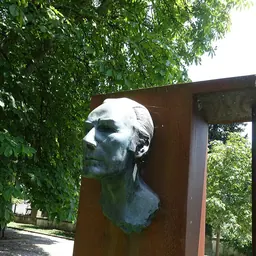
Hujr ibn Adi
Islamic figure and companion of Muhammad
About Hujr ibn Adi
Hujr ibn Adi was an Arab militant and companions of the Prophet, known for Ali.
Ḥujr ibn ʿAdī al-Kindī was a Muslim revolutionary and a supporter of ʿAlī ibn Abī Ṭālib, the fourth Rashidun caliph and the first Imam of the Shi'ites. He was known for rallying against Muʿāwiya, the first Umayyad Caliph and opponent of Ali, which ultimately led to his execution in the 670s.
Biography Hujr ibn Adi was from the tribe of Kinda, as indicated by his epithet al-Kindi, and claimed descent from the ancient Sabaeans of Yemen. His position in the Islamic historical record is widely agreed to have been as one of the Tabi'un, putting him in the second generation of Muslims who did not meet Muhammad. However, Ibn Sa'd and Ahmad al-Baladhuri disagree with this and state that he was one of the Sahabah, basing their statement on a narration which says that Hujr and his brother accepted Islam in the city of Medina while in the presence of Muhammad himself. Hujr took part in the 7th-century conquests of the Levant under the service of the first two Rashidun caliphs, Abu Bakr and Umar ibn al-Khattab. During the Friday sermon of Ziyad ibn Abihi, Hujr reportedly threw stones at him and abandoned the gathering. His motives for such an action are disputed; according to Ibn al-Arabi, Hujr threw stones at Ziyad after hearing of unsatisfying actions done by the latter; while an earlier narration states that Hujr threw the stones out of anger due to the fact that Ziyad had extended his speech during the Friday sermon and Hujr felt it was taking too long. Regardless, Mu'awiyah, who did not fully understand the situation, saw this as a means of inciting rebellion and he had Hujr executed. The execution of Hujr ibn Adi earned Mu'awiyah the criticism of both supporters and opponents of Ali, such as Aisha, who was reportedly displeased with him until Mu'awiyah explained himself to her.
Legacy The minaret of the mosque built around the purported tomb of Hujr by the Ayyubids. Hujr ibn Adi became a revered figure to the early Shi'ites. The Ayyubids, a Sunni dynasty, built a mosque around his alleged tomb that was renovated in 1205. The mosque and its tomb became notable for the fact that it used materials from an earlier Roman ruin in the area, such as pillars and bricks. The New York Times identified Abu Anas al-Wazir, a lieutenant of the Islamist group, as the perpetrator behind the desecration. However, after being arrested, members of Jabhat al-Nusra who participated in the desecration admitted that they had not exhumed any remains and there was no body found inside the tomb. Images of the so-called body were also spread online After the fall of the Assad rule over Syria, the mosque of Hujr ibn Adi was rebuilt and reopened to visitors.
Don’t just read it —
keep it.
Full-length biographies made to live with: read them, listen on the way to work, watch them tonight.
- E-book
- Audio
- Video
Instant download · yours to keep · every purchase keeps this site free
Important facts
Related people
Same field, nearest in time





Frequently asked questions
Who was Hujr ibn Adi?
Islamic figure and companion of Muhammad
When did Hujr ibn Adi die?
Hujr ibn Adi died in Adra.
What was Hujr ibn Adi's occupation?
Hujr ibn Adi was a militant and companions of the Prophet.
What was Hujr ibn Adi known for?
Hujr ibn Adi was known for Ali.
What nationality was Hujr ibn Adi?
Hujr ibn Adi was Arab.
Sources & further reading
Cite this page
APA: Biography.guide. (2026). Hujr ibn Adi. https://biography.guide/hujr-ibn-adi/
MLA: "Hujr ibn Adi." Biography.guide, https://biography.guide/hujr-ibn-adi/.
Chicago: "Hujr ibn Adi." Biography.guide. https://biography.guide/hujr-ibn-adi/.
Data last updated: 2026-09-24 · Spot an error? Report a correction.
Portrait: Wikimedia Commons · author & licence
Page generated 2026-09-27 05:09 UTC