
About Hugo Stintzing
Lived 1888 – 1970 (aged 82). Hugo Stintzing was a German physicist, university teacher and chemist.
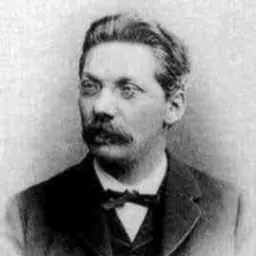
Hugo Stintzing (10 August 1888 in Munich, Germany – 11 December 1970 in Darmstadt, West Germany) was a German university lecturer in physics at the Technische Hochschule Darmstadt. He was involved in early research on the electron scanning microscope, studied radioactive elements and developed a model for the periodic table. He was the Director of the Institute of X-Ray Physics and Technology at Darmstadt from 1936 to 1945. He was removed from his position due to his involvement in the National Socialist German Workers' Party (NSDAP, Nazi Party, joined 1933), and was interned in 1946.
Childhood Hugo Stintzing was born in Munich, Germany on 10 August 1888 the son of Roderich Stintzing, an internist and later professor of internal medicine.
From 1913 he was assistant at the Photochemical Department of the Physikalisch-Chemisches Institut (the Institute of Physical Chemistry) at the University of Leipzig.
In 1916 he proposed a model for the periodic table, organized as a cone-like rotational body. His paper, "Eine neue Anordnung des periodischen Systems der Elemente" (A new arrangement of the periodic system of the elements) was published in Zeitschrift für Physikalische Chemie. His representation of the elements is one of several early helix-based displays.
From 1918 he was an assistant at the Physikalisch-Chemisches Institut of the University of Giessen. He habilitated in 1923 with a thesis on the use of x-rays for chemical investigations: Röntgenographisch-chemische Untersuchungen.
In 1929, Stintzing filed a patent for a proposed electron scanning microscope, to be capable of automatic detection and measurement of particles using a light beam or beam of electrons. He suggested the use of crossed slits to obtain a small diameter probe. A light beam could be mechanically scanned, while an electron beam could be detected using electric or magnetic fields. Detectors would observe the beam transmitted after absorption or scattering. A chart recorder would represent the linear dimension of a particle by the width of a deflection, and its amplitude by thickness. No drawings accompany the specification, and Stintzing is presumed not to have attempted construction of such an instrument. Almost forty years later, a computer-controlled scanning electron microscope based on his specifications was built and tested. The results were presented at the Fifth International Congress on X-Ray Optics and Microanalysis at Tübingen University in 1968.
Stintzing worked on the chemical analysis of x-ray spectra, developing apparatus with x-ray tubes for the measurement of secondary fluorescent emission lines. He published a textbook on Rontgenstrahlen und Chemische Bindung ("X-ray and chemical bonding") in 1931.
In 1936, Stintzing was appointed to Technische Hochschule Darmstadt, to replace Paul Knipping, who had died unexpectedly. Knipping had founded an institute for X-ray physics and technology at Darmstadt in 1929/30. Stintzing held a lectureship (Lehrauftrag) at Darmstadt as of 1 April 1936, and was appointed Director of the Institute of X-Ray Physics and Technology as of 1 October 1936. On 10 June 1943 he received promotion to the rank of extraordinary professor of X-ray physics and technology at Darmstadt.
Military and political involvement During the First World War Hugo Stintzing was in the artillery with the rank of lieutenant of the reserve. On 1 May 1933, Hugo Stintzing joined the National Socialist German Workers' Party (NSDAP, Nazi Party) as well as its paramilitary wing, the Sturmabteilung. From September 1938 to June 1940, he held the position of National Socialist lecturer at the University of Darmstadt. Like Karl Lieser, Friedrich List and Jakob Sprenger, he was a strong supporter of Nazism. A notice in Physick Journal in 1958 commemorated his 70th birthday.
Personal life Hugo Stintzing was married to Friedel (Frieda) Gertrud Keferstein (1899–1989) on 15 October 1929.
Hugo Stintzing died at the age of 82 on 11 December 1970 and was buried in the Old Cemetery in Darmstadt, Germany.
Don’t just read it —
keep it.
Full-length biographies made to live with: read them, listen on the way to work, watch them tonight.
- E-book
- Audio
- Video
Instant download · yours to keep · every purchase keeps this site free
Important facts
People in Hugo Stintzing's life
Named in this biography and alive at the same time

Related people
Same field, nearest in time


Contemporaries
People whose lives overlapped Hugo Stintzing's




Frequently asked questions
Who was Hugo Stintzing?
German physicist
When was Hugo Stintzing born?
Hugo Stintzing was born on 10 August 1888 in Munich.
When did Hugo Stintzing die?
Hugo Stintzing died on 11 December 1970 in Darmstadt.
What was Hugo Stintzing's occupation?
Hugo Stintzing was a physicist, university teacher and chemist.
What nationality was Hugo Stintzing?
Hugo Stintzing was German.
Sources & further reading
Cite this page
APA: Biography.guide. (2026). Hugo Stintzing. https://biography.guide/hugo-stintzing/
MLA: "Hugo Stintzing." Biography.guide, https://biography.guide/hugo-stintzing/.
Chicago: "Hugo Stintzing." Biography.guide. https://biography.guide/hugo-stintzing/.
Data last updated: 2026-09-20 · Spot an error? Report a correction.
Page generated 2026-09-27 05:14 UTC