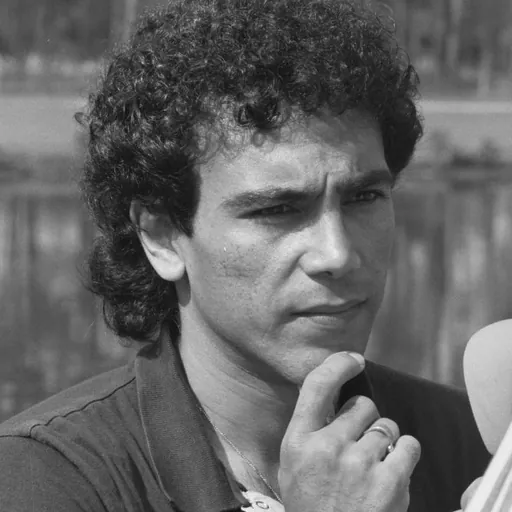
Hugo Sánchez
Mexican footballer and manager
About Hugo Sánchez
Born 1958. Hugo Sánchez is a Mexican association football player and association football coach.
Hugo Sánchez Márquez (born 11 July 1958) is a Mexican former professional footballer and manager, who played as a forward. A prolific goal scorer known for his spectacular strikes and volleys, he is widely regarded as the greatest Mexican footballer of all time, one of the best players of his generation, and one of the greatest strikers of all time. In 1999, the International Federation of Football History and Statistics voted Sánchez the 26th best footballer of the 20th century, and the best footballer from the CONCACAF region. In 2004, Sánchez was named in the FIFA 100 list of the world's greatest living players.
Sánchez is regarded as one of La Liga's best foreign imports, and one of Real Madrid's top strikers of all time. He is the fifth highest scorer in the history of La Liga, the fourth highest scoring foreign player after Cristiano Ronaldo, Lionel Messi, and Karim Benzema, and is the seventh highest goal scorer in Real Madrid's history. He scored a total of 562 senior career goals for both club and country in 956 matches, amassing a total of five Pichichi top goal scorer trophies in Spain.
Beginning his career at Pumas UNAM in 1976, he briefly went on loan to the San Diego Sockers of the North American Soccer League in 1979, during the Mexican League's off-season period. In 1981, he moved to Spain to play for Atlético Madrid, playing for the Colchoneros for four years before moving to cross-town rivals Real Madrid, where he would spend the best years of his career, winning numerous titles and accolades.
From 1977 to 1994, Sánchez was a member of the national team, gaining 58 caps and scoring 29 goals. He participated in three FIFA World Cup tournaments and was a part of the Mexico team that reached the quarter-finals of the 1986 World Cup. Famous for his acrobatic goal celebrations throughout his club and international career, Sánchez was the first notable exponent of the backflip.
As a manager, he won two consecutive league championships with Pumas UNAM. After managing Necaxa, he was announced as coach of the Mexico national football team in 2006, but was fired in March 2008 due to poor results. In 2009, Sánchez was named manager of Almería, and helped to save the club from relegation.
Club career Pumas UNAM As a teenager, Sánchez played for the Mexico national football team at the 1976 Summer Olympics. Having already played in over 80 international matches, Sánchez signed as a youth player at the age of 18 for Pumas UNAM, a professional team representing Mexico's national university, where he completed a degree in Dentistry while playing for the first team. Later that year, Pumas UNAM managed to win its first championship in the Primera División. Two years later, he became the league's top-scorer with 26 goals.
In 1979, Pumas UNAM agreed to exchange players during the off-season with the San Diego Sockers of the North American Soccer League (NASL). He played in the NASL during the summer and in the Mexican league during the fall, winter and spring. Pumas UNAM loaned Sánchez to the Sockers in 1979 and 1980 where he became a prolific striker for the Sockers, averaging nearly a goal a game.
Sánchez's five seasons with Pumas UNAM were during the team's golden years. In 1980–81, his last season with the club, Sánchez and Pumas UNAM won its second league championship, a CONCACAF Champions Cup and a Copa Interamericana. During his five years with Pumas UNAM, Sánchez scored 104 goals in 200 appearances.
With Hugo's exemplary performances in the Toulon Tournament and 1975 Cannes Youth Tournament, he earned his nickname Niño de Oro (Golden Boy).
Atlético Madrid After five successful seasons in Mexico, Sánchez drew the attention of several European sides, including that of English club Arsenal, It was reported that due to Atlético Madrid's reluctance to anger their fan base with a direct deal with Real, Sánchez was transferred to Pumas UNAM back in his home country on 4 July before being signed by Real Madrid, with the contract signing taking place in a bank in Mexico City.
He played alongside the famed group of players known as the La Quinta del Buitre ("Vulture's Cohort"), which consisted of Emilio Butragueño, Manuel Sanchís, Martín Vázquez, Míchel, and Miguel Pardeza. His 38-goal tally stood as a league record until Cristiano Ronaldo surpassed it after scoring 40 goals in the 2010–11 season. In European Cup competitions, Sánchez scored 27 goals in 46 matches.
Later career In 1992, Sánchez returned to his native Mexico for a season and there he won the 1992 CONCACAF Champions' Cup with Club América before playing for a variety of clubs in Spain, Austria and the United States. He played for Dallas Burn in the inaugural year of Major League Soccer, becoming one of two footballers, along with Roy Wegerle, to play outdoor football in both the NASL and Major League Soccer (MLS). He finished his career playing for Atlético Celaya, along with Butragueño and Míchel, his old colleagues from Real Madrid.
Retirement Sánchez retired from Spanish football on 29 May 1997, playing with Real Madrid at the Santiago Bernabéu Stadium. His last official game was during the 1998 World Cup qualifiers, where he touched the ball as a symbol of his retirement.
International career Sánchez made 58 appearances for Mexico between 1977 and 1994, scoring 29 goals. and at the 1976 Summer Olympics. at the age of 19, he took part in the final tournament, where Mexico lost all three of their group games and suffered a first round elimination. He scored his only World Cup goal during his nation's opening match of the tournament on 3 June, the winning goal in a 2–1 victory over Belgium, although he also missed a penalty in Mexico's second group match against Paraguay, and was later booked, causing him to miss the final group match. Four years later, however, Mexico once again missed out on the final tournament as they were suspended from the 1990 FIFA World Cup in Italy. Sánchez later also appeared at the 1994 FIFA World Cup in the United States, his final major tournament, where Mexico suffered a round of 16 elimination; he made his only appearance in the tournament on 19 June, in Mexico's opening match of the competition, a 1–0 defeat to Norway. he was released on 20 December 2009.
Mexico After briefly managing Club Necaxa, Sánchez was named head coach of the Mexico national team, with the aim of leading Mexico through the qualification process for the 2010 World Cup in South Africa.
During his coaching career especially, Sánchez became known for his volatile temperament and his willingness to speak candidly, often expressing strong emotions and opinions, a trait that engenders equally emotional and strong responses from those he criticizes. He had a long-standing feud with the previous Mexico coach, Ricardo La Volpe.
Sánchez's first match as Mexico coach was a 2–0 loss to the United States in Phoenix, Arizona in February 2007. Sánchez recorded his first victory against Venezuela, a 3–1 win in front of 67,000 fans in San Diego. Hugo's first game in Mexico took place against Paraguay in Monterrey on 25 March 2007, which Mexico won 2–1. A few days later on 28 March 2007, Mexico defeated Ecuador 4–2 in Oakland, California.
In June 2007, Sánchez coached Mexico in the 2007 edition of the Gold Cup, his first official competition. After struggling in the first stages of the tournament, México reached the final 24 June 2007 and lost 2–1 against the US.
On 27 June 2007, in the opening game of the 2007 Copa América held in Venezuela, Sánchez led the Mexico national team to a stunning 2–0 win Brazil, Hugo's first major victory as a coach. After easing through the group stage of the tournament, Hugo led the team to the semi-finals (beating Paraguay 6–0 in the quarter-finals) where they were beaten 3–0 by Argentina. Mexico ended the tournament in third place by defeating Uruguay 3–1.
In August 2007, Sánchez announced that Mexico would permanently, or at least in his time coaching the team, drop their famous green home kit, replacing it with their white away kit, meaning that their new away kit would be red. For this decision, Sánchez was subject of a lot of criticism. The two main arguments against him were that the decision was breaking a long-standing Mexican tradition, yet the strongest critics suggested that he should devote more time to the strategy and training of the Mexico team rather than entertaining himself with superfluous features of the sport.
In March 2008, Sánchez suffered poor results, including draws with Australia and Finland, and a loss at home in Querétaro against Ecuador's U-23 team. Disappointing results continued in the CONCACAF Olympic Qualification, a draw with Canada and a loss to Guatemala. His only victory was a 5–1 win against Haiti. Mexico were eliminated from the Pre-Olympic qualifying tournament on goal difference.
On 31 March 2008, Hugo Sánchez was fired from his post as Mexico head coach.
Style of play Sánchez, nicknamed Hugol and Pentapichichi, played primarily as a centre-forward . He was known for his movement, positioning, and finishing in the penalty area, and scored the majority of his goals from close range with relatively few touches of the ball.
Due to his athleticism, Sánchez was good in the air, despite his diminutive stature, and was also known for his ability to score acrobatic and flamboyant goals from spectacular strikes and volleys from any position on the pitch, both inside or outside the area; his mastery of the "Chilena", or "Bicycle kick", was a result of his own early training in gymnastics, and his goals scored in this manner were later dubbed Huguinas. His trademark was to perform a celebratory somersault followed by a fist pump after each goal he scored, in honour of his sister, who was a gymnast and participated in the Montreal Olympics. Sánchez is considered to be the first noted exponent of the backflip.
According to his FIFA profile, Sánchez is credited as the creator of the scorpion kick, which was later popularised by Colombian goalkeeper René Higuita. Though he regularly practised the trick in training, the Mexican striker never scored a goal with it in an official match.
Outside football Personal life
Hugo Sánchez was raised in the Jardín Balbuena neighborhood in Mexico City to a middle-class family. His father, Héctor Sánchez, was also a footballer who played for Asturias F.C. and Atlante F.C. His sister, Herlinda Sánchez, was an Olympic gymnast who participated in the 1976 Summer Olympic Games in Montreal. Sánchez credits her for his acrobatic skills, including his signature somersault goal celebrations.
His son, Hugo Sánchez Portugal, was also a footballer and played for Pumas UNAM and Atlante. He also has two daughters from his current marriage. On 8 November 2014, Sánchez Portugal died from the effects of a gas leak in a Mexico City apartment as stated by the Mexican Red Cross.
In 2006, Sánchez was appointed as the official FIFA/SOS Ambassador for Mexico, joining Wayne Rooney (Ambassador for England), Ruud van Nistelrooy (Netherlands), and fifty others in fund raising for the official 2006 FIFA World Cup Charity.
On 1 September 2007, Sánchez inaugurated a street with his name in Puebla, central Mexico, before a thousand of the locals around there.
Sánchez holds a dental surgery degree from UNAM, though he never practiced the profession.
Media As of January 2015, Sánchez was a commentator for ESPN in Mexico and the United States. He had previously served as a guest analyst during their coverage of the 2014 FIFA World Cup before featuring as a regular analyst. He was introduced as an Ultimate Team Icon in the video game, FIFA 20.
Career statistics
Club
International
Scores and results list Mexico's goal tally first, score column indicates score after each Sánchez goal.
Managerial statistics Last updated 17 June 2019
1Includes results from Liga MX 2Includes only results from 2000 U.S. Cup 3Includes results from Liga MX, Campeón de Campeones, 2003 Copa Libertadores, CONCACAF Champions' Cup 2005 and Trofeo Santiago Bernabeu 4Includes results from 2008 CONCACAF Men's Pre-Olympic Tournament and under-23 international friendly matches 5Includes results from La Liga, Copa del Rey and Trofeo Lagarto de Jaén 6Includes results from Liga MX and Copa MX
Honours Player Pumas UNAM Liga MX: 1976–77, 1980–81 Liga MX Regular Season: 1976–77 CONCACAF Champions' Cup: 1980 Copa Interamericana: 1981
San Diego Sockers American Conference West Division: 1979
Atlético Madrid Copa del Rey: 1984–85 Copa de la Liga runner-up: 1984 Supercopa de España: 1985
Real Madrid La Liga: 1985–86, 1986–87, 1987–88, 1988–89, 1989–90 Copa del Rey: 1988–89 Copa de la Liga: 1985 Supercopa de España: 1988, 1989, 1990 UEFA Cup: 1985–86
América CONCACAF Champions' Cup: 1992
Linz First League: 1995–96
Mexico Copa América runner-up: 1993 CONCACAF Championship: 1977 Pan American Games: 1975 CONCACAF Pre-Olympic Tournament: 1976 CONCACAF U-20 Tournament: 1974, 1976
Individual CONCACAF Pre-Olympic Tournament Golden Boot: 1976 Mexican Primera División Best Winger: 1977–78, 1978–79 Mexican Primera División Golden Ball: 1978–79 Mexican Primera División Golden Boot: 1978–79 (Shared) CONCACAF Championship Golden Boot: 1981 CONCACAF Championship Team of the Tournament: 1981 FIFA World Cup Qualification Bronze Boot: 1982 FIFA XI: 1982 Copa de la Liga Golden Boot: 1984 La Liga Pichichi Trophy: 1984–85, 1985–86, 1986–87, 1987–88, 1989–90 La Liga Team of The Year: 1985, 1986, 1987, 1988, 1990 Copa del Rey Golden Boot: 1986–87 Don Balón Award Best Foreign Player: 1986–87, 1989–90 World Soccer World XI: 1987 1980'S Greatest XI Honorable Mention European Golden Shoe: 1989–90 Real Madrid Legend CONCACAF Champions' Cup Golden Boot: 1992 CONCACAF Team of the Century: 1998 IFFHS Best Mexican Footballer of the 20th century IFFHS Best CONCACAF Footballer of the 20th century Premio Nacional del Deporte: 2004 FIFA International Football Hall of Fame: 2011 IFFHS CONCACAF 20th Century Men's Dream Team IFFHS CONCACAF Men's Team of All Time: 2021 IFFHS Men's All Time Mexico Dream Team
Manager Pumas UNAM Mexican Primera División Apertura: 2004 Mexican Primera División Clausura: 2004 Campeón de Campeones: 2004
Mexico Copa América third place: 2007 CONCACAF Gold Cup runner-up: 2007
Individual Mexican Primera División Best Manager: 2003–04, 2004–05 La Liga Best Replacement Manager: 2008–09
Records Top Goalscorer of The Decade: 1980’s Most Bicycle Kicks In History: 38 Top Non-European and Non-South American Goalscorer In History Highest Scoring North American Player of All Time Most Goals Scored In a Season With The First Touch: 38 In 1989–90 Among the 20 Players with the Most Goals In First Division Leagues In History: 394 goals The Only Non-European or Non-South American Player to win the European Golden Boot La Liga Fifth All Time Goalscorer: 234 goals Fifth Player with The Most goals In a Single La Liga season: 38 In 1989–90 Real Madrid Seventh All Time Goalscorer: 208 goals Real Madrid All Time Foreign Goalscorer (Until surpassed by Cristiano Ronaldo) Eleventh Player With The Most Goals In a Season In Europe's Top Five Leagues Highest Scoring Mexican and North American Player for Real Madrid One of 3 Players who have won the European Golden Shoe while playing for Real Madrid Most Bicycle Kick Goals for Real Madrid: 17 One of 3 players who have scored the most goals in a single season more than once for Real Madrid Highest Scoring Mexican and North American Player In La Liga Highest Scoring Non-European and Non-South American Player In La Liga Most Hat-tricks By a North American Player In La Liga Most Hat-tricks By a Non-European and Non-South American Player In La Liga Highest Scoring Mexican Player of All Time Pumas UNAM Fourth All Time Scorer Sixth Highest Penalty Scorer In the History of Football Most Penalties Scored In a Single La Liga Season: 12 Third Player With The Most Career Penalties In La Liga One of only 25 Players In History to surpass the 500-Goal Barrier Most Career Goals by a Mexican and North American Player In the UEFA Champions League Mexican player with the most matches played in Europe (until being surpassed by Andrés Guardado in 2023) Third Player with the Most La Liga Pichichi Trophies Second Player with the Most Consecutive La Liga Pichichi Trophies The Player With the Highest Number of Goals In a Season along with Telmo Zarra (Until surpassed by Cristiano Ronaldo, Luis Suárez, and Lionel Messi) The First and Only North American Player to win the La Liga Pichichi Trophy The First Non-European and Non-South American Player to win the La Liga Pichichi Trophy Copa de la Liga All-Time Top Goalscorer: 14 goals First Non-American to Play Outdoor Football In both the NASL and MLS One of Two Footballers to Play Outdoor Football In Both the NASL and MLS (along with Roy Wegerle) Most goals scored in a UEFA Champions League match for Real Madrid: 4 goals in 1990–91 Sixth Fastest Goal In Real Madrid's History: 24 seconds against Sporting Gijón In 1986–87 Most penalty kick goals in a season for Real Madrid: 14 in 1986–87 Most league home wins in a season: 18 matches In 1987–88 Most unbeaten matches in a season in La Liga: 39 matches In 1986–87 Record away league win: 7–1 against Real Zaragoza In 1987–88 Most home wins in a row (all competitions): 28, 2 June 1985 – 30 April 1986 Most home league wins in a row: 24, 3 December 1988 – 28 January 1990 Most home wins in a row in all competitions: 28 in 1985–86 Most home wins in a season: 18 In 1987–88 Most points in a season: 66 In 44 matches In 1986–87 100% home win record in a season: 17 games In 1985–86 Most home league goals scored in a season: 78 In 1989–90
Don’t just read it —
keep it.
Full-length biographies made to live with: read them, listen on the way to work, watch them tonight.
- E-book
- Audio
- Video
Instant download · yours to keep · every purchase keeps this site free
Important facts
People in Hugo Sánchez's life
Named in this biography and alive at the same time






Related people
Same field, nearest in time




Contemporaries
People whose lives overlapped Hugo Sánchez's



Frequently asked questions
Who is Hugo Sánchez?
Mexican footballer and manager
When was Hugo Sánchez born?
Hugo Sánchez was born on 11 July 1958 in Mexico City.
What is Hugo Sánchez's occupation?
Hugo Sánchez is an association football player and association football coach.
What nationality is Hugo Sánchez?
Hugo Sánchez is Mexican.
Sources & further reading
Cite this page
APA: Biography.guide. (2026). Hugo Sánchez. https://biography.guide/hugo-sanchez/
MLA: "Hugo Sánchez." Biography.guide, https://biography.guide/hugo-sanchez/.
Chicago: "Hugo Sánchez." Biography.guide. https://biography.guide/hugo-sanchez/.
Data last updated: 2026-09-20 · Spot an error? Report a correction.
Portrait: Wikimedia Commons · author & licence
Page generated 2026-09-27 04:57 UTC