
About Howard Haugerud
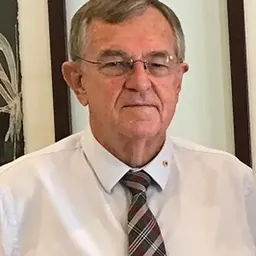
Lived 1924 – 2019 (aged 94). Howard Haugerud was an American aircraft pilot.
Career
Military Haugerud served for eight years on active duty during World War II and Korea as an aviation cadet, pilot and unit commander with tours of duty in the U.S., Europe and the Far East. At the height of the Cold War, he headed the air section of the Reconnaissance Squadron assigned 24/7 to patrol the borders of Soviet occupied East Germany and Czechoslovakia.
Government After leaving the military, Haugerud joined the staff of the late Senator Hubert H. Humphrey of Minnesota. After working with Senator Humphrey, Haugerud joined the committee staffs of Senator Henry M. (Scoop) Jackson of Washington state and Senator John L. McClellan of Arkansas, working on national security and governmental reorganization matters. Along with the late J.K. Mansfield and Dr. Dorothy Fosdick, he participated in a study recommending major changes in the National Security Council, which were adopted in 1961 by the newly elected John F. Kennedy.
During this period, Haugerud also authored articles for national publications. His 1953 Harper's piece, The Unfortunate Taft Memorial, resulted in legislation being enacted to prohibit the building of future monuments to any senator or congressman on the Capitol grounds until they had been deceased a minimum of 50 years. In the more than half a century since that legislation became law, no legislator has been so honored.
While both were serving on Senator McClellan's Government Operations Committee staffs, Haugerud and the late Robert Kennedy became friends. As a result, when Kennedy became head of his brother's presidential election campaign organization in 1960, he asked Haugerud to join the group. Knowing that he had a close personal friendship with Senator McClellan, the conservative senior senator and dominate political power in Arkansas, Kennedy asked Haugerud to set up headquarters in Little Rock and to aid the campaign in Texas, Kansas, Oklahoma and Missouri.
During that period, Haugerud had the task of insuring mandatory access to the Arkansas voting apparatus, which was tightly controlled by the segregationist governor, Orville Fabus, and, at the same time, convince the governor not to endorse the Kennedy-Johnson ticket. Such an endorsement, right up to poll closing time in an election where the margin proved to be razor thin, could have cost Kennedy many hundreds of thousands of votes in large urban areas and thrown the victory to Nixon.
Shortly after the inauguration, President Kennedy nominated Haugerud to the post of Assistant Secretary of the Army for Manpower and Reserve Affairs. Assured of easy senate conformation, the Minnesotan was preparing to assume the new job when officials discovered the post had been eliminated during the last days of the Eisenhower administration.
A new position, that of Deputy Undersecretary of the Army for International Affairs was then created giving Haugerud responsibility for all army overseas interests, including the Administration of the Panama Canal Zone, the Panama Canal Company, Okinawa and the Ryukyu Islands. His domestic assignments also gave him responsibility to oversee the activities of U. S. Civil Defense and the U.S. Army Corps of Engineers. At that time, a special presidential order formulated by President Eisenhower was in force designating the Secretary of the Army as having exclusive authority over policies and operations concerning the Canal Zone and the Ryukyu Islands.
In one of his first actions, Haugerud formed a committee to study the return of Okinawa and the surrounding Islands to Japan under conditions that would permit continued U.S. use of the military bases. He appointed Dr. Carl Kaysen, then deputy director of the National Security Council to head the group and asked that they proceed to Naha. Within six weeks, Dr. Kaysen's committee presented recommendations so comprehensive that they remained little changed during years of negotiations from 1961 until 1971 when the final treaty with Japan was signed.
Shortly after taking office, Haugerud traveled to the Panama Canal Zone to inspect the Zone government and the Panama Canal Company. He found the company, charged with the operation of the legendary canal was being run efficiently, but under work rules differing little from those established when the project was completed in 1914. Under the guise of “security,” no Panamanian man or woman was permitted employment in positions other than as domestic help, or to reside within the ten mile wide strip of land that split the country from ocean to ocean. In the meantime, only American citizens were eligible for employment and they were being paid a 25% salary bonus based on the premise that the Zone was a hardship post. While assignment to the Zone was indeed a hardship in the early days of the Canal, by 1961 conditions had improved so as to be unrecognizable to former workers. Resentment among the native population was high and building, helped along by some thoughtless Americans who boasted they had lived and worked in the zone for 20 years and had never ventured over the line into largely destitute Panama. After reporting his findings to the Secretary of the Army and the President, Haugerud instituted programs to begin reducing the bonus payments, amend the security regulations and training Panamanians to fill substantive positions in the Canal Company work force.
During his tenure with the Army, Haugerud worked closely with Attorney General Robert Kennedy in his fight against organized crime, and was able to place a number of persons in the witness protection program. One such occasion, at the request of Kennedy, he arranged for the legendary mobster Joe Valacchi to be secretly sequestered at a military prison in New Jersey for some 18 months to keep him from being assassinated by gang figures who feared being implicated by his testimony. This assignment, at times proved, very difficult as Haugerud was requested to refrain from sharing knowledge of the effort with any of his colleagues or superiors at the Dept. of Defense.
A few weeks prior to his death, President Kennedy asked Haugerud to accept the position of Inspector General of Foreign Assistance at the Department of State as he was planning to name the incumbent to an ambassadorial post. After the president was assassinated, President Johnson decided not to move the sitting Inspector General, but supported congressional legislation elevating the position of Deputy Inspector General to that of the Inspector General, making the two leaders equal in rank. The congress quickly passed the provision and Haugerud was one of the earliest nominations sent to the Senate by the new president. At the time of his appointment, he was the youngest person to have attained the rank of Assistant Secretary of State.
During this period, Haugerud's work was repeatedly praised on the floor of the House of Representatives and the United States Senate, with members of both bodies entering their remarks in the Congressional Record. In a 1966 New York Times op-ed article, legendary investigative reporter Felix Belair wrote that Mr. Haugerud “knows the ins and out of commercial skullduggery like the back of his hand.”
When President Nixon took office in 1969, he asked Haugerud to remain in his administration. He then became the Chairman of the Foreign Affairs Executive Seminar, the U.S. government's most senior training institution. The Chairman of the Foreign Affairs Executive Seminar was the U.S. government's most senior training institution, staffed and funded by the Department of State, the Department of Defense, the Central Intelligence Agency, the Department of Treasury, the Department of Agriculture, the Agency for International Development and the Department of Commerce. Its students were senior officers from those organizations who were preparing to assume overseas posts as well as those returning from such assignments on their way to domestic positions in their respective branches. Mr. Haugerud had a wide latitude to prescribe the curriculum, select the faculty members and to recruit outside lecturers from government, industry and academe.
Many of the students became ambassadors; Chiefs of Military Missions; Commerce, Agriculture and Treasury Attaches, AID Mission Directors; and CIA Station Chiefs, which enabled Haugerud and his staff to convince hundreds of high level speakers from all walks of life to teach at the institution. Haugerud once said that during the 6 years he headed the organization, he could not recall a single instance where an invitation to lecture was not accepted.
Later, he was appointed the chairman and CEO of Controlled Environment Systems, a high tech energy and lighting company located in Rockville, Maryland. He also became a managing director of the TASEA Investment and Real Estate Development Corporation of Washington, D.C.
In 1993, Haugerud purchased controlling interest in the National Tribune Corporation of Washington D.C., which had published military and veterans newspapers since shortly after the Civil War.
During his career, Haugerud also served as the Vice President of the Army Aviation Association and President of the McClellan Memorial Foundation.
Awards Certificate of Merit, National Police Officers Association Decoration for Exceptional Civilian Service, Department of the Army, 1963 Certification of Merit for Saving a Life, American National Red Cross
Personal life Haugerud was married to the former Tomajean Akers of Washington D.C. and Bal Harbour, Florida. They resided in Indian Wells, California. He died in Palm Springs, California in January 2019 at the age of 94, and his ashes were subsequently buried at Arlington National Cemetery on May 11, 2020. He had a penchant of bringing socks full of coins to his grandchildren.
Don’t just read it —
keep it.
Full-length biographies made to live with: read them, listen on the way to work, watch them tonight.
- E-book
- Audio
- Video
Instant download · yours to keep · every purchase keeps this site free
Important facts
People in Howard Haugerud's life
Named in this biography and alive at the same time




Related people
Same field, nearest in time


Contemporaries
People whose lives overlapped Howard Haugerud's



Frequently asked questions
Who was Howard Haugerud?
American government official
When was Howard Haugerud born?
Howard Haugerud was born on 22 August 1924 in Harmony.
When did Howard Haugerud die?
Howard Haugerud died on 26 January 2019 in Palm Springs.
What was Howard Haugerud's occupation?
Howard Haugerud was an aircraft pilot.
What nationality was Howard Haugerud?
Howard Haugerud was American.
Sources & further reading
Cite this page
APA: Biography.guide. (2026). Howard Haugerud. https://biography.guide/howard-haugerud/
MLA: "Howard Haugerud." Biography.guide, https://biography.guide/howard-haugerud/.
Chicago: "Howard Haugerud." Biography.guide. https://biography.guide/howard-haugerud/.
Data last updated: 2026-09-26 · Spot an error? Report a correction.
Page generated 2026-09-27 05:16 UTC