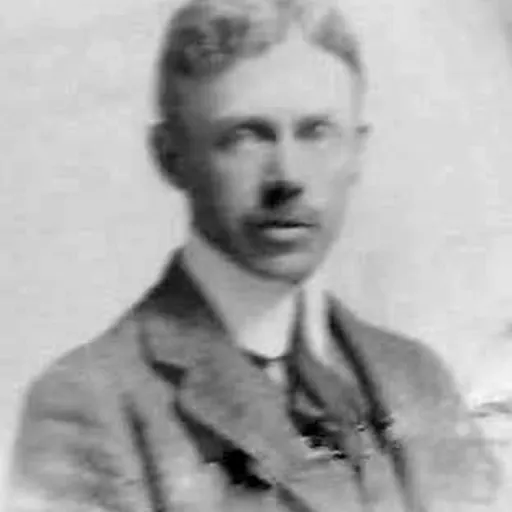
About Howard Burnham
Lived 1870 – 1917 (aged 46). Howard Burnham was an American explorer, engineer, mining engineer and spy.
Mather Howard Burnham (May 27, 1870 – May 4, 1917), was an American who went by the name of Howard; his brother was the celebrated scout Frederick Russell Burnham. He traveled the world, frequently worked as a mining engineer and, during World War I, he became an intelligence officer and spy for the government of France.
At 14, Burnham was in school in Massachusetts. Ill with an injured leg, his brother sent him the money to return to Los Angeles. His leg was removed four inches below the knee. He also suffered from tuberculosis, and following the amputation, he had a long convalescence. For those two years, he lived with his brother, who taught him how to shoot, saddle a horse and pack animals, the art of scoutcraft and how to ride the range, and all of this in spite of his wooden leg. A voracious reader with an amazing memory, he enjoyed books on military strategies and tactics and was fascinated by history, geology, metallurgy, and mining. He roamed the deserts from Death Valley to lower California, living among and learning from the Cahuilla Indians of Agua Caliente (now Palm Springs, California), and teaming up at times with solitary prospectors to learn desert prospecting, pocket hunting, and the mysteries of the "great horn spoon" (probably the California Gold Rush).
For the next few years, Burnham studied mining and worked on and off in the California desert as mining engineer at the Alvord mine, a gold mine owned and operated by the Burnham-Clapp family and their Pasadena business partners 1885–1891. He received his professional mining certification from the Pacific Chemical Works of San Francisco, an assay company owned and operated by Henry Garber Hanks, the first State Mineralogist for California.
South Africa and Rhodesia After the Alvord mine in California was destroyed in a fire, Burnham stayed in California until 1894 to wrap up his family's affairs with the mine and left for the South African Republic as soon as he could to join his brother Fred already in Bulawayo, Matabeleland. In 1895, he was preparing to accompany his brother in a massive expedition into Northern Rhodesia when he took ill and was forced to leave for Europe to recuperate. He left for Germany accompanied by his nephew Roderick, and the two of them then went to London, England. He returned to the United States and from 1896 to 1898 attended the Michigan Mining School (now Michigan Technological University), graduating with an S.B. By September 1898, he and his wife were back in Africa and he was working for an English syndicate and supervising over 2,000 miners at the Rosa deep gold mine near Johannesburg, South Africa. While in the Transvaal, Burnham was a chief chemist, an engineer, and an assistant inspector for mines, and he wrote a textbook: Modern Mine Valuation.
When the Second Boer War broke out in 1899, Burnham felt he would be protected because of his American citizenship. Initially, he remained at his post in the mines in the Boer Republic, but as a precaution, he sent his wife to Cape Town, South Africa, then a British colony. Only weeks earlier, his brother had been prospecting in Alaska during the Klondike Gold Rush when he received a telegram from Lord Roberts requesting his assistance in the war – Fred left for Africa within the hour. Fred Burnham had just been appointed Chief of Scouts for the British Army and was en route to South Africa via England, but he was still too distant to provide any immediate help. From 1905 until about 1908, Burnham was a non-resident fellow at the Royal Colonial Institute in London.
Mexico
While his wife and children stayed in England and France, Burnham returned to North America in 1907 and for the next few years became associated with the Yaqui River irrigation project in Mexico with his brother Fred. Negotiations were made for the purchase of four properties: the Batue, Mequite, La Fiera, and another property. He considered the La Fiera to be the best of the lot and a small force of men under the supervision of John Anderson was put to work there. His brother purchased water rights and some of land in this region and contacted an old friend of the Burnhams from Africa, John Hays Hammond, who conducted his own studies and then purchased an additional of this land—an area the size of Rhode Island. Just as the irrigation and mining projects were nearing completion in 1912, a long series of Mexican revolutions began. The final blow to Burnham-Hammond plans came in 1917 when Mexico passed laws prohibiting the sale of land to foreigners. The Burnham and the Hammond families carried their properties until 1930 and then sold them to the Mexican government.
World War I Espionage During World War I, Burnham worked in intelligence for France. In 1914, he was incarcerated near Tampico, Mexico as a suspected spy, and was released with the help of William Jennings Bryan, the U.S. Secretary of State. He immediately left Mexico for France and stopped in Barcelona, Spain on his way to Algiers, Algeria, then a French colony that the German Intelligence had infiltrated to support of the rebels.
He had four children: Frederick Newton Burnham (Aug 25, 1904–1959), b. Lydenburg, Republic of South Africa (now the Territory of South Africa). d. Hastings, England. Thomas Chambers Burnham (May 14, 1906 – 2004), b. England; d. Key Largo, Florida. Mary Burnham (May 29, 1909 – 1987), b. England; d. London, England Katherine "Kitty" Burnham (October 9, 1911 – 1999), b. San Francisco, California; d. [Tormarton, Bath], England
Don’t just read it —
keep it.
Full-length biographies made to live with: read them, listen on the way to work, watch them tonight.
- E-book
- Audio
- Video
Instant download · yours to keep · every purchase keeps this site free
Important facts
People in Howard Burnham's life
Named in this biography and alive at the same time




Related people
Same field, nearest in time




Contemporaries
People whose lives overlapped Howard Burnham's

Frequently asked questions
Who was Howard Burnham?
French spy (1870–1917)
When was Howard Burnham born?
Howard Burnham was born on 27 May 1870 in Blue Earth County.
When did Howard Burnham die?
Howard Burnham died on 14 May 1917 in Cannes.
What was Howard Burnham's occupation?
Howard Burnham was an explorer, engineer, mining engineer and spy.
What nationality was Howard Burnham?
Howard Burnham was American.
Sources & further reading
Cite this page
APA: Biography.guide. (2026). Howard Burnham. https://biography.guide/howard-burnham/
MLA: "Howard Burnham." Biography.guide, https://biography.guide/howard-burnham/.
Chicago: "Howard Burnham." Biography.guide. https://biography.guide/howard-burnham/.
Data last updated: 2026-09-20 · Spot an error? Report a correction.
Portrait: Wikimedia Commons · author & licence
Page generated 2026-09-27 04:57 UTC