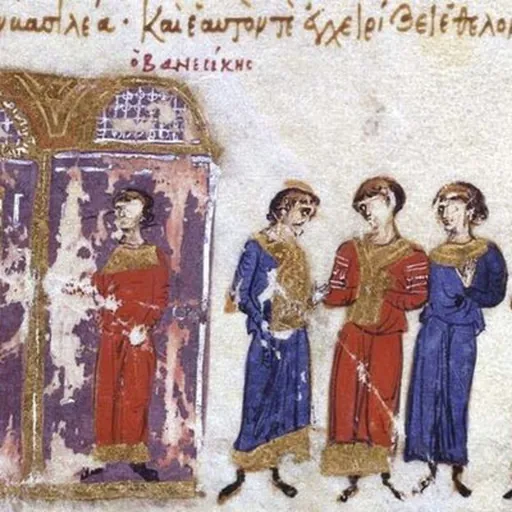
About Hovhannes-Smbat III of Armenia
Hovhannes-Smbat III of Armenia was a sovereign.
Hovhannes-Smbat built and dedicated the Saint John church and zhamatun of Horomos Monastery in 1038. Hovhannes-Smbat III was King of Ani (1020–1040). He succeeded his father Gagik I of Ani (989–1020) being the king's elder son and legal heir to the throne.
Situation after the death of Gagik I Gagik I died in 1020, at an old age. The power was inherited by Gagik's two sons, Smbat, who was called Hovhannes and Ashot IV. A fight broke out between the two brothers over the issue of inheriting the kingdom, in which King Gevorg of the Apkhazians intervened. Hovhannes-Smbat, as the firstborn son, inherited the capital of Ani with its surroundings, and Ashot inherited the inner regions of the kingdom, the area around Sevan, bordering Persia and Georgia.
Byzantine conquest policy towards Armenian territories In the 11th century, after its military successes against the Bulgarians, the Byzantine Empire focused its attention on the East, in particular on the Bagratudin Kingdom of Ani. From the end of the 10th century, the Bagratudin Kingdom of Ani was in decline. As early as 908, the Kingdom of Vaspurakan had separated, followed by Tashir Dzoraget, Syunik, and Vanand (Kars). For its part, the Byzantine Empire did everything to create discord in the country and destroy the country from within, so it soon began to divide and subjugate the territories of the Bagratudin Kingdom of Ani. The goal of the empire was to turn the Bagratudin Kingdom into an ordinary province of the empire. In 1001, after the death of David Kyurapalat, Tayk passed to Byzantium, and in 1021, Senekerim Artsruni handed over Vaspurakan and left for Byzantium. All these conquests were made by wills. The prince or governor bequeathed his domains to Byzantium, receiving another territory in some part of Byzantium in return. Such a will had to be signed by Hovhannes-Smbat.
The Reign of Hovhannes-Smbat and the Fall of Ani Gagik I was the last powerful king of the Armenian realm. After his death, separatist tendencies made themselves felt even within the Kingdom of Ani. The struggle for royal power between the sons of Gagik I escalated into an armed conflict in which neighboring states intervened. Ultimately, through the intervention of the Armenian sparapet (commander-in-chief) Vahram Pahlavuni and the Georgian king, the brothers reconciled. The elder son, Hovhannes-Smbat, supported by the court elite, inherited the throne, receiving the city of Ani, Shirak, and neighboring provinces. The younger brother, Ashot IV, was allotted the southern and eastern regions of the Kingdom of Ani. After Hovhannes-Smbat's death, Ashot was to inherit his domains. In effect, the Kingdom of Ani became fragmented, and its subordinate kingdoms became virtually independent. The Bagratid state ceased to exist.
Hovhannes-Smbat ruled from 1020 to 1041. In order to save the country from destruction, he sent a delegation led by Catholicos Petros I to Trebizond to negotiate with the emperor. The Armenian king instructed the Catholicos to draft a will bequeathing the country to the emperor after his death as an inheritance. In 1021, in Trebizond, the Byzantine Emperor Basil II dictated his will by force of arms to the sovereigns of Armenia and Georgia. Under these dire conditions, by order of Hovhannes-Smbat, the Armenian Catholicos Petros I Getadarts departed for Trebizond. There, the fatal "will-treaty" in Armenian history was signed, by which Hovhannes-Smbat bequeathed the Kingdom of Ani to the Byzantine Empire after his death. The motives for creating the will are presented in detail in Byzantine primary sources. In particular, historian John Skylitzes, referring to the Treaty of Trebizond, writes that Hovhannes-Smbat bequeathed the country to Byzantium under severe pressure from the emperor. . Regarding this will, Aristakes Lastivertsi writes: "...there was written the deed and letter of Armenia's ruin...". According to him, Hovhannes-Smbat had instructed the Catholicos: "Write a document and give a will to the emperor, so that after my death he may receive my cities and my land as an inheritance". Unwilling to accept this, Hovhannes-Smbat's younger brother Ashot rebelled and proclaimed himself king. Sparapet Vahram Pahlavuni and the Georgian King Bagrat intervened in the armed conflict. The elder son, Hovhannes-Smbat, who was supported by the court elite, inherited the throne, receiving Ayrarat. The younger brother Ashot, who became known as Ashot IV the Brave (1022–1040), received the southern and eastern regions of the kingdom, and was set to inherit the entire country after his brother's death. Ashot died in 1040, and Hovhannes-Smbat passed away one year later. Primary sources hint that their quick succession of deaths was advantageous to Byzantium and may have been orchestrated by it. After their deaths, Emperor Constantine IX Monomachos, citing the Will of Trebizond, dispatched troops to capture Ani, but faced heroic resistance from Ashot's son, Gagik II (whom the Byzantine historian Skylitzes mistakenly considered the son of Hovhannes-Smbat), and Armenian patriotic forces.
After Hovhannes-Smbat's death, Vest Sarkis attempted to consolidate power in his hands and rule the country as a Byzantine agent; however, his plans failed because supporters of central authority, led by sparapet Vahram Pahlavuni in 1042, elevated Ashot's 18-year-old son, Gagik, to the Armenian throne.
Don’t just read it —
keep it.
Full-length biographies made to live with: read them, listen on the way to work, watch them tonight.
- E-book
- Audio
- Video
Instant download · yours to keep · every purchase keeps this site free
Important facts
Family & relationships
Related people
Same field, nearest in time



Frequently asked questions
Who was Hovhannes-Smbat III of Armenia?
King of Ani
When did Hovhannes-Smbat III of Armenia die?
Hovhannes-Smbat III of Armenia died in 1041.
What was Hovhannes-Smbat III of Armenia's occupation?
Hovhannes-Smbat III of Armenia was a sovereign.
Sources & further reading
· Wikipedia: Hovhannes-Smbat III of Armenia
· DBpedia: Hovhannes-Smbat III of Armenia
Cite this page
APA: Biography.guide. (2026). Hovhannes-Smbat III of Armenia. https://biography.guide/hovhannes-smbat-iii-of-armenia/
MLA: "Hovhannes-Smbat III of Armenia." Biography.guide, https://biography.guide/hovhannes-smbat-iii-of-armenia/.
Chicago: "Hovhannes-Smbat III of Armenia." Biography.guide. https://biography.guide/hovhannes-smbat-iii-of-armenia/.
Data last updated: 2026-09-23 · Spot an error? Report a correction.
Portrait: Wikimedia Commons · author & licence
Page generated 2026-09-27 05:06 UTC