
About Horst Gläsker
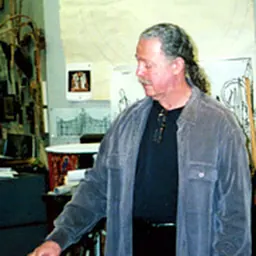
Born 1949. Horst Gläsker is a German sculptor, painter and university teacher.
Horst Gläsker (born 21 March 1949) is a German artist. His work is a symbiosis of music, dance, theatre, drawing, painting, sculpture, installation and architecture.
Development From 1963 to 1966 Horst Gläsker did an apprenticeship as a showcase designer and in the following years up to 1968 he worked as poster artist. From 1970 to 1973 he visited a course of lectures and did the university-entrance diploma. Parallel to this he was active as a musician. During the 60s he and his 4 brothers were in a dance combo and in the 70s he was involved with diverse Kraut-rock groups of the era. At the end of the 70s he began to build sound sculptures and to make music performances. From 1973 to 1979 he studied at the Kunstakademie Düsseldorf, with Lambert Maria Wintersberger, Gerhard Richter and Karl Otto Götz. 1975 he lived 1 year in a mountain shelter in the Toscana where he painted landscapes and portraits and grappled intensely with the effect of colours. After that he developed a painture out of his colour palettes, collected old Persian carpets from the rubbish and painted psychedelic colour patterns on its ornaments which had the consequence, that Gerhard Richter expelled him from his class. After that Gläsker worked alone in an abandoned room, belonging to the suspended professor Joseph Beuys, who had been dismissed without notice by Johannes Rau, the minister of science at that time, because he indiscriminately admitted all people who applied to the academy. Later Gläsker became master student of Karl Otto Götz (professor of Sigmar Polke, Franz Erhard Walther and others).
Work Art scientists have linked Horst Gläsker with the category “Individual Mythology” coined by Harald Szeemann or grouped him with the “Junge Wilde” ("wild youth"). The closest definition of his art is perhaps the idea of the “Gesamtkunstwerk”. Harald Falckenberg (see: Collection Falckenberg), the Hamburger art collector, businessman, lawyer and art theorist, described him as ”bird of paradise and holy fool” and saw him in a reference to the newer development of the “pictorial turn” and the ancient tradition of the grotesque. Besides the relation of his art to music, there is the connection with architecture. This began in the 80s with space filling painting on wallpapers, self built and repainted architectural pieces, and space frame works like columns, candelabra, cupolas, and pavilions etc. Following on from that there were numerous “art in architecture” applications and projects, for example murals, mosaics, fountains and floor designs. The art theorist and curator Manfred Schneckenburger named Gläsker, in relation to his carpet and wallpaper paintings, the European founder of the Pattern Art and wrote that he developed his own particular new, idea of the ornament, “as if the hard verdict of Adolf Loos “ornament is a crime” had never existed".
Life Gläsker was born in Herford, Germany. He lives and works in Düsseldorf, Germany. He has an artist family. He works organizationally and artistically together with his wife Margret Masuch-Gläsker. Their two common children are Louis Gläsker (artist, musician, writer, and filmmaker) and Cecilia Gläsker (filmmaker, camerawoman and photographer).
Teachings 1983-1984: visiting professorship at the Kunstakademie Münster, Germany 1988–1991: visiting professorship at the Kunstakademie Münster, Germany 1995–1997: visiting professorship at the Hochschule für Bildende Künste Braunschweig, Germany 1998–2004: professorship at the Kunsthochschule Kassel, Germany 2006: Guest lecturer at the Savannah College of Art and Design, Georgia, US
Individual exhibitions (selection) 1980: Galerie Löhrl, Mönchengladbach 1981: Kunst- und Museumsverein Wuppertal / Von der Heydt-Museum 1981: Neue Galerie-Sammlung Ludwig, Aachen 1990: Gustav-Lübcke-Museum, Hamm 1998: Kunstmuseum Düsseldorf 2003: Galerie Hans Mayer, Düsseldorf 2005: St. Petri Lübeck
Joint exhibitions (selection) 1980: Les nouveaux Fauves-Die neuen Wilden, Neue Galerie-Sammlung Ludwig, Aachen 1980: XI. Biennale de la Jeunesse, Musée d'Art moderne, Paris 1981: Bildwechsel (Change of Picture), Akademie der Künste, Berlin 1983: Montevideo Diagonale, Antwerpen 1985: Märchen, Mythen, Monster (Fairy tales, Myths, Monsters), Neue Galerie Graz und Rheinisches Landesmuseum, Bonn 1986: Bonnefantenmuseum, Maastricht 1994: Paper Art, International Biennial of Paper Art, Leopold-Hoesch-Museum, Düren 1998: Glut (Ardour), Kunsthalle Düsseldorf 2004: ARTKlyazma, International festival of contemporary art, Moskau 2007: Tatort Paderborn, Irdische Macht – Himmlische Mächte (Crime Scene Paderborn, Earthly Power - Heavenly Powers)
Public commissions - Art in Architecture (selection) 1988: Wall and fountain mosaic, Landeszentralbank, Frankfurt / M. 1988: Mural, AID-Gebäude, Bonn 1990: Tower of the Four Elements and murals, im Posttechnischen Zentralamt, Darmstadt 1998: Two church rooms, JVA Gelsenkirchen 1999: Mural and column painting, Paracelsus-Klinik Marl 2008: Scala, Holsteiner Treppe, Wuppertal 2008: Cross and World Mirror, Sankt Martin Kirche, Langenfeld
Performances and concerts with Sound Sculptures (selection)
Pedal-Organ-Carpet-Concerts
1980: XI Biennale de Paris, Musée d'Art modern de la Ville de Paris 1980: Von der Heydt-Museum, Wuppertal 1981: Neuen Galerie-Sammlung Ludwig, Aachen
Table Concerts
1987: Kunstmuseum Chur, Schweiz 2004: Louisiana-Museum, Humlebaek, Dänemark 2004: ARTKliazma, International festival of contemporary art, Moskau 2005: Langen-Foundation, Raketenstation - Insel Hombroich, Neuss
Living Pictures
1991: Der Tanz des Schüttelgeistes und die Verführung des Ton (The Dance of the Shivering Spirit and the Enticement of Tone), Düsseldorfer Schauspielhaus 1992: Gesang der vier Elemente (Song of the Four Elements), Kunsthalle Recklinghausen, Ruhrfestspiele 1993: Der Gesang der vier Elemente und die Verführung des Lichts (The Song of the Four Elements and the Enticement of Light), MEDIALE, Deichtorhalle, Kammerspiel, Hamburg and Städtisches Gustav-Lübcke-Museum, Hamm and ARENA DI SKALA, Lindinger und Schmid, Regensburg
Don’t just read it —
keep it.
Full-length biographies made to live with: read them, listen on the way to work, watch them tonight.
- E-book
- Audio
- Video
Instant download · yours to keep · every purchase keeps this site free
Important facts
People in Horst Gläsker's life
Named in this biography and alive at the same time



Related people
Same field, nearest in time




Contemporaries
People whose lives overlapped Horst Gläsker's


Frequently asked questions
Who is Horst Gläsker?
German artist (born 1949)
When was Horst Gläsker born?
Horst Gläsker was born on 21 March 1949 in Herford.
What is Horst Gläsker's occupation?
Horst Gläsker is a sculptor, painter and university teacher.
What nationality is Horst Gläsker?
Horst Gläsker is German.
Sources & further reading
Cite this page
APA: Biography.guide. (2026). Horst Gläsker. https://biography.guide/horst-glasker/
MLA: "Horst Gläsker." Biography.guide, https://biography.guide/horst-glasker/.
Chicago: "Horst Gläsker." Biography.guide. https://biography.guide/horst-glasker/.
Data last updated: 2026-09-20 · Spot an error? Report a correction.
Page generated 2026-09-27 05:11 UTC