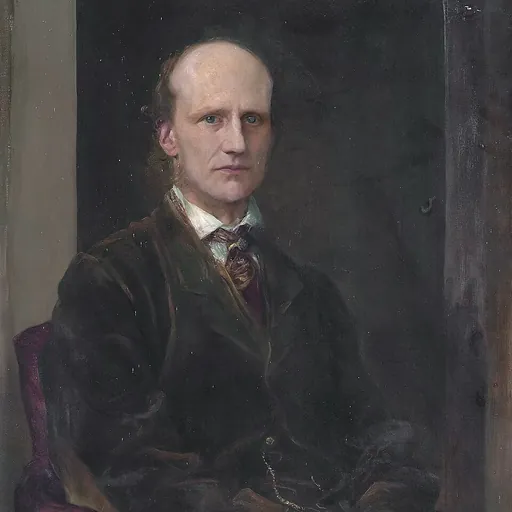
Horace Davey, Baron Davey
English barrister, judge and Liberal politician
About Horace Davey, Baron Davey
Lived 1833 – 1907 (aged 73). Horace Davey, Baron Davey was a British judge, politician, barrister and jurist.
Horace Davey, Baron Davey, PC, FRS, FBA (30 August 183320 February 1907) was an English lawyer, Liberal politician, and judge.
Graduating with a double first class degree in classics and mathematics from Oxford, he read law and was called to the bar. He specialised in chancery cases and acquired a strong reputation. Appointed Queen’s Counsel, he entered politics and was elected to the House of Commons in 1880, but was defeated in the 1885 general election. He was re-elected in a by-election in 1886, but defeated in the 1892 general election. He served as Solicitor General for England and Wales in Gladstone's short third ministry in 1886.
Davey was appointed to the English Court of Appeal in 1893, and then appointed to the House of Lords with a life peerage in 1894. He died in 1907, survived by his wife, four daughters and two sons.
Early life and family
Davey was born on 30 August 1833, in Camberwell, Surrey. His parents were Peter Davey, of Horton, Buckinghamshire and Caroline Emma Pace.
Davey was admitted to Lincoln's Inn on 19 January 1857. On 26 January 1861, he was called to the Bar at Lincoln's Inn. The following summer, he married Louisa Hawes Donkin at St George's, Camberwell, on 5 August 1862. She was the daughter of John Donkin of Ormond House, Old Kent Road, a civil engineer. Lord MacNaughten believed that there was no one better at "arguing a point of practice."
Devoting himself to the Chancery side, Davey soon acquired a large practice, and in 1875 was appointed Queen's counsel.
Davey was standing counse] to the University of Oxford, and senior counsel to the Charity Commissioners, and was engaged in all the important Chancery suits of his time. Among the chief leading cases in which he took a prominent part were those of The Mogul Steamship Company v. M'Gregor, Gow & Co., 1892, Boswell v. Coaks, 1884, Erlanger v. New Sombrero Company, 1878, and the Ooregum Gold Mines Company v. Roper, 1892; he was counsel for the promoters in the trial of Edward King, Bishop of Lincoln, and leading counsel in the Berkeley peerage case. In 1893, he was raised to the bench as a Lord Justice of Appeal, and on 18 August the next year was made a Lord of Appeal in Ordinary and a life peer Lord Davey's great legal knowledge was displayed in his judgments no less than at the bar. In legislation, he was a keen promoter of the act passed in 1906 for the checking of gambling. After the fall of the Conservative government in January 1886, Gladstone returned to power in February 1886 and appointed Davey as Solicitor General for England and Wales in his short-lived third ministry.
Judicial career
Baron and Baroness Davey in baronial robes for the coronation of Edward VII, June 1902.
Having left parliament for the last time Davey was appointed as a bencher in Lincoln's Inn, on being promoted to the Court of Appeal on 23 September 1893. By 23 November he was sworn to the Privy Council. Monson v. Tussauds Ltd (1894) was a case that determined the future of a museum. On 13 August, Davey was made a Lord of Appeal in Ordinary.
In the famous Wee Frees Case, General Assembly of Free Church of Scotland (1906) the Great War intervened to withhold a judgement. The occasion of a united church of Presbyterians caused the sale of property, the church lost £2 m of real property. Haldane, acting for the church successfully argued the case in point, but lost the decision, although he won the deeds of property. Nonetheless Parliament legislated at the transfer was ordered.
The case of Salomon v. Salomon (1896) was a precedent for many years on the nature of company law and incorporation. The case of Allen v. Flood (1898) symbolized the number of political arguments between Liberals, like Davey and the Conservative Lord Halsbury, over the propriety of Trade Union rights.
Walter v. Lane (1900) was a case about the law of copyright for reporters. Burland v. Earle (1901) was the fraud in the exception to the contract rules since 1843 in Foss v. Harbottle (1901). Noakes Co v. Rice (1901) and Bradley v. Carritt (1903) were cases about the collateral benefits in mortgage laws. In Ruben v. G. Fingall Cons (1906) it was established the effects of a forged certificate on a company.
In 1905, Davey approached the Liberal leader Sir Henry Campbell-Bannerman to become Lord Chancellor in the new government, but was turned down in favour of Lord Loreburn. Davey and Lord Lindley were perhaps the greatest intellects of their generation. Lord MacNaughten, himself a powerful thinker, called Davey "the most lawyer of his day."
Court appointments
Davey was counsel to Oxford University, 1877–93. He was made an honorary fellow of University College, Oxford in 1884, and an honorary DCL by the University of Oxford in 1894. On 24 Jan 1895, Davey was made a Fellow of the Royal Society (FRS). As Treasurer of Lincoln's Inn he headed the Inn of Court, in 1897. Partly due to the influence of his friend, Richard Haldane, Lord Davey was appointed Chairman of the Royal Commission to reconstitute the Statutes of the University of London (1897–98). He was also a Fellow of the British Academy from 1905.
Death
Lord Davey died in London on 20 February 1907, aged 74. He was survived by his wife, four daughters and two sons.
Don’t just read it —
keep it.
Full-length biographies made to live with: read them, listen on the way to work, watch them tonight.
- E-book
- Audio
- Video
Instant download · yours to keep · every purchase keeps this site free
Important facts
People in Horace Davey, Baron Davey's life
Named in this biography and alive at the same time


Related people
Same field, nearest in time

Contemporaries
People whose lives overlapped Horace Davey, Baron Davey's



Frequently asked questions
Who was Horace Davey, Baron Davey?
English barrister, judge and Liberal politician (1833-1907)
When was Horace Davey, Baron Davey born?
Horace Davey, Baron Davey was born on 30 August 1833.
When did Horace Davey, Baron Davey die?
Horace Davey, Baron Davey died on 20 February 1907.
What was Horace Davey, Baron Davey's occupation?
Horace Davey, Baron Davey was a judge, politician, barrister and jurist.
What nationality was Horace Davey, Baron Davey?
Horace Davey, Baron Davey was British.
Sources & further reading
· Wikipedia: Horace Davey, Baron Davey
· DBpedia: Horace Davey, Baron Davey
Cite this page
APA: Biography.guide. (2026). Horace Davey, Baron Davey. https://biography.guide/horace-davey-baron-davey/
MLA: "Horace Davey, Baron Davey." Biography.guide, https://biography.guide/horace-davey-baron-davey/.
Chicago: "Horace Davey, Baron Davey." Biography.guide. https://biography.guide/horace-davey-baron-davey/.
Data last updated: 2026-09-21 · Spot an error? Report a correction.
Portrait: Wikimedia Commons · author & licence
Page generated 2026-09-27 04:59 UTC