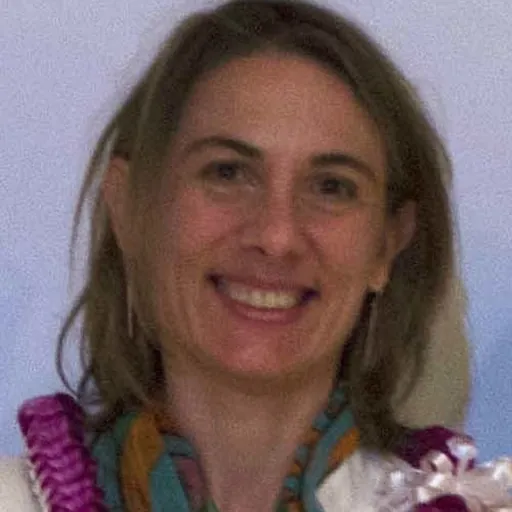
About Hope Jahren
Born 1969. Hope Jahren is an American geochemist, geobiologist, biologist, geologist and docent.
Anne Hope Jahren (born September 27, 1969) is an American geochemist and geobiologist at the University of Louisiana at Lafayette, known for her work using stable isotope analysis to analyze fossil forests dating to the Eocene. She has won many awards in the field, including the James B. Macelwane Medal of the American Geophysical Union.
Her book Lab Girl (2016) has been praised as both "a personal memoir and a paean to the natural world", a literary fusion of memoir and science writing, and "a compellingly earthy narrative".
Early life and education Jahren was born in Austin, Minnesota, on September 27, 1969. Her father taught science at a community college and she has three older brothers.
Career and research Jahren earned her Ph.D. in 1996 at the University of California, Berkeley in the field of soil science. Her dissertation covered the formation of biominerals in plants and used novel stable isotope methods to examine the processes. Her research at Johns Hopkins also included the first extraction and analysis of DNA found in paleosol and the first discovery of stable isotopes existing in a multicellular organism's DNA. Her research there focused on using stable isotope analysis to determine characteristics of the environment on different timescales. On September 1, 2016, Jahren became the J. Tuzo Wilson Professor at the University of Oslo's Centre for Earth Evolution and Dynamics, where she studies how living and fossil organisms are chemically linked to the environment. She is now an Adjunct Professor at the University of Louisiana at Lafayette.
Writing career
In addition to her research contributions, Jahren is also a writer. Her memoir "Lab Girl", published in 2016 gives perspectives on science and gender dynamics. Jahren discusses her experiences as a woman in the scientific field and reflects on the life lessons she learned during her childhood. The book encompasses topics such as gender dynamics in STEM fields, the challenges encountered by women scientists, and her personal and professional journey to success as a scientist and author. "Lab Girl" chronicles her life and career in science.
In 2020, Jahren published "The Story of More: How We Got to Climate Change and Where to Go from Here." The book grew out of her experience teaching courses on climate change.
Honors and awards Jahren has received three Fulbright Awards: in 1992 for geology work in Norway, in 2003 for environmental science work in Denmark, and in 2010 for arctic science work in Norway. Jahren was profiled by Popular Science magazine in 2006 as one of its "Brilliant 10" scientists. She was a 2013 Leopold Fellow at Stanford University's Stanford Woods Institute for the Environment. In 2016, Time Magazine named her one of the world's "100 Most Influential People." Jahren was awarded Australian Society for Medical Research Medal for 2018. She was also elected to the Norwegian Academy of Science and Letters in 2018. In 2020, Jahren received the James Shea Award by the National Association of Geoscience Teachers.
Support for science awareness
Jahren is an advocate for raising public awareness of science and has been working to lift the stereotype surrounding women and girls in science. One such example included the repurposing of the Twitter hashtag #ManicureMondays. Seventeen magazine originally came up with the hashtag, but focused mainly on manicured and painted fingernails. Subsequently, Jahren encouraged fellow scientists, specifically girls, to tweet pictures of their hands conducting scientific experiments.
Jahren has also written compellingly about the sexual harassment of women in science. She recommends that people draw strong professional boundaries, and that they carefully document what occurs, beginning with the first occasion of harassment.
Don’t just read it —
keep it.
Full-length biographies made to live with: read them, listen on the way to work, watch them tonight.
- E-book
- Audio
- Video
Instant download · yours to keep · every purchase keeps this site free
Important facts
more
Jahren, Anne Hope Florine JahrenPeople in Hope Jahren's life
Named in this biography and alive at the same time


Related people
Same field, nearest in time



Contemporaries
People whose lives overlapped Hope Jahren's





Frequently asked questions
Who is Hope Jahren?
American geologist
When was Hope Jahren born?
Hope Jahren was born on 27 September 1969 in Austin.
What is Hope Jahren's occupation?
Hope Jahren is a geochemist, geobiologist, biologist, geologist and docent.
What nationality is Hope Jahren?
Hope Jahren is American.
Sources & further reading
Cite this page
APA: Biography.guide. (2026). Hope Jahren. https://biography.guide/hope-jahren/
MLA: "Hope Jahren." Biography.guide, https://biography.guide/hope-jahren/.
Chicago: "Hope Jahren." Biography.guide. https://biography.guide/hope-jahren/.
Data last updated: 2026-09-21 · Spot an error? Report a correction.
Portrait: Wikimedia Commons · author & licence
Page generated 2026-09-27 04:59 UTC