
About Honorius II
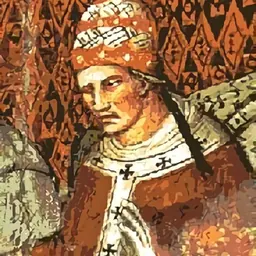
Lived 1100 – 1130. Honorius II was a catholic priest and writer.
Early life Lamberto was of simple rural origins, hailing from Fiagnano in the Casalfiumanese commune, near Imola in present-day Italy. who presumably appointed him cardinal priest of an unknown church, in , though S. Prassede has been discussed. His successor, Pope Paschal II, made Lamberto a Canon of the Lateran before elevating him to the position of cardinal bishop of Ostia in 1117. The struggle came to a conclusion with the Concordat of Worms in 1122 and the "Pactum Calixtinum", almost entirely due to Lamberto's efforts, The pontificates of Urban II and Paschal II saw an expansion in the College of Cardinals of Italian clerics that strengthened the local Roman influence. These cardinals were reluctant to meet with the batch of cardinals recently promoted by Callixtus II, who were mainly French or Burgundian. With Callixtus II's death on 13 December 1124, both families agreed that the election of the next pope should be in three days time, in accordance with the church canons. The Frangipani, led by Leo Frangipani, pushed for the delay in order that they could promote their preferred candidate, Lamberto,
On 16 December, all the cardinals, including Lamberto, assembled in the chapel of the monastery of St. Pancratius attached to the south of the Lateran basilica. He had only just put on the red mantle and the Te Deum was being sung when an armed party of Frangipani supporters (in a move pre-arranged with Cardinal Aymeric)
Rome descended into factional infighting, while Cardinal Aymeric and Leo Frangipani attempted to win over the resistance of Urban, the City Prefect, and the Pierleoni family with bribes and extravagant promises. In 1116, Henry had crossed the Alps to lay claim to the Italian territories of Matilda of Tuscany, which she had supposedly left to the papacy on her death. Henry had immediately begun appointing imperial vicars throughout the newly acquired province over the objections of both the Tuscan cities and the papacy.
The death of Emperor Henry V on 23 May 1125 put an end to these squabbles, but soon Honorius was involved in a new power struggle in the Holy Roman Empire. Henry died childless and had nominated his nephew Frederick Hohenstaufen, Duke of Swabia, to succeed him as King of the Romans and Holy Roman Emperor. Of the German princes, the ecclesiastical faction was against any expansion of Hohenstaufen power, At Lothair's request, Honorius also sent Cardinal John of Crema to Pisa to hold another synod that excommunicated Archbishop Anselm of Milan, who had crowned Conrad king.
One of the key ecclesiastical advisors of Lothair III was Saint Norbert of Xanten, to seek the formal sanction from Honorius to establish a new monastic order, the Premonstratensian Order (also known as the Norbertines), In 1125, papal force brought to heel the lords of Ceccano. Papal armies took possession of various towns, including Maenza, Roccasecca and Trevi nel Lazio. Honorius, however, was most concerned about the former papal stronghold at Fumone, which the nobles, who held it in the pope's name, had decided to keep possession of. The town fell in July 1125, after a siege of ten weeks. With that, Honorius turned his attention to the powerful and independent-minded abbot of Monte Cassino, Oderisio di Sangro.
Honorius had a long-standing dislike of Oderisio going back to the time when Honorius was cardinal-bishop of Ostia. Honorius had asked for permission from the abbot to allow him and his entourage permission to stay in the church of Santa Maria in Pallara, which was a traditional privilege belonging to the bishops of Ostia.
Using reports that the abbot had been lining his own pockets rather than spending it on his monastery, Honorius publicly denounced Oderisio, calling him a soldier and a thief, not a monk. The monks elected Niccolo, the dean of the monastery. In the meantime, open warfare was being waged between the supporters of Oderisio and Niccolo. Eventually, however, Honorius was able to secure not only the resignation of Oderisio, but he also excommunicated Niccolo for good measure. Honorius also insisted that the monks take an oath of fidelity to the papacy, but they strenuously objected. Honorius had just suffered a defeat at the hands of a local baron at Arpino in 1127 when Honorius received word that Roger had landed in Italy. Roger left his armies threatening Benevento, while he returned to Sicily for reinforcements. Honorius in the meantime entered into an alliance with the new Prince of Capua, Robert II. On 30 December 1127, Honorius preached a crusade against Roger II after having anointed Robert as Prince of Capua. Trying to salvage something of the situation, Honorius sent his trusted advisor Cardinal Aymeric together with Cencio II Frangipane to negotiate with Roger secretly. Furious, he declared he would wreak a terrible vengeance on the city, whereupon the residents asked Honorius for forgiveness and to send another governor. In 1125, accompanied by an armed following, Pons took possession of Cluny Abbey, melted down the treasures stored in the monastery, and paid his followers, who continued to terrorise the monks and the villages dependent upon the abbey. Pons eventually obeyed the summons, and was deposed by Honorius in 1126 Honorius personally reinvested Peter the Venerable as Abbot of Cluny. Louis confiscated Stephen's wealth and began harassing him so that he would cease his reforming activities. Charging Henri with simony, Louis attempted to remove another threat from within the French church.
Royal pressure was also brought to bear on Hildebert of Lavardin, whom Honorius had transferred from the see of Le Mans to become the Archbishop of Tours in 1125. In 1126, Louis insisted on filling episcopal vacancies in the See of Tours with his own candidates over Hildebert's objections. Hildebert also complained to Honorius about the constant appeals to Rome whenever he made a ruling.
In response to the king's actions, the French bishops laid an interdict on the diocese of Paris, causing Louis to write to Honorius, who suspended the interdict in 1129. Although this incurred the wrath of Bernard of Clairvaux, who wrote to Honorius expressing his disgust, That same year, Honorius helped Conan III, Duke of Brittany, bring one of his rebellious vassals to heel. He also intervened on behalf of the monks of the Lérins Islands who were constantly harassed by Arab pirates, encouraging a crusade to help defend the monks.
Honorius was also called to intervene in the affairs of Normandy, as Fulk of Anjou and King Henry I of England battled for domination. Henry objected to the marriage of Fulk's daughter Sibylla of Anjou to William Clito, the son of the duke of Normandy, on the grounds that they were too closely related by blood, being sixth cousins. They refused to divorce, and Honorius was forced to excommunicate Fulk and his son-in-law and to impose an interdict upon their territories.
Relations with England and Spain In England, the ongoing dispute between the Sees of Canterbury and York over primacy continued unabated. On 5 April 1125, Honorius wrote to Thurstan, Archbishop of York, advising him that Honorius planned to settle the issue personally. He sent a legate, Cardinal John of Crema, to deal with the question of primacy, as well as other jurisdictional issues between Canterbury and Wales, and between York, Scotland and Norway. Upholding the claims of York, Honorius was unsuccessful in forcing the Scottish bishops to obey Archbishop Thurstan.
Next, John convened the Synod of Westminster in September 1125, which was attended by both the archbishops of Canterbury and York, together with twenty bishops and forty abbots. Although the synod issued rulings on the forbidding of simony and of holding multiple sees at the same time, it did not touch on the vexed question of primacy between Canterbury and York. Instead, John summoned the two prelates to travel with him to Rome to discuss the matter in person before Honorius. They arrived in late 1125 and were greeted warmly by Honorius, and they remained in Rome until early 1126. While there, Honorius ruled that the Bishop of St Andrews was to be subject to the Archbishop of York To emphasise this, Honorius decreed that the Archbishop of Canterbury could not ask for any oath of obedience from the Archbishop of York, and in the matter of honorary distinction, it was the Archbishop of Canterbury in his role as Legate that was the most elevated ecclesiastic in the kingdom.
In Spain, Honorius was deeply suspicious of the ambitions of Diego Gelmírez, the Archbishop of Compostela. Although Pope Callixtus II had made him Papal Legate of a number of Spanish provinces, Honorius informed Diego that he had been made aware of Diego's ambitions and subtly advised him to keep his ambition in check.
Nevertheless, Honorius was not prepared to completely alienate Diego, and when the Archbishop of Braga nominated a successor to the vacant See of Coimbra, Honorius reprimanded the archbishop for usurping the rights of Diego, who should have been the one to nominate a successor.
Honorius also wished to promote the ongoing struggle against the Moors in Spain, and to that end he bestowed the city of Tarragona, which had been recently captured from the Moors, to Robert d'Aguiló. Robert travelled to Rome to receive the gift from Honorius in 1128. To rectify this situation, some members of the order appeared before the Council of Troyes in 1129, where the Council expressed its approval of the order and commissioned Bernard of Clairvaux to draw up the order's rules, which now included vows of poverty, chastity and obedience. The order and the rules were subsequently approved by Honorius.
Honorius, as suzerain of the Kingdom of Jerusalem, re-confirmed the election of King Baldwin II of Jerusalem and established him as the royal patron of the Templars. Honorius tried to manage as best he could the rivalries of the different princes and high-ranking ecclesiastics that were destabilising the Latin Kingdom of Jerusalem. Bernard refused to give up his claims to the sees, and William travelled to Rome and presented his case before Honorius. The pope sent a legate back to Palestine with instructions that Bernard was to acquiesce and that the various bishops were to submit to William of Malines within forty days. Bernard managed to resist implementing Honorius's instructions, and soon Honorius was too ill to do anything about it. Honorius fell seriously ill in early 1130. on a rumor that Honorius had died, stormed the monastery of the dying Honorius, hoping to force the election of Pietro. Only the sight of the still living Honorius in full pontifical robes forced them to disperse. Honorius eventually transferred from the monastery to the Lateran for reburial once Innocent II had been elected. Aymeric expanded his powerbase further, with Honorius elevating mostly non-Roman candidates to the college of cardinals,
Gregorovius, Ferdinand (1896) History of Rome in the Middle Ages, Volume IV. 2 second edition, revised (London: George Bell). Hüls, Rudolf (1977) Kardinäle, Klerus und Kirchen Roms: 1049–1130 (Tübingen) [Bibliothek des Deutschen Historischen Instituts in Rom, Band 48]. Levillain, Philippe (2002) The Papacy: An Encyclopedia, Vol II: Gaius-Proxies, Routledge
Pandulphus Pisanus (1723) "Vita Calisti Papae II," "Vita Honorii II," Ludovico Antonio Muratori (editor), Rerum Italicarum Scriptores III. 1 (Milan), pp. 418–419; 421–422. Stroll, Mary (1987) The Jewish Pope (New York: Brill 1987). Stroll, Mary (2005) Calixtus II (New York: Brill 2005). Thomas, P. C. (2007) A Compact History of the Popes, St Pauls BYB
Don’t just read it —
keep it.
Full-length biographies made to live with: read them, listen on the way to work, watch them tonight.
- E-book
- Audio
- Video
Instant download · yours to keep · every purchase keeps this site free
Important facts
People in Honorius II's life
Named in this biography and alive at the same time




Related people
Same field, nearest in time


Contemporaries
People whose lives overlapped Honorius II's


Frequently asked questions
Who was Honorius II?
Pope from 1124 to 1130
When was Honorius II born?
Honorius II was born in 1100 in San Martino in Pedriolo.
When did Honorius II die?
Honorius II died on 20 February 1130 in Rome.
What was Honorius II's occupation?
Honorius II was a catholic priest and writer.
Sources & further reading
Cite this page
APA: Biography.guide. (2026). Honorius II. https://biography.guide/honorius-ii/
MLA: "Honorius II." Biography.guide, https://biography.guide/honorius-ii/.
Chicago: "Honorius II." Biography.guide. https://biography.guide/honorius-ii/.
Data last updated: 2026-09-20 · Spot an error? Report a correction.
Page generated 2026-09-27 05:29 UTC