
About Homer C. Blake
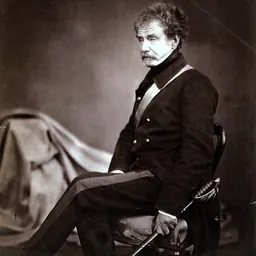
Lived 1822 – 1880 (aged 57). Homer C. Blake was an American military officer.
Commodore Homer Crane Blake (1 February 1822 – 21 January 1880) was a flag officer of the United States Navy, notable for his gallant but ultimately doomed battle with the in his ship in the action off Galveston Light during the American Civil War. He later served with distinction on the James River, and in 1871, while serving in the Asiatic Squadron, took part in the Korea Expedition.
Biography Early career Blake was born in Dutchess County, New York, the son of Elisha Blake (1788–1837) and Merilla Crane (1791–1877). When Blake was a year old, his family moved to what was then considered the far West, and settled in Boardman, Ohio.
After preparing himself for the naval service, and passing the regular examination,
Hatteras v. Alabama The sinking of Hatteras by CSS Alabama, off Galveston, Texas, 11 January 1863. Hatteras, as part of the West Gulf Blockading Squadron, patrolled the coast as part of the fleet under the command of Commodore Henry H. Bell. On the afternoon of 11 January 1863, she was ordered to sail to the south-east. After one and a half hours a ship was seen. Blake approached and soon identified her as the Confederate raider CSS Alabama, then under the command Raphael Semmes. Blake knew that the rest of the fleet were too far off to render any assistance and that his own ship was outgunned Despite this Blake ordered his vessel to clear for action, hoping to capture the Alabama by boarding, or to disable her for long enough for the rest of the fleet to arrive.
On the James River Blake was given command of the gunboat stationed in the James River, engaged in transporting troops and in occasional engagements with the enemy. The most important of these was on 24 January 1865, when a powerful Confederate squadron launched an attack on the Union blockade of the river at Trent's Reach. Sailing downriver the Confederate force drove away the Union pickets, and commenced removing the boom and obstructions. William A. Parker, the Union naval commander, instead protecting the defences, retired and allowed them to be removed, leaving a clear passage for the enemy. However, two rams went aground, and the Confederates had to wait until high water the following night before proceeding. On the morning of the 25th, Parker was relieved of his command and Blake was made temporary commander of the naval division. Blake ordered the monitor to put herself into a position within the range of enemy batteries, such that, if sunk, she would take the place of the removed obstructions. Subsequent attacks by Union ships and shore batteries sank two and badly damaged six of the Confederate ships, who eventually withdrew. In a letter Admiral David Dixon Porter wrote to Blake, "Had your predecessor done as well, we should now be in possession of the entire rebel navy, and on our way to Richmond."
Blake was promoted to captain on 25 May 1871, and soon after joined four other ships of the Asiatic Squadron in an expedition to Korea. In early June, while sailing up the Han River the American ships were fired upon from forts on shore, and Rodgers decided upon a punitive action to capture and destroy them in reprisal. In the subsequent battle of Ganghwa Blake took command of the ground attack forces, successfully capturing three forts. The next day the landing force re-embarked to await the Korean government's response. By 3 July, it became apparent that the Koreans would make no official response to the action and that the desired treaty was not in the offing. Accordingly, Alaska and her consorts got underway to resume their duties on the Asiatic station, finally sailing from Hong Kong on 28 October 1872 bound for New York.
On returning home in early 1873, Blake commanded the Naval Rendezvous in New York until 1876. In late 1879, on the retirement of Commodore James Mullany, Blake was nominated for promotion to commodore, and was successfully examined at Washington, D.C. However he became ill, and soon after receiving his commission on 12 January 1880, he died, reportedly of malaria, on the afternoon of 21 January 1880 at his home at 10 East 33rd Street, New York. His funeral was held at the Church of the Atonement on Madison Avenue and 28th Street on 24 January. He left a widow and a daughter, his only son, a law student, having died two years earlier.
Don’t just read it —
keep it.
Full-length biographies made to live with: read them, listen on the way to work, watch them tonight.
- E-book
- Audio
- Video
Instant download · yours to keep · every purchase keeps this site free
Important facts
People in Homer C. Blake's life
Named in this biography and alive at the same time

Related people
Same field, nearest in time


Contemporaries
People whose lives overlapped Homer C. Blake's





Frequently asked questions
Who was Homer C. Blake?
U.S. Navy commodore (1822-1880)
When was Homer C. Blake born?
Homer C. Blake was born on 1 February 1822 in Dutchess County.
When did Homer C. Blake die?
Homer C. Blake died on 21 January 1880 in New York City.
What was Homer C. Blake's occupation?
Homer C. Blake was a military officer.
What nationality was Homer C. Blake?
Homer C. Blake was American.
Sources & further reading
Cite this page
APA: Biography.guide. (2026). Homer C. Blake. https://biography.guide/homer-c-blake/
MLA: "Homer C. Blake." Biography.guide, https://biography.guide/homer-c-blake/.
Chicago: "Homer C. Blake." Biography.guide. https://biography.guide/homer-c-blake/.
Data last updated: 2026-09-20 · Spot an error? Report a correction.
Page generated 2026-09-27 05:23 UTC