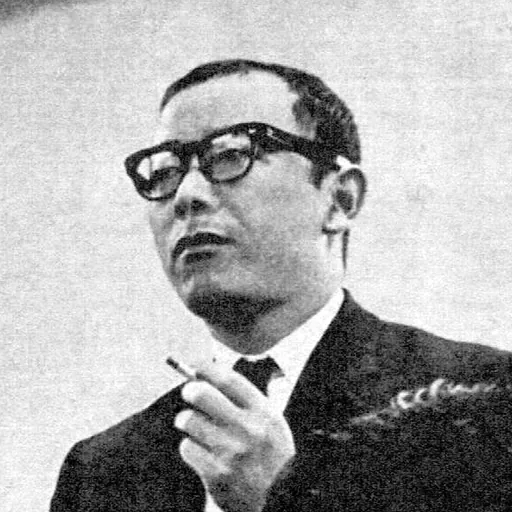
About Hitomi Yamaguchi
Lived 1923 – 1995 (aged 71). Hitomi Yamaguchi was a Japanese novelist, essayist, writer, literary critic and professional shogi player.
was a novelist and essayist in Shōwa period Japan.
Early life Yamaguchi was born in the Azabu district of Tokyo to a working-class family. He was forced to support himself through college, attending the Kokugakuin University. After graduation, he went to work for the publishing company Kawade Shobō, but that company went bankrupt a couple of years later. He then found employment as the editor of a wine magazine published by Kotobukiya (the forerunner of Suntory); his colleagues at the same magazine included Kaikō Ken and Yanagihara Ryōhei. The advertising campaign he mounted popularized Hawaii as a tourist destination as well as promoting Suntory whiskey.
Literary career Yamaguchi's true literary career started in 1954, when he began contributing works to the magazine of literary criticism, Gendai Hyoron ("Contemporary Criticism").
Yamaguchi won the 1963 Naoki Prize for his novel, ("The Refined Lifestyle of Mr. Everyman"), which appeared serialized in the women's monthly magazine, Fujin Gahō, from 1961 to 1962. This story about an average white-collar worker in Tokyo set the tone for many of his future works, which mock the new affluence of urban society in the 1960s, in contrast to the bitter war and post-war period. The novel was adapted into a film, The Elegant Life of Mr. Everyman, directed by Kihachi Okamoto.
Other noted works are: Majime ningen ("A Serious Person"), Izakaya Choji, Ketsu zoku ("Blood Relations"), Kazoku (Family) and Waga machi ("Our Town"). Nanjamonja is a humorous account of travels around Japan.
Yamaguchi also wrote a biography on Yoshino Hideo, in which he describes his own experiences during the period he lived in Kamakura, in the house next door to Kawabata Yasunari from 1945 to 1948. During his time in Kamakura, he attended the , where his teachers included the philosopher and science historian, , the tanka poet, Yoshino Hideo, and the novelist and poet, Takami Jun. After that, he moved to Kunitachi, in the outskirts of Tokyo.
Dansei jishin ("Man Himself"), a series of witty essays about the joys and sorrows of everyday life, was serialized in the weekly magazine, Shukan Shincho, from 1963 until his death in 1995 for a total of 1,614 episodes.
Yamaguchi was an amateur shogi player and published a book chronicling his games against professional players fought with a rook handicap (hisha ochi) advantage. His opponents included Yasuharu Ōyama, Makoto Nakahara, Kunio Yonenaga, among others.
Yamaguchi died in 1995. His grave is in Uraga, Kanagawa.
Don’t just read it —
keep it.
Full-length biographies made to live with: read them, listen on the way to work, watch them tonight.
- E-book
- Audio
- Video
Instant download · yours to keep · every purchase keeps this site free
Important facts
People in Hitomi Yamaguchi's life
Named in this biography and alive at the same time


Related people
Same field, nearest in time





Contemporaries
People whose lives overlapped Hitomi Yamaguchi's

Frequently asked questions
Who was Hitomi Yamaguchi?
Japanese writer (1923–1995)
When was Hitomi Yamaguchi born?
Hitomi Yamaguchi was born on 3 November 1923 in Tokyo.
When did Hitomi Yamaguchi die?
Hitomi Yamaguchi died on 30 August 1995 in Kunitachi.
What was Hitomi Yamaguchi's occupation?
Hitomi Yamaguchi was a novelist, essayist, writer, literary critic and professional shogi player.
What nationality was Hitomi Yamaguchi?
Hitomi Yamaguchi was Japanese.
Sources & further reading
Cite this page
APA: Biography.guide. (2026). Hitomi Yamaguchi. https://biography.guide/hitomi-yamaguchi/
MLA: "Hitomi Yamaguchi." Biography.guide, https://biography.guide/hitomi-yamaguchi/.
Chicago: "Hitomi Yamaguchi." Biography.guide. https://biography.guide/hitomi-yamaguchi/.
Data last updated: 2026-09-23 · Spot an error? Report a correction.
Portrait: Wikimedia Commons · author & licence
Page generated 2026-09-27 05:07 UTC