About Hipparchia of Maroneia
Lived 350 BC – 280 BC (aged 69–70). Hipparchia of Maroneia was a philosopher.
Hipparchia of Maroneia (; ; fl. c. 325 BC) was a Cynic philosopher, and wife of Crates of Thebes. She was the sister of Metrokles, the cynic philosopher. She was born in Maroneia, but her family moved to Athens, where Hipparchia came into contact with Crates, the most famous Cynic philosopher in Greece at that time. She fell in love with him, and, despite the disapproval of her parents, she married him. She went on to live a life of Cynic poverty on the streets of Athens with her husband.
Little survives of her own philosophical views, but like most Cynics, her influence lies in the example of her life, choosing a way of life which was usually considered unacceptable for respectable women of the time. The story of her attraction to Crates, and her rejection of conventional values, became a popular theme for later writers.
Life Hipparchia was born c. 350 BC in Maroneia, Thrace. Her family came to Athens, where Hipparchia's brother, Metrocles, became a pupil of the Cynic philosopher Crates of Thebes. Hipparchia fell in love with Crates, and developed such a passion for him, that she told her parents that if they refused to allow her to marry him, she would kill herself. They begged Crates to dissuade her, and he stood before her, removed his clothes, and said, "Here is the bridegroom, and this is his property." Crates called their marriage "dog-coupling" (cynogamy; the term 'Cynic' is derived from Ancient Greek kŭ́ōn, 'dog'). We are told that they lived in the stoas and porticoes of Athens, and both Sextus Empiricus and the Latin-language writer Apuleius wrote accounts of their having sex, publicly, in broad daylight. Although this would have been consistent with Cynic shamelessness (anaideia), the mere fact that Hipparchia adopted male clothes and lived on equal terms with her husband would have been enough to shock Athenian society. and a son named Pasicles. It is not known how or when she died. There is an epigram ascribed to Antipater of Sidon, as to what may have been written on her tomb: I, Hipparchia chose not the tasks of rich-robed woman, but the manly life of the Cynic. Brooch-clasped tunics, well-clad shoes, and perfumed headscarves pleased me not; But with wallet and fellow staff, together with coarse cloak and bed of hard ground, My name shall be greater than Atalanta: for wisdom is better than mountain running.
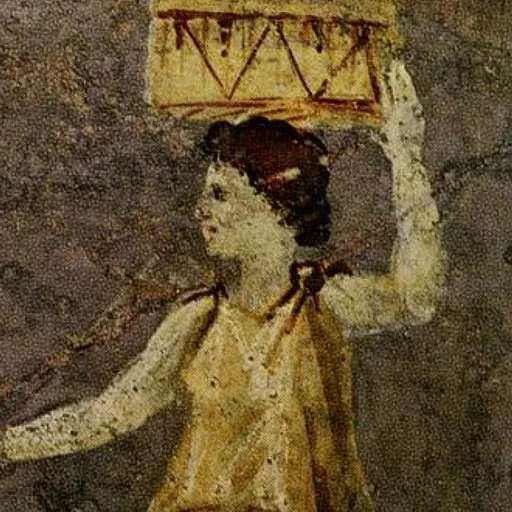
Philosophy Roman wall painting of Hipparchia and Crates from the Villa Farnesina, Rome. Hipparchia approaches Crates carrying a box, implying that she has come to Crates as a potential bride bearing her possessions.
The Suda says she wrote some philosophical treatises and some letters addressed to Theodorus the Atheist. Many other anecdotes existed about Hipparchia,
Later influence
Hipparchia's fame undoubtedly rests on the fact that she was a woman practising philosophy and living a life on equal terms with her husband. Both facts were unusual for ancient Greece or Rome. She is also the only woman to have her own entry among the 82 philosophers in Diogenes Laërtius' Lives and Opinions of Eminent Philosophers, and she continued to fascinate later writers. There are, for example, a set of Cynic epistles, written in the 1st century AD, some of which purport to give advice from Crates to Hipparchia: Our philosophy is called Cynic not because we are indifferent to everything, but because we aggressively endure what others, due to being soft or general opinion find unbearable. So it is for this reason and not the former that they have called us Cynics. Stay, therefore, and continue as a Cynic—for you are not by nature worse than we [men] are, for neither are female dogs worse than male—in order that you might be freed from Nature, as all [people] either because of law or due to vices, live as slaves.
Other letters mention events, which, like a lot of the Cynic epistles, may be based on actual anecdotes which existed at the time. In two of the letters, we are told that Hipparchia sent a cloak to Crates which she had made. Crates, though, fears that she may have undertaken the task "so that you might appear to the masses to be someone who loves her husband." Crates urges her to renounce wool-spinning and take-up philosophy since that is the reason she married him. In another letter, Crates learns why she has taken up domestic tasks: Hipparchia, we are told, has given birth. After agreeing with her that she gave birth easily because of her Cynic training, Crates proceeds to give advice on how to rear the child: Let his bath water be cold, his clothes be a cloak, his food be milk, yet not to excess. Rock him in a cradle made from a tortoise shell. ... When he is able to speak and walk, dress him, not with a sword, as Aethra did with Theseus, but with a staff and cloak and wallet, which can guard men better than swords, and send him to Athens.
Perhaps most remarkable is a letter purporting to come from Diogenes of Sinope addressed to the people of Maroneia: You did well when you changed the name of the city and, instead of Maroneia, called it Hipparchia, its present name, since it is better for you to be named after Hipparchia, a woman, it's true, but a philosopher, than after Maron, a man who sells wine.
Modern influence Engraving of Hipparchia and Crates from the Touchstone of the Wedding Ring by Jacob Cats. Depicted in 17th-century clothing, Crates tries to dissuade Hipparchia from her affections for him by pointing to his head to show how ugly he is
The story of Hipparchia's pursuit of Crates, despite the disapproval of her parents and the initial reluctance of Crates, was a popular tale from the 16th century onwards. It featured in Lodovico Guicciardini's commonplace book Hore di ricreatione published in 1568, and it was one of the stories told by the Dutch poet Jacob Cats in his Touchstone of the Wedding Ring (Proefsteen van de Trou-ringh) published in 1637. William Penn wrote about her in his No Cross, No Crown, which he wrote in prison in 1668. For Penn she was an example of puritan discipline and virtue:
Her marriage to Crates inspired Pierre Petit to write the Latin poem Cynogamia, sive de Cratetis et Hipparches amoribus in 1676. In the same century, Clemenza Ninci, an Italian nun, wrote a play entitled Sposalizio d'Iparchia filosofa (The marriage of Hipparchia the philosopher). The play deals with Hipparchia's desire to marry Crates, and the obstacles which are placed in her way until she achieves her desire. The play was written for convent performance (with all the parts played by nuns) and was not published until the 19th century. The German writer Christoph Martin Wieland made Crates and Hipparchia the heroes of his epistolary novel Krates und Hipparchia (1804). Crates and Hipparchia feature in Marcel Schwob's Vies Imaginaires (Imaginary Lives, 1896). The American writer H.D. wrote a novella Hipparchia (1921), a highly fictionalised account of Hipparchia's daughter, (whom H.D. imagines is also called Hipparchia). Hipparchia was an inspiration for the book L'Étude et le rouet (1989) (translated in English under the title Hipparchia's Choice) by the French feminist philosopher Michèle Le Dœuff, a reflection on women's relation to philosophy. Martha Nussbaum, in her speech to the University of Chicago Law School graduating class of 2010, presented Hipparchia's life as an illustrative example of the benefits of continuing education beyond academic settings.
Namesake A genus of butterflies, Hipparchia, bears her name.
Don’t just read it —
keep it.
Full-length biographies made to live with: read them, listen on the way to work, watch them tonight.
- E-book
- Audio
- Video
Instant download · yours to keep · every purchase keeps this site free
Important facts
People in Hipparchia of Maroneia's life
Named in this biography and alive at the same time
Related people
Same field, nearest in time




Contemporaries
People whose lives overlapped Hipparchia of Maroneia's


Frequently asked questions
Who was Hipparchia of Maroneia?
Cynic philosopher
When was Hipparchia of Maroneia born?
Hipparchia of Maroneia was born in 350 BC in Maroneia.
When did Hipparchia of Maroneia die?
Hipparchia of Maroneia died in 280 BC.
What was Hipparchia of Maroneia's occupation?
Hipparchia of Maroneia was a philosopher.
Sources & further reading
· Wikipedia: Hipparchia of Maroneia
· DBpedia: Hipparchia of Maroneia
Cite this page
APA: Biography.guide. (2026). Hipparchia of Maroneia. https://biography.guide/hipparchia-of-maroneia/
MLA: "Hipparchia of Maroneia." Biography.guide, https://biography.guide/hipparchia-of-maroneia/.
Chicago: "Hipparchia of Maroneia." Biography.guide. https://biography.guide/hipparchia-of-maroneia/.
Data last updated: 2026-09-20 · Spot an error? Report a correction.
Portrait: Wikimedia Commons · author & licence
Page generated 2026-09-27 04:58 UTC