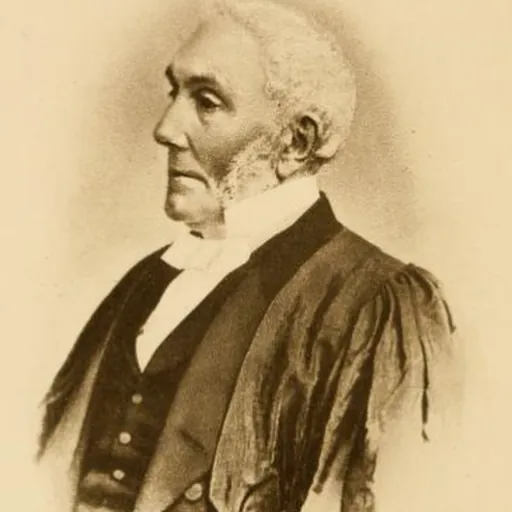
Hew Scott
British minister, born 1791
About Hew Scott
Lived 1791 – 1872 (aged 80–81). Hew Scott was a religious person.
Hew Scott (5 February 1791 - 12 July 1872) was a minister of the Church of Scotland parish of Anstruther Wester. He is largely remembered as a religious researcher and author. His "magnum opus" is the comprehensive, multi-volume work, Fasti Ecclesiae Scoticanae: The succession of ministers in the parish churches of Scotland, from the reformation, A.D. 1560, to the present time. This is a detailed, biographical record of each of the ministers of each of the parishes of the Church of Scotland from 1560 to 1870. (It also refers to earlier priests/ministers, where possible). It was first published between 1866 and 1871 but it is regularly updated by the Church of Scotland.
The project took him 50 years and covered 760 parishes (often with more than one church per parish), including parishes which were either gone, amalgamated or fleeting in existence. Volume 1 was in part aided by Dr Gordon of Newbattle, Dr Struthers of Prestonpans and David Laing.
Profits from the book went to the Ministers' Daughters' College. However, it was not well received in the literary world, as it is hardly "bedtime reading". Of 250 copies printed less than half sold. Nevertheless, it is a truly outstanding academic work of research. Scott became somewhat depressed regarding the huge task he had taken on, especially when starting to lose his eyesight in later life.
Life He was born in Haddington, East Lothian on 5 February 1791, the son of Robert Scott an excise officer (a distant cousin of Sir Walter Scott) and his second wife, Catherine Dunbar of Coldingham.
He taught himself Latin by the age of 10 and was encouraged by the local minister, Rev Dr Lorimer, to study for the ministry.
On the death of his father, around 1800, the family fell into extreme poverty and his mother opened a small shop in order to survive. Hew was apprenticed to an ironmonger around 1803 and spent evenings selling stationery door-to-door. Around 1810 he opened his own shop, selling books.
Through his mother's relatives in Coldingham he appears to have met George Dunbar who despite both poverty and disablement managed to gain a degree at Glasgow University. He applied for Edinburgh University and matriculated in 1813. He studied a wide range of subjects and said "had the [Napoleonic] war continued, he would have been an army surgeon rather than a minister". Part of this period would now be called "working his way through college" and twice he was employed as assistant librarian in the Edinburgh university in exchange for his university fees. In 1816 he transferred to King's College, Aberdeen and it was there where he got his first MA. Hew probably sighed a huge sigh of relief on publication, before realising within two or three years that the work had to be updated regularly in order to retain its value. It therefore became a never-ending project.
He died on 12 July 1872 in Anstruther.
His will endowed a "Scott and Dunbar Prize" at Edinburgh University: this is an annual prize for the best Greek student.
Fasti Ecclesiae Scoticanae First Edition Volume 1, Part 1 - Synod of Lothian and Tweeddale - 1866 also
Volume 1, Part 2 - Synods of Merse and Teviotdale, Dumfries, and Galloway - 1867 also
Volume 2, Part 1 - Synod of Glasgow and Ayr - 1868 also
Volume 2, Part 2 - Synods of Fife, and Perth and Stirling - 1869 also
Volume 3, Part 1 - Synods of Argyll, Glenelg, Moray, Ross, Sutherland and Caithness, Orkney and Zetland - 1870 also
Volume 3, Part 2 - Synods of Aberdeen, and Angus and Mearns - 1871 also
Second Edition Volume I - Synod of Lothian and Tweeddale - 1915 also
Volume II - Synods of Merse and Teviotdale, Dumfries, and Galloway - 1917
Volume III - Synod of Glasgow and Ayr - 1920 also
Volume IV - Synods of Argyll, and of Perth and Stirling - 1923
Volume V - Synods of Fife, and of Angus and Mearns - 1925 also
Volume VI - Synods of Aberdeen and of Moray - 1926 also
Volume VII - Synods of Ross, Sutherland and Caithness, Glenelg, Orkney and of Shetland, the Church in England, Ireland and Overseas - 1928
Family
In 1859 he married Sarah MacDougall Kennedy. She was a widow, the daughter of James Kennedy (a farmer in Colmonell), and died in 1874.
Don’t just read it —
keep it.
Full-length biographies made to live with: read them, listen on the way to work, watch them tonight.
- E-book
- Audio
- Video
Instant download · yours to keep · every purchase keeps this site free
Important facts
People in Hew Scott's life
Named in this biography and alive at the same time



Related people
Same field, nearest in time


Contemporaries
People whose lives overlapped Hew Scott's




Frequently asked questions
Who was Hew Scott?
British minister, born 1791
When was Hew Scott born?
Hew Scott was born in 1791.
When did Hew Scott die?
Hew Scott died in 1872.
What was Hew Scott's occupation?
Hew Scott was a religious person.
Sources & further reading
Cite this page
APA: Biography.guide. (2026). Hew Scott. https://biography.guide/hew-scott/
MLA: "Hew Scott." Biography.guide, https://biography.guide/hew-scott/.
Chicago: "Hew Scott." Biography.guide. https://biography.guide/hew-scott/.
Data last updated: 2026-09-21 · Spot an error? Report a correction.
Portrait: Wikimedia Commons · author & licence
Page generated 2026-09-27 05:01 UTC