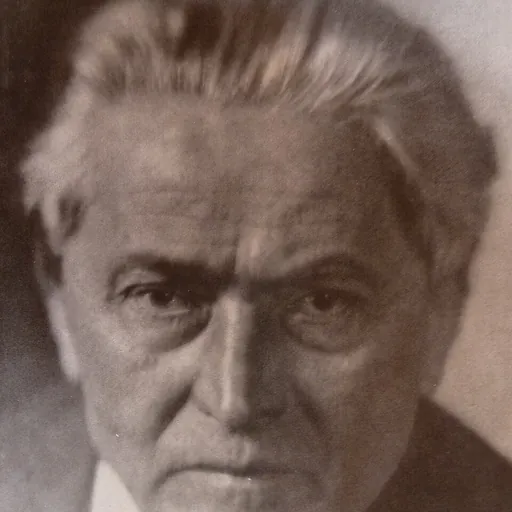
About Hermann Stehr
Lived 1864 – 1940 (aged 76). Hermann Stehr was a poet, autobiographer, writer and folkeskole teacher.
Hermann Stehr (16 February 1864 – 11 September 1940) was a German novelist, dramatist and poet. He was nominated for the Nobel Prize in Literature four times.
Personal life Stehr was born in Habelschwerdt (today Bystrzyca Kłodzka) in 1864; he was the fifth child of Robert Stehr. He was brought up in an indigent family under the strict rules of his religious parents. Much of Stehr's family background remains unknown, however in the novel Drei Nächte, if accepted as being autobiographical, he mentioned a grandfather, who came from Baden. This grandfather worked in a higher legal office during the outbreak of the European Revolutions of 1848 in Germany.
Stehr married Hedwig Nentwig in 1894, four of their sons died in infancy. Stehr described the painful death of children in some of his fictional works, notably Das letzte Kind. In 1899 he moved to Dittersbach (today a district of Wałbrzych). He abandoned teaching and in 1915 and devoted himself to writing with the support of his patron, the Silesian textile manufacturer Hans Pinkus. In autumn 1915 he settled in Bad Warmbrunn (today a district of Jelenia Góra), and in 1926 he moved to Schreiberhau where he lived until his death.
Career Between 1881 and 1885, Stehr trained as an elementary school teacher in Bad Landeck and then in Habelschwerdt. He objected to the educational methods at school, as well as he was against priggishness and prudery of the teachers. He doubted basic tenets of the Catholic Church which triggered a conflict between Stehr and his superiors. However, he was a believer but as he claimed, he needed no mediator between himself and God. In 1885 he started working as a teacher in Silesian Bukowina. In 1887 he moved to Patschkau - a small village in the mountains where he worked under the supervision of two parish priests. During his time in Patschkau he felt abandoned and lonely. His time in Patschkau was difficult but then he found solace in God. In his poem An Gott he wrote that God had a huge influence on his life.
He published several novels, including Leonore Griebel (a story of marital conflict), Der begrabene Gott (about a poor maid from Patschkau and her contrary husband) and Drei Nächte (set in Habelschwerdt and thought to be autobiographical). In his satire Meicke, der Teufel, a tale of alcoholism, he described a dishonest and disreputable protagonist who too precisely resembled a farmer from Patschkau, for which he was sued and sentenced to pay 50 marks. In his works he often described the lives of the characters, mainly Silesian peasants and workers, as a dramatic search for God. He also wrote fairy tales and poetry. His most famous and successful work was the novel Der Heiligenhof about a Silesian farmer, his blind daughter, her love for a young man and the farmer's search for God. This story was retold in a later work from the point of view of the young man, Peter Brindeisner.
Some German nationalists identified Stehr as a eulogist of the German soul. However, the more ideological National Socialists criticised Stehr for his advocacy of independent thought and seeking God within oneself rather than finding solace in society. His works are not celebrations of an innocent rural life, extolling men of the soil, as Blood and Soil literature did, but owe more to naturalism through the portrayal of the poverty and hardship of ordinary people's lives, and the Heimat-Roman or regional novel genre through their focus on Silesia and, more specifically, the people of the Grafschaft Glatz.
His letters and manuscripts can mostly be found in the German Museum of Modern Literature in Marbach am Neckar (Deutsches Literaturarchiv Marbach).
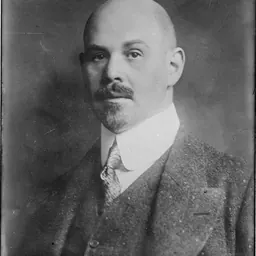
Political involvement During the founding of the Weimar Republic, Stehr appeared as an election speaker for his friend Walther Rathenau, a candidate for the Democratic Party.
In 1934 Stehr wrote a letter to Adolf Hitler, which was a protest against the president of the police and SA-Obergruppenfűhrer Edmund Heines who pursued a policy of terror and violence against citizens. The letter remained unanswered.
Awards and recognition Throughout his career Stehr received several awards, including an honorary doctorate from the University of Breslau in 1934 and honorary citizenships of Habelschwerdt and Schreiberhau. In Münster there is a street named in his honor Literary prizes that he received included:
the Bauernfeld Prize (1910), the Fastenrath Prize (1919),
Stehr was also appointed as a founding member of the Prussian Literary Academy (1926).
Don’t just read it —
keep it.
Full-length biographies made to live with: read them, listen on the way to work, watch them tonight.
- E-book
- Audio
- Video
Instant download · yours to keep · every purchase keeps this site free
Important facts
People in Hermann Stehr's life
Named in this biography and alive at the same time

Related people
Same field, nearest in time

Contemporaries
People whose lives overlapped Hermann Stehr's



Frequently asked questions
Who was Hermann Stehr?
German author (1864–1940)
When was Hermann Stehr born?
Hermann Stehr was born on 16 February 1864 in Bystrzyca Kłodzka.
When did Hermann Stehr die?
Hermann Stehr died on 11 September 1940 in Szklarska Poręba.
What was Hermann Stehr's occupation?
Hermann Stehr was a poet, autobiographer, writer and folkeskole teacher.
What nationality was Hermann Stehr?
Hermann Stehr's recorded nationality: German Reich.
Sources & further reading
Cite this page
APA: Biography.guide. (2026). Hermann Stehr. https://biography.guide/hermann-stehr/
MLA: "Hermann Stehr." Biography.guide, https://biography.guide/hermann-stehr/.
Chicago: "Hermann Stehr." Biography.guide. https://biography.guide/hermann-stehr/.
Data last updated: 2026-09-22 · Spot an error? Report a correction.
Portrait: Wikimedia Commons · author & licence
Page generated 2026-09-27 04:58 UTC