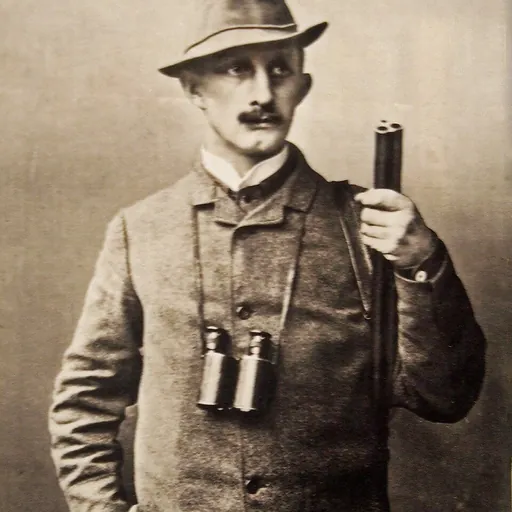
About Hermann Löns
Lived 1866 – 1914 (aged 48). Hermann Löns was a German poet, journalist, screenwriter, writer, dramaturge and librettist.
Hermann Löns (29 August 1866 – 26 September 1914) was a German journalist and writer. He is most famous as "The Poet of the Heath" for his novels and poems celebrating the people and landscape of the North German moors, particularly the Lüneburg Heath in Lower Saxony. Löns is well known in Germany for his famous folksongs. He was also a hunter, naturalist and conservationist. Despite being well over the normal recruitment age, Löns enlisted and was killed in World War I and his purported remains were later used by the German government for celebratory purposes.
Life and work Hermann Löns was born on 29 August 1866 in Kulm (now Chełmno, Poland) in the Province of Prussia. He was one of twelve siblings, of whom five died early. His parents were Friedrich Wilhelm Löns (1832–1908) from Bochum, a teacher, and Klara (née Cramer; 1844–96) from Paderborn. Hermann Löns grew up in Deutsch-Krone (West Prussia). In 1884, the family relocated back to Westfalen as his father found a position in Münster. In 1887, he started his studies at the University of Greifswald. There he joined the dueling fraternity Turnerschaft Cimbria, but was dismissed cum infamia (with infamy). However, he was also arrested in 1889 for disorderly conduct and sentenced to five days in jail for extinguishing gas lights and resisting arrest while drunk. On 26 September 1914, just three weeks after enlisting on 3 September, Löns was killed in action during an assault on a French position at Loivre near Reims in France. Of the 120 men in his unit, only two dozen survived.
As some of his writings had included nationalistic ideas, he was considered by the National Socialists as one of their writers. Some parts of his works conformed well with the blood and soil ethos endorsed by National Socialist ideologues such as Walther Darre and Alfred Rosenberg, which lauded the peasantry and small rural communities as the true character of the German nation.
On 5 January 1933, a French farmer found the boots of a German soldier in one of his fields. With the help of the local sexton, he uncovered a skeleton and identification tag. The sexton buried the body in an individual grave in a German graveyard near Loivre. It took almost 18 months for the tag to reach Berlin via the German embassy in France. This tag was subsequently lost during an Allied bombing raid on Berlin; an extant photograph of it does not allow a definite conclusion on whether the tag said "F.R." (Füselier-Regiment) or "I.R." (Infanterie-Regiment). However, on 8 May 1934, the newspaper Völkische Beobachter announced that the grave of Löns had been discovered. In October 1934, at the behest of Adolf Hitler, Löns' purported body was exhumed and brought to Germany. There was not any medical examination to try to verify that these were indeed the remains of the writer.
In 1919, several bodies had been exhumed in the vicinity of the area where Löns was killed and transferred to the war cemetery at Luxembourg. From there they were moved to a mass grave near Loivre, where they remain to this day, according to the Volksbund Deutsche Kriegsgräberfürsorge, a charity. It is quite possible that Löns' remains were among them.
The 1932 movie Grün ist die Heide ( Green Is The Heath) was based on Löns' writings. Finally, there is Hermann Löns Stadium at Paderborn.
Don’t just read it —
keep it.
Full-length biographies made to live with: read them, listen on the way to work, watch them tonight.
- E-book
- Audio
- Video
Instant download · yours to keep · every purchase keeps this site free
Important facts
People in Hermann Löns's life
Named in this biography and alive at the same time
Related people
Same field, nearest in time

Contemporaries
People whose lives overlapped Hermann Löns's




Frequently asked questions
Who was Hermann Löns?
German journalist and writer (1866–1914)
When was Hermann Löns born?
Hermann Löns was born on 29 August 1866 in Chełmno.
When did Hermann Löns die?
Hermann Löns died on 26 September 1914 in Loivre.
What was Hermann Löns's occupation?
Hermann Löns was a poet, journalist, screenwriter, writer, dramaturge and librettist.
What nationality was Hermann Löns?
Hermann Löns was German.
Sources & further reading
Cite this page
APA: Biography.guide. (2026). Hermann Löns. https://biography.guide/hermann-lons/
MLA: "Hermann Löns." Biography.guide, https://biography.guide/hermann-lons/.
Chicago: "Hermann Löns." Biography.guide. https://biography.guide/hermann-lons/.
Data last updated: 2026-09-21 · Spot an error? Report a correction.
Portrait: Wikimedia Commons · author & licence
Page generated 2026-09-27 05:00 UTC