
About Herman Nicolaas Ridderbos
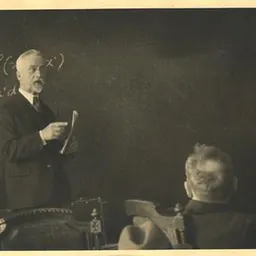
Lived 1909 – 2007 (aged 98). Herman Nicolaas Ridderbos was a Dutch theologian and university teacher.
Herman Nicolaas Ridderbos (13 February 1909 – 8 March 2007) was a Dutch Christian theologian and Biblical scholar. He was a New Testament theologian and worked extensively on the history of salvation (Heilsgeschichte) and biblical theology.
Life
Ridderbos was born in Hennaarderadeel, Friesland, Netherlands. His father, Jan Ridderbos, was an ordained minister in the Reformed Churches in the Netherlands, a biblical commentator, and professor of Old Testament at the Theological School of the Reformed Churches of the Netherlands in Kampen. His brother, Nico Ridderbos, was also a professor, but at VU University Amsterdam, where he taught ancient history.
Herman Ridderbos studied theology at the Theological College in Kampen and at the Free University of Amsterdam. After graduating, he took up his first position as a pastor in Eefde-Gorssel in the Achterhoek region in 1934. On November 13, 1936, he earned his doctorate cum laude under Professor Frederik Willem Grosheide with a dissertation titled De strekking van de bergrede naar Matteüs (The Meaning of the Sermon on the Mount According to Matthew). In 1939, he moved to Rotterdam-Charlois to serve as a pastor there. On January 21, 1943, he became a professor in Kampen; he retired in 1975, and become emeritus.
In 1943, after serving as a pastor for eight years, Ridderbos was appointed to the post of Professor of New Testament Studies at Kampen. He succeeded Seakle Greijdanus who had been one of his professors. He served there for over forty years.
Herman Ridderbos died at home at the age of 98.
Research
During his tenure as a professor, he wrote several theological books. In 1966, his most important publication, Paulus. Ontwerp van zijn Theologie (Paul: An Outline of His Theology), was published. One of his last major works was a commentary on the Gospel according to John. In his publications, Ridderbos placed particular emphasis on the salvation-historical character of the Gospel. This means that Christian salvation has entered the history of humanity; in theological terms, that het Woord vlees is geworden (the Word became flesh), meaning that God's Son (that is, Jesus Christ) became human.
Ridderbos exerted considerable influence within the Reformed Churches in the Netherlands. Thanks in part to his articles in the Gereformeerd Weekblad, he was also well known among ordinary churchgoers. During the conflict of the 1970s involving the Reformed theologian Herman Wiersinga regarding atonement, he defended the classical doctrine of atonement, which is based on atonement by satisfaction (the classical doctrine of atonement was articulated, among others, by Anselm of Canterbury, a renowned Italian-British theologian of the Middle Ages. This understanding of atonement is fully professed in the Reformed confession. Many Reformed believers see this as the heart of the gospel). Ridderbos regarded the Gospels as an account of what actually happened concerning Jesus and how Jesus revealed himself, rather than as the interpretation of certain early Christians.
In the ecclesiastical conflict over Wiersinga and the authority of the Bible, Ridderbos would have liked to see the Reformed Churches in the Netherlands remain united on a single orthodox line, but he later realized, to his regret, that they had sided with the then-Dutch Reformed Church—namely, that even within his own Reformed denomination, various religious views had come to coexist side by side. Nevertheless, he did not believe that his church had strayed into liberal territory, though he did believe there was a certain degree of departure from the orthodox Reformed faith.
His thinking also exerted influence abroad. Several of his books have been translated and reprinted in English, Spanish, Portuguese, Korean, and Indonesian.
Works
These are his major writings in chronological order:
Thesis
Books
556 pp. 104 pp.
46 pp. Authored by F. W. Grosheide. 31 pp.
653 pp. 587 pp.
[During the celebration of the 25th anniversary of his professorship in 1968, his colleagues presented him with a collection of a number of his articles and lectures.]
498 pp.
. Ridderbos was involved in a controversy about Herman Wiersinga's dissertation He wrote this as a response. 109 pp.
721 pp.
Don’t just read it —
keep it.
Full-length biographies made to live with: read them, listen on the way to work, watch them tonight.
- E-book
- Audio
- Video
Instant download · yours to keep · every purchase keeps this site free
Important facts
People in Herman Nicolaas Ridderbos's life
Named in this biography and alive at the same time





Related people
Same field, nearest in time


Contemporaries
People whose lives overlapped Herman Nicolaas Ridderbos's





Frequently asked questions
Who was Herman Nicolaas Ridderbos?
Dutch theologian (1909–2007)
When was Herman Nicolaas Ridderbos born?
Herman Nicolaas Ridderbos was born on 13 February 1909 in Easterein.
When did Herman Nicolaas Ridderbos die?
Herman Nicolaas Ridderbos died on 8 March 2007 in Kampen.
What was Herman Nicolaas Ridderbos's occupation?
Herman Nicolaas Ridderbos was a theologian and university teacher.
What nationality was Herman Nicolaas Ridderbos?
Herman Nicolaas Ridderbos was Dutch.
Sources & further reading
· Wikipedia: Herman Nicolaas Ridderbos
· DBpedia: Herman Nicolaas Ridderbos
Cite this page
APA: Biography.guide. (2026). Herman Nicolaas Ridderbos. https://biography.guide/herman-nicolaas-ridderbos/
MLA: "Herman Nicolaas Ridderbos." Biography.guide, https://biography.guide/herman-nicolaas-ridderbos/.
Chicago: "Herman Nicolaas Ridderbos." Biography.guide. https://biography.guide/herman-nicolaas-ridderbos/.
Data last updated: 2026-09-20 · Spot an error? Report a correction.
Page generated 2026-09-27 05:24 UTC