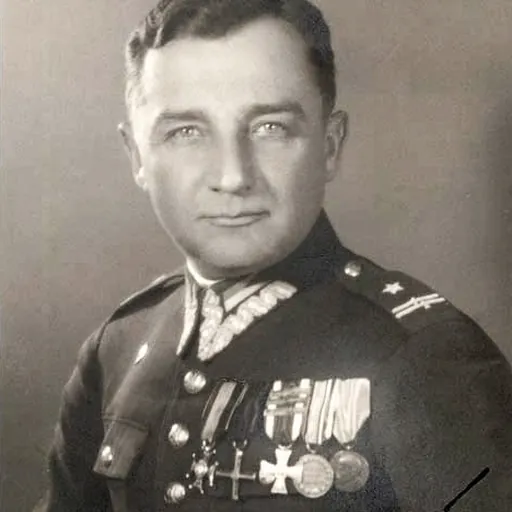
About Henryk Dobrzański
Lived 1897 – 1940 (aged 42). Henryk Dobrzański was a Polish athlete, military officer, resistance fighter, soldier and major.
Major Henryk Dobrzański (22 June 1897 – 30 April 1940), also known by his nom-de-guerre "Hubal," was a Polish soldier, sportsman and partisan. He fought in the Polish Legions in World War I, Polish–Ukrainian War of 1918, the Polish–Bolshevik War of 1919–1921 and the Polish September Campaign of 1939. He is however best known as the leader of the partisan unit known as the Detached Unit of the Polish Army which operated in 1939 and early 1940 near Kielce.
Exploits of Dobrzański and his unit, considered the first partisans in Poland and arguably, of World War II, became a legend in Poland already during the war. Known as Hubal, he has been described as Poland's last "Romantic Hero" and compared to figures such as Robin Hood, William Tell, Till Eulenspiegel and Davy Crockett.
Early life and career Henryk Dobrzański was born on 22 June 1897 in Jasło, Austria-Hungary to a Polish noble family (Coat of arms of Leliwa), of Henryk Dobrzański de Hubal and Maria Dobrzańska née Lubieniecka. In 1912, he joined the pro-independence Polish Rifle Squads. When World War I broke out, he volunteered to join Józef Piłsudski's Polish Legions. He served with distinction in the 2nd Regiment of Uhlans and participated in many battles such as Stawczany and Battle of Rarańcza. In 1918 after Poland regained its independence, he joined the Polish Army.
Dobrzański took part in the Polish–Ukrainian War of 1918 and fought with his cavalry platoon during the Siege of Lwów. He participated in Polish–Bolshevik War of 1919–1921. For his bravery, he was awarded the Virtuti Militari, the highest Polish military award, and four times the Krzyż Walecznych, in addition to many other military awards.
After the Peace of Riga, he remained in the Polish Army. He became a member of the Polish equestrian team, winning many international competitions. He also took part in the 1928 Summer Olympics in Amsterdam and came fourth at the prestigious Aldershot competition. In his sports career, he gained 22 gold, three silver and four bronze medals altogether.
World War II Shortly before the 1939 Invasion of Poland he was assigned to the 110th Reserve Cavalry Regiment [pl] as a deputy commander. His unit was to enter combat as a second-line formation, but fast advances of the Wehrmacht made the completion of training impossible. On 11 September it was moved to Wołkowysk, from where it marched towards Grodno and Augustów Forest. It fought several skirmishes against the German army and after the Soviet invasion of Poland took part in the defense of the city against the Red Army.
After two days of heavy fighting against the numerically superior Soviets, on 20 September Grodno was lost and three days later gen. bryg. Wacław Przeździecki, the commander of the defense of the Grodno area, ordered all his troops to escape to neutral Lithuania. According to another account that order was given shortly after the Soviet invasion begun, around 17 or 18 September. In either, case, the 110th Regiment did not obey this order. The unit joined with the remnants of several routed regiments and fought its way towards the capital Warsaw.
Warsaw capitulated on 27 September, before Dobrzański and his men were able to reach it. That left him faced with three choices: disband, evacuate (via Hungary or Romania) to France, or continue the fight. Approximately 50 men volunteered to continue the fight. He led his unit southwards to try to break out and reach France. Due to these reprisals local sentiment turned against Hubal's unit, and the newly formed ZWZ became concerned that this would inhibit their ability to recruit. The ZWZ and the Government Delegate's Office at Home ordered Hubal to disband his unit. He refused to do so.
Death and legacy On 30 April 1940 his staff quarters, in a ravine near the village of Anielin (near Opoczno), were ambushed. During the battle Dobrzański and one of his men were killed. The Germans desecrated his body and put it on public view in the local villages. They then transported it to Tomaszów Mazowiecki and either burnt it or buried it in an unknown location. The remnants of the "Detached Unit of the Polish Army" continued the struggle until 25 June 1940, when it was disbanded. The exact place of Hubal's burial remains uncertain, despite efforts to locate it.
In 1973 the film Hubal, based on his resistance campaign, was released.
The pseudonym "Hubal" comes from his family coat of arms.
Decorations Military decorations awarded to Henyrk Dobrzański include:
Don’t just read it —
keep it.
Full-length biographies made to live with: read them, listen on the way to work, watch them tonight.
- E-book
- Audio
- Video
Instant download · yours to keep · every purchase keeps this site free
Important facts
People in Henryk Dobrzański's life
Named in this biography and alive at the same time

Related people
Same field, nearest in time


Contemporaries
People whose lives overlapped Henryk Dobrzański's



Frequently asked questions
Who was Henryk Dobrzański?
Polish army commander (1897–1940)
When was Henryk Dobrzański born?
Henryk Dobrzański was born on 22 June 1897 in Jasło.
When did Henryk Dobrzański die?
Henryk Dobrzański died on 30 April 1940 in Opoczno.
What was Henryk Dobrzański's occupation?
Henryk Dobrzański was an athlete, military officer, resistance fighter, soldier and major.
What nationality was Henryk Dobrzański?
Henryk Dobrzański was Polish.
Sources & further reading
· Wikipedia: Henryk Dobrzański
Cite this page
APA: Biography.guide. (2026). Henryk Dobrzański. https://biography.guide/henryk-dobrzanski/
MLA: "Henryk Dobrzański." Biography.guide, https://biography.guide/henryk-dobrzanski/.
Chicago: "Henryk Dobrzański." Biography.guide. https://biography.guide/henryk-dobrzanski/.
Data last updated: 2026-09-21 · Spot an error? Report a correction.
Portrait: Wikimedia Commons · author & licence
Page generated 2026-09-27 04:59 UTC