
Henry V
King of Germany and Holy Roman Emperor, the fourth and last ruler of the Salian dynasty
About Henry V
Lived 1086 – 1125 (aged 38). Henry V was a German patron of the arts and monarch.
Henry V (; probably 11 August 1081 or 1086 – 23 May 1125) was King of Germany (from 1099 to 1125) and Holy Roman Emperor (from 1111 to 1125), as the fourth and last ruler of the Salian dynasty. He was made co-ruler by his father, Henry IV, in 1098.
In Emperor Henry IV's conflicts with the imperial princes and the struggle against the reform papacy during the Investiture Controversy, young Henry V allied himself with the opponents of his father. He forced Henry IV to abdicate on 31 December 1105 and ruled for five years in compliance with the imperial princes. He tried, unsuccessfully, to withdraw the regalia from the bishops. Then in order to at least preserve the previous right to invest, he captured Pope Paschal II and forced him to perform his imperial coronation in 1111. Once crowned emperor, Henry departed from joint rule with the princes and resorted to earlier Salian autocratic rule. After he had failed to increase control over the church, the princes in Saxony and on the Middle and Lower Rhine, in 1121 the imperial princes forced Henry V to consent with the papacy. He surrendered to the demands of the second generation of Gregorian reformers, and in 1122 he and Pope Callixtus II ended the Investiture Controversy in the Concordat of Worms.
Life Imperial crisis
Henry V was probably born on 11 August in 1081 or 1086. However, only the date of his accolade (Schwertleite) at Easter 1101 can be confirmed. This ceremony usually took place at the age of 15.
At the time of Henry's birth, his father, emperor Henry IV, had already been engaged in many years of drawn out conflicts with the pope, the imperial bishops, and secular princes for the preservation of his rule. Henry IV had never paid much attention to the advice, or the rights and privileges of the landed nobility.
Another line of research supports the theory that the murder of Sieghard of Burghausen in February 1104 by ministerials and citizens of Regensburg was the trigger for the overthrow of Henry IV. According to Burghausen's relatives and other nobles, the emperor had failed to punish the perpetrators appropriately, proving that Henry IV viewed aristocrats with disdain. Henry V had attempted in vain to mediate an amicable settlement between Burghausen and the ministerials in the dispute that led to the murder, and he also would have had a reason to resent his father's inaction. A flaw in this theory is that there was a very long time lag between the murder of Burghausen and when Henry V turned his back on his father.
In November 1104, Henry V joined his father's army on a punitive expedition against Saxon Reformers who had opposed the election of the Archbishop of Magdeburg. On 12 December 1104, Henry V broke away from his father, thereby breaking the oath of allegiance to the ruling king. Henry V made his way to Regensburg, where he celebrated Christmas with his followers. While there, his father's enemies sought to convince him to revolt. Henry considered their arguments, but he was restrained by the oath he had taken to take no part in the business of the Empire during his father's lifetime. At the turn of the year 1104/05, he sent messengers to Rome to seek absolution from his loyalty oath by Pope Paschal II,
Between 1105 and 1106, supporters of Henry IV and Henry V each disseminated arguments in letters and historiographic texts in order to build support among the people of the empire, while father and son each accused the other of disregard for the divine and earthly orders. Henry V began to strengthen his ties with Saxony, where the opposition against his father was particularly strong due in part to his absence from the duchy since 1089. In the spring of 1105, Henry V stayed in Saxony for two months and showed his willingness to work with the church on the basis of Gregorian ideas by removing the bishops, Friedrich von Halberstadt, Udo von Hildesheim, and Henry von Paderborn, who had been appointed by his father. In Quedlinburg, he entered the town barefoot on Palm Sunday, thus demonstrating his humility (humilitas), an elementary Christian virtue of rulers. His stay concluded with the celebration of the Pentecost festival in Merseburg and the confirmation of the Magdeburg metropolitan.
Henry V promised the hand of his sister, Agnes, in marriage to the Babenberger, Leopold III, thereby convincing Leopold to abandon his father's party. At the end of October 1105, Henry V arrived at Speyer, the centre of Salian rule. Here he installed Gebhard, a fervent opponent of his father, as Bishop. In the fall of 1105, the armies of father and son faced each other at the Regen river. However, a battle was prevented by the princes of both sides who wished to find a peaceful solution. At Christmas 1105, an agreement was to be reached at a diet in Mainz.
Henry IV advanced to Mainz for the announced diet. According to the Vita Heinrici IV On 20 December 1105 in Koblenz Henry V "fell around his father's neck", "shed tears and kissed him" – public expressions of reconciliation that were morally binding during the 12th century. Henry IV then disbanded and released his army as father and son left for the diet in Mainz on 21 December. On 23 December in Bingen, Henry persuaded his father to retreat to a castle for his own protection, as Archbishop Ruthard of Mainz would refuse to let him into the city. Henry agreed and was led to Böckelheim Castle, the property of Bishop Gebhard, not for his protection, but for custody. Henry was thrown into the dungeon and was held there "unwashed and unshaven and deprived of any service" over Christmas. At the Reichstag in Mainz, Henry prompted his father to hand over the imperial insignia (crown, scepter, imperial cross, holy lance and imperial sword). Henry IV then was transferred to Ingelheim where he personally was to hand over the imperial insignia and was forced to abdicate on 31 December 1105. Henry V subsequently spread the narrative in which his father had ceded the insignia and his rule to him voluntarily. This distortion of the events implied his strong desire to feign dynastic continuity. The beginning of his reign was marked by a lengthy time of unusual harmony between the king and the princes. Unlike his Salian predecessors, Henry V would count his reign only from the day on which he received the imperial insignia and was chosen for royal duty by the election of the princes. The reference to Saint Mary and the divine mandate was no longer the legitimate basis for Salian rule.
However, Henry IV escaped from prison in Ingelheim and fled to Liège. His son feared a reversal of the balance of power and summoned a Reichstag for Easter 1106. Henry IV had already begun to organize resistance against his son, but suddenly died on 7 August 1106 in Liège, where he received an honorable funeral. The princes opposed a funeral in Speyer, but Henry V overruled this decision. On 24 August, he had his father's body dug up and transferred to Speyer, since in Liège some form of veneration of the deceased as a saint was about to begin. The re-burial at the Speyer crypta would imply continuity and help stabilize the position of the rebel son, who could present himself as a legitimate force of conservation and progress. On 3 September 1106 the body was once again temporarily buried in a still unconsecrated chapel north of Speyer cathedral. An appropriate funeral among his ancestors was only admissible and indeed performed in 1111 after the abolishment of Henry IV's pending excommunication.
Period of consensual rule
Lothair of Supplinburg who had supported Henry during his struggle with his father. Henry rewarded him generously with the land and title of the Duchy of Saxony as fief, the basis for his ascent as Henry's royal and imperial successor
In spring 1106, while Henry reflects on his father's mistakes, he remarked that "disregard for the princes was the downfall of the empire." Thus, the following years of his reign were characterized by greater shared responsibilities of the princes and the sanctioning of church reforms. Documents and annals prove the consensual practice of his rule. Records of princes and nobles in royal documents, who actively take part in government affairs, increased. In several documents Henry would state that he had carried out his actions "with the judgment and advice of the princes". In order to find greater consent with the nobility he would summon diets (Hoftage). The princes' participation in great numbers at the diets and the strong increase in chroniclers' reports confirm the new sense of responsibility among the king's vassals for the empire. Henry V reinstalled the bishops who had been banned from entering their bishoprics under his father. Negotiations with the Pope now took place among representatives of the clerics and secular princes. Bishop Eberhard von Eichstätt (until his early death in 1112), Count Berengar II of Sulzbach and Count Palatine Gottfried von Calw were particularly close to the young king and are most frequently mentioned by the worldly nobles in the royal documents. Additionally, the archbishops Friedrich of Cologne and Bruno von Trier, the bishops Burchhard von Münster, Otto von Bamberg and Erlung von Würzburg and Count Hermann von Winzenburg were named remarkably often in official documents. From 1108 the Staufer Duke Friedrich II and from 1111 Margrave Hermann von Baden would frequently appear in the records.
In 1107, Henry campaigned to restore Borivoi II in Bohemia, which was only partially successful. Henry summoned Svatopluk the Lion, who had captured Duke Borivoi. Borivoi was released at the emperor's command and appointed godfather to Svatopluk's new son. Nevertheless, on Svatopluk's return to Bohemia, he assumed the throne. In 1108, Henry went to war with Coloman of Hungary on behalf of Prince Álmos. An attack by Boleslaus III of Poland and Borivoi on Svatopluk forced Henry to give up his campaign. Instead, he invaded Poland to compel them to renew their accustomed tribute but was again defeated at the Battle of Hundsfeld. In 1110, he succeeded in securing the Duchy of Bohemia for Ladislaus I.
Imperial rule had eroded in Italy after the demise of Henry IV. For fifteen years, from October 1095 to October 1110, neither Henry IV nor Henry V had issued a single document for the Italian administration. Consequently, Italian officials saw no reason to travel to the northern part of the empire and obtain their royal documents. Under Henry V opposition to Salian rule reached its climax in the Milan metropolis.
Henry V. continued the practice of investiture with ring and staff (per anulum et baculum) and was able to maintain a working relationship with the clerical princes.
In Mainz on 7 January 1106 Conrad I was invested with ring and staff as the new Archbishop of Salzburg. In 1107, the Salians occupied the bishoprics of Halberstadt, Magdeburg, Speyer and Verdun with the expressed participation of and approval by the princes. The court chapel, the cathedral schools and the diocesan chapters of Speyer, Bamberg or Liège had lost all relevance for the Episcopal Consecration, but family ties to the high nobility. Upon the selection of the bishops, the king only sought the consent of an exclusive circle of a few noble families. These families in turn only campaigned for candidates among their own ranks, who might become important in the future expansion of their respective territories. This practice effectively promoted a clerical office, that was attainable via a hereditary selection process.
Henry's indicative bishop investiture with ring and staff did not help to solve the conflict with the papacy. Pope Paschal II eventually demanded Henry's complete renunciation of the investiture of clerics. However, the king and the bishops collaborated further as the Pope proved incapable to suppress these practices. Attempts to come to any form of agreement on the question of the investiture failed in 1106 at the Synod of Guastalla and 1107 in Châlons-en-Champagne.
First Italian expedition
Duke Welf II of Bavaria and Matilda of Tuscany were married from 1089 to 1095. Henry's primary concern during his reign was the settlement of the Investiture Controversy, which had caused serious setbacks for the empire during the previous imperial tenure. The papal party who had supported Henry in his resistance to his father hoped he would endorse the papal decrees, which had been renewed by Paschal II at the synod of Guastalla in 1106. The king, however, continued to invest the bishops, but wished the pope to hold a council in Germany to settle the question. After some hesitation, Paschal preferred France to Germany, and, after holding a council at Troyes, renewed his prohibition of lay investiture. The matter slumbered until 1110, when, negotiations between king and pope having failed, Paschal renewed his decrees.
At a Hoftag in August 1110 concrete plans were made for a march on Rome and arrangements to bring about an honorable end to the investiture dispute. The army chose the shortest route via the Great St Bernard Pass, reached Piacenza and Parma, then moved to Florence, arrived at Sutri in February 1111 and from there proceeded towards Rome.
Henry was imbued with ideas of an epochal event upon his departure for Italy. He signalled preparedness as he ordered a new royal seal to be made. Duke Welf II of Bavaria commanded a second column that entered Italy from the southeast of the empire and had orders to rendez-vous with the main contingent near Roncaglia. This impressive display of integrity proved that even the clans that had opposed and violently fought Henry's father were now on the Salian side. Welf's presence was particularly important for Henry as he had been married to Matilda of Tuscany from 1089 to 1095, which entitled him to inheritance claims on her vast property. Matilda allowed the troops to traverse her substantial territories in the greater part of Northern Italy, that included present-day Lombardy, Emilia, the Romagna and Tuscany.
Henry V sent envoys to Matilda in order to negotiate and complete the note: "de pace [...] de regis honore suoque" (for peace and the honor of the king [...]). This honor, that determined the rank of the king was an idea, that had developed among the latest Salians towards a concept of lordship from which also future imperial claims on Southern Italy and on Matilda's property were derived. Matilda, who in 1079 had indeed intended to bequeath all her property to the pope in the event of her childlessness, now opted for an agreement between the pope and the king, and deployed the name Henry. The way to Rome was open for the king.
Henry put great effort into documentation and into staging events favorably for the royal party. He was allegedly accompanied by a huge army of 30,000 knights from all over the empire, that according to Otto of Freising, gave an impressive display of worldly power in the nightly glow of the torches. The strength of his forces helped him to secure general recognition in Lombardy, where archbishop Grossolano intended to crown him with the Iron Crown of Lombardy. Henry could only command such a large army because his rule was based on consensus with the princes and dukes. Among the participants of this great procession was Henry's court chaplain David, who as a chronicler had been tasked to document a chronicle of all important events in volumes and in such a simple style that even less learned people can understand it. Thus, Henry had already planned the historiographic elements of documentation and propaganda, that might be useful in likely future clashes with the Pope. David's account has not survived, but the work has been used by later authors.
The celebrations for the coronation began on 12 February 1111. Henry V kissed the feet of the Pope in public in front of St. Peter's Basilica. In doing so, he symbolized his subordination to the spiritual father. This ritual was mentioned in the 1111 coronation for the first time and became an official ritual in the coronation ceremonies of the future emperors before entering St. Peter's Basilica.
Upon the Pope's imprisonment, however, Henry lost widespread acknowledgment as he had apprehended Christ's representative, the highest authority in the Latin Christian world. In response, he was banned by cardinal and legate Cuno of Praeneste at a synod in Jerusalem in the summer of 1111. In September 1112 he was excommunicated by a Burgundian synod headed by Archbishop Guido of Vienne, the future Pope Calixtus II. According to scholar Stefan Weinfurter, the year 1111 was a turning point in the reign of Henry V. The recent unity between the Reform Church and the king broke and with it the ties of consensual rule between the king and the secular princes. In March 1112, the Investiture privilege was revoked by the curia on a Lateran council and designated as depraved privilege (Pravilege).
The funeral ritual was of particular importance to Henry regarding the legitimization of his rule. At the funeral, he had presented himself as the loyal son and legitimate heir of the late emperor and demonstrated dynastic continuity. At the same time, he made it clear that his kingship was based not only on his successful rebellion against the father and the approval of the princes, but also on his inheritance claim to the throne. The city of Worms was also granted generous privileges in 1114, however, unlike in Speyer, the residents were not granted any personal freedoms. though was later pardoned.
The insurgents united behind the Archbishop of Cologne and collectively fell from the emperor in early 1114. Two imperial campaigns against the dissidents failed. Initially, Henry took the fortified town of Deutz, which lay across the Rhine from Cologne. His control of Deutz allowed him to cut Cologne off from all river trade and transportation. At this point, the citizens of Cologne assembled a large force, including bowmen, and crossed the river, formed their ranks, and prepared to meet Henry's army. When Frederick, Count of Westphalia, arrived with his brother, also named Henry, and their substantial force, the emperor withdrew, barely escaping capture. From then on Lothair maintained a near royal rule in Saxony, while Henry's power to uphold universal kingship decreased further. The lack of acceptance and loss of prestige reflected itself at the court as none of the princes attended the Hoftag on 1 November 1115 in Mainz. Scheduled court days had to be cancelled in advance due to the lack of confirmed participants. Henry celebrated Christmas of 1115, one of the most essential occasions of royal representation, in Speyer, surrounded by only a few faithful adherents among whom Duke Frederick II of Swabia gained increasing significance. Simultaneously, Henry's opponents gathered in Cologne upon the invitation of Adalbert of Mainz, to discuss clerical issues.
Henry's position in Bavaria remained uncontested. After a short stop in 1111 on his return from Italy, he was absent until 1121. The conflicts in Saxony and the Rhineland required lengthy presence in these regions. Nevertheless, the Duchy of Bavaria remained loyal and Henry's opponents failed to assert themselves in Bavaria while the Bavarian nobles attended Henry's court throughout the empire. Despite the events of 1111 and the clashes in 1115, Berengar II of Sulzbach, Diepold III, Margrave of Vohburg, count Engelbert II of Spanheim as well as his brother Hartwig, Bishop of Regensburg and Hermann, Bishop of Augsburg proved to be loyal supporters of Henry V. These nobles received extraordinary treatment for their services. Engelbert II acquired the March of Istria and in 1124 the Duchy of Carinthia.
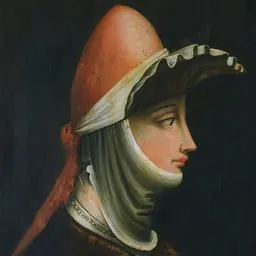
Marriage to Matilda of England (1110) Wedding banquet of Henry V. and Matilda of England. (Chronicle of Ekkehard of Aura, Corpus Christi College, Cambridge) From 1108 on Henry V made official proposals for a marriage with a princess of the English royal family, seeking to increase the authority of the Salian king and secure his throne. His engagement with the eight-year-old princess Matilda took place in Utrecht at Easter of 1110. The Anglo-Norman King Henry I of England paid the extraordinarily high sum of 10,000 or 15,000 pounds of silver as dowry. In return, his daughter's marriage to Henry V enormously increased his prestige. On 25 July 1110 Matilda was crowned Roman-German Queen in Mainz by the Archbishop of Cologne. Four years later the wedding celebrations also took place in Mainz on 7 January 1114 amid great splendor and the attention of princes from all over the empire. The Salians appropriated the occasion to reaffirm unanimity with the imperial nobles after the conflicts in recent years. Duke Lothair of Supplinburg appeared barefoot and in penitent clothing at the wedding. He was forgiven for his participation in the inheritance disputes of Carniola after performing a Deditio (submission). This occasion is the only known case of a Deditio during Henry V's reign, which historians have compared to the amicable set of rules and conflict management and settlement of the Ottonian dynasty. On the other hand, Henry had Count Louis of Thuringia captured and imprisoned for his participation in the Saxon rebellion, which upset many princes. Henry's impertinent demonstrations of power greatly diminished the overall atmosphere of the festivity. Some princes left the festival without permission, as others used the opportunity for conspiracies.
The marriage to Matilda produced no male heirs. The chronicler Hériman of Tournai mentions a child of Henry and Matilda that died soon after birth. A single source mentions a daughter of Henry named Bertha, who was probably illegitimate. She married Count Ptolemy II of Tusculum in 1117. The emperor's bond with the nobility of Rome through marriage was unique. In his conflict with the Pope and the struggle for domination in Italy, the Tusculan marriages of imperial partisans would receive particular honor.
Eventually, affairs in Italy compelled Henry to leave and appoint duke Frederick II of Hohenstaufen and his brother Conrad, the future king Conrad III as administrators.
Second Italian expedition
After Henry had departed from Rome in 1111, a council declared the privilege of the lay investiture to be invalid. Guido, Archbishop of Vienne, excommunicated the emperor, and called upon the pope to ratify the verdict. Paschal, however, refused to take so extreme a step. The discord entered a new stage in 1115 when Matilda of Tuscany died. Matilda's death on 24 July 1115 caused Henry, accompanied only by a small contingent, to leave for Italy in February 1116 in order to secure his inheritance of the enormous property complex in Upper and Central Italy. In addition, he wished to stabilize Salian rule in Northern Italy and create a new power base against the overpowering opposition in the northern part of the empire. He had issued a whole series of court documents in advance, with which he intended to present himself as guarantor of law and justice in Italy. Henry was able to obtain Matilda's property without any problems and his authority was accepted in all the Italian municipalities. Henry regarded Rome as to be of particular importance and, ardently welcomed, he honored the city with five visits, more than any other Salian king.
Concordat of Worms
After the second Italian expedition, the opposition in Germany was gradually crushed, and a general peace was declared at Tribur, while the desire for a settlement of the investiture dispute was growing.
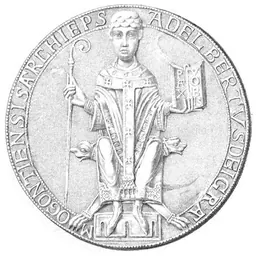
On 2 February 1119, Pope Callixtus II took over the pontificate. On 24 October 1119, the Pope and Emperor again negotiated a settlement in the investiture dispute in Mouzon on the Meuse. Henry only wished to make extensive commitments with the consent of the princes. The negotiations failed. The encounter at Reims in October 1119 is considered the "end and turning point of royal penance in Medieval Europe". During the negotiations on the solution of the ban, Henry V found it hard, even unbearable to submit to a reconciliation ritual and meet the Pope bare-footed. After his father's walk to Canossa in 1077, the ideas of penitence and the personal exposure within one's social status could no longer be reconciled by another papal ban, as the intrinsic meanings symbolized subordination to the Pope. It is, however not certain whether the negotiations failed due to those circumstances. Only upon the conclusion of the Worms Concordat in 1122 was Henry re-admitted without penance or submission to the ecclesial community by a papal legate. After the negotiations had failed, Pope Calixt conferred the honor of papal legacy to the Archbishop Adalbert of Mainz, and thus strengthened the opposition to Henry.
In 1121 the situation escalated again and Henry decided to launch a military campaign against Adalbert of Mainz. The Archbishop mobilized large contingents, largely from Saxony, for the defense of Mainz. As the two armies faced each other near the city, the commanding princes of both sides began negotiations and in autumn 1121 urged the emperor to make peace and seek balanced policies with regards to the Pope. This princely action was an important developmental step towards the establishment of consensual forms of rule as the princes acted cooperatively to bring about negotiations that end the conflict. A princely peace commission composed of equal numbers was appointed. Made up of twelve supporters and twelfe opponents of Henry, the committee intended to represent all imperial estates. The princely assembly, that chronicler Ekkehard of Aura called a gathering of many "heads of the state" (tot capita rei publicae) met on 29 September 1121 in Würzburg and forced the emperor to finally reconcile with the pope. The Calixtinum allowes the emperor to be present at the ordination of bishops and abbots. Henry is only allowed to grant the royal regalia to the newly elected with his scepter. The final consecration was to be performed by the Metropolitan for bishops and by the bishops for the abbots. Henry, who had been solemnly excommunicated at Reims by Calixt in October 1119, abandoned his former papal nominee, Gregory VIII and is again received into the community of the Roman church.
Campaign in France
The marriage ties with the English royal dynasty involved Henry into the Franco-Norman conflict in 1123. Henry I of England asked his son-in-law for military support in his struggle for dominance in Normandy. Like Louis VI of France, Henry V had vague designs on the Low Countries and an invasion in Northern France would enable him to strengthen his position in Flanders. In August 1124 Henry V began preparations for a campaign into France with very limited ducal support. The attack spurred a hitherto unknown patriotic feeling of unity in France, which the French King Louis VI utilized for the deployment of a massive army against which Henry V's forces represented no match, according to French chronicles. The campaign was abandoned near Metz and Henry returned to Germany, where an uprising at the city of Worms was underway. However, the campaign had diverted Louis VI's support from rebel forces opposing Henry I in Normandy. Without such support, the rebellion was defeated by Henry I's household knights at Bourgthéroulde. The extent of Henry V's ambitions beyond this distraction is unclear.
Death and succession
During his last years the emperor was occupied with a campaign in Flanders and the succession of the margraviate of Meissen, two disputes in which his opponents were aided by Lothair of Saxony. On 23 May 1125, Henry died of disease in Utrecht. Upon his death the dynastic line of the Franconian, Salian emperors went extinct.
Speyer's importance as the Salic memorial site soon declined and it took several generations until it became a royal burial site again. The emperor's long tenure of excommunication was probably the reason that only Gladbach, a reform monastery under Siegburg domain, and the Niederaltaich Imperial Abbey have adopted Henry V's memorial service.
Matilda handed the imperial insignia to the Archbishop of Mainz and in September 1126 she returned to England. The Hohenstaufer Duke Friedrich II had been considered a promising candidate for royal succession due to his kinship with Heinrich V and his involvement in the efforts towards imperial unification. However, his candidacy at the Mainz electoral assembly on 24 August 1125 was unsuccessful since he refused to accept free elections (libera electio) of the princes and he further destroyed his chances due to his overconfidence of victory, which was generally perceived as haughty (ambicone cecatus). Further royal candidates were Leopold III, Margrave of Austria, Charles I, Count of Flanders and the Saxon Duke Lothar III, who was eventually elected. Legitimacy was no longer determined by inheritance, but through election by the imperial princes.
Judgement
King Henry's ruthless maneuvers and the incarceration of the pope in 1111 initiated a general change of perception. The arrest of an elder was no longer regarded as a commendable act of the disempowerment of a schismatic ruler, but viewed under the aspect of betrayal of the biological father. Archbishop Adalbert of Mainz characterized the immediate reign of Henry V as "oppression" of "church and empire" and the upcoming "election" should bring "freedom" to the church and "peace" to the people.
French ecclesiastical sources in particular consistently judged Henry negatively, stylized him as a troublemaker and as a traitor or tyrant. For the French abbot Suger of Saint-Denis, Henry was a troublemaker, who died justly within a year of his attack on France in 1124. For Suger, national standards did not matter, but the souvereign's attitude towards the pope constituted the decisive component for his judgment. For Geoffrey of Vendôme Henry was the incarnation of Judas and Richard of Cluny asserted that his childlessness was the just punishment for the betrayal of his father. For Hériman of Tournai, Henry was guilty of planned betrayal and treachery in Rome ("proditio et perfidia diu premeditata"), who behaved like a tyrant. The 1111 events in Rome were discussed throughout all Latin Christianity. The French annals often only mention the imprisonment of the pope by Henry. The events of 1111 also echoed into the far west of Europe. The Breton Chronicon Kemperlegiense of the Quimperlé monastery mentioned an "emperor" for the very first time among its record on the capture of the pope: "Emperor Henry came to Rome, captured Paschal by treason and forced him to take an oath".
Don’t just read it —
keep it.
Full-length biographies made to live with: read them, listen on the way to work, watch them tonight.
- E-book
- Audio
- Video
Instant download · yours to keep · every purchase keeps this site free
Important facts
Family & relationships
People in Henry V's life
Named in this biography and alive at the same time





Related people
Same field, nearest in time



Contemporaries
People whose lives overlapped Henry V's
Frequently asked questions
Who was Henry V?
King of Germany and Holy Roman Emperor, the fourth and last ruler of the Salian dynasty
When was Henry V born?
Henry V was born on 11 August 1086 in Goslar.
When did Henry V die?
Henry V died on 23 May 1125 in Utrecht.
What was Henry V's occupation?
Henry V was a patron of the arts and monarch.
What nationality was Henry V?
Henry V was German.
Sources & further reading
· DBpedia: Henry V, Holy Roman Emperor
Cite this page
APA: Biography.guide. (2026). Henry V. https://biography.guide/henry-v/
MLA: "Henry V." Biography.guide, https://biography.guide/henry-v/.
Chicago: "Henry V." Biography.guide. https://biography.guide/henry-v/.
Data last updated: 2026-09-20 · Spot an error? Report a correction.
Page generated 2026-09-27 05:30 UTC