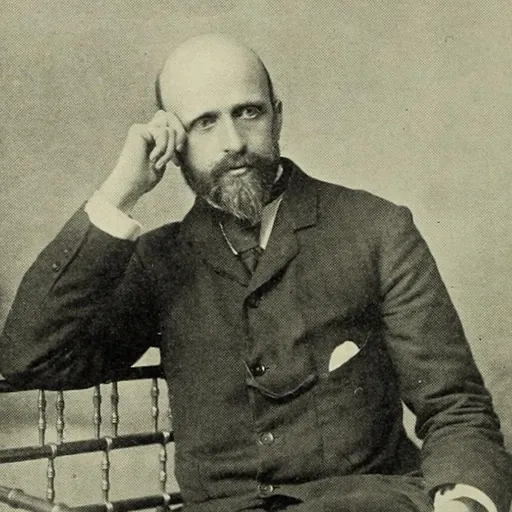
About Henry Rutgers Marshall
Lived 1852 – 1927 (aged 74). Henry Rutgers Marshall was an American architect and psychologist.
Henry Rutgers Marshall (July 22, 1852 – May 3, 1927) was an American architect and psychologist.
Early life
Henry Rutgers Marshall was born July 22, 1852, in New York City to Henry Perry Marshall and Cornelia Eliza Conrad. His mother was descendant of Everardus Bogardus. Related to the famous Rutgers family of New York City and New Jersey, Marshall had a privileged upbringing. He attended the finest New York private schools as a child, and studied architecture as both an undergrad and graduate student at Columbia. He graduated from Columbia College with a Bachelor of Arts in 1873 and from Columbia University with a Master of Arts degree in architecture in 1875. At this time in Marshall's life, psychology wasn't a concern to him.
He began practicing architecture, his lifelong career, two years after graduating in 1878. His most famous designs include Rudyard Kipling's house Naulakha in Dummerston, Vermont, the First Congregational Church in Colorado Springs, Colorado, and the Old Buildings of Brearley School in New York City. He was most known for his designs of country houses. Marshall's accomplishments in the world of architecture did not go unnoticed. He was elected to be a Fellow of the American Institute of Architects, and was eventually given the honor of becoming president of the Institute's New York chapter. In this book, Marshall rejected the structuralist ideals of physiological and anatomical evidence pointing to pleasure and pain sensations. He further criticized the work of Goldsheider, who discovered pressure spots, cold spots, and heat spots on the surfaces of skin. Marshall believed that Goldsheider was too quick to cite physiology for his findings. James and many others believed that Marshall had made a great contribution to psychology in this book.
Soon after the publishing of this famous book, he wrote a series of lectures on aesthetics, which he delivered as an honorary lecturer at Columbia University, his alma mater. Rutgers also lectured at Harvard University, the Nineteenth Century Club of New York City, the Contemporary Club of Philadelphia, and Yale Art School.
Contributions to psychology after death
The awareness of Marshall's contributions is reflective of the end of his life. His work has almost completely vanished from today's psychological systems. Theories on pain were debated years after Marshall's death, however his pleasure-pain theory on pain was completely forgotten. Benjamin (1984) views Marshall's legacy to psychology as his system and theories on aesthetics, which proved to be no legacy at all. Though the study of aesthetics is still popular today, it is primarily from an arts and philosophy perspective, with no attention paid to Marshall's work. Marshall is now known as the forgotten APA president.
Stout, Bain, Titchener, Angell, and Calkins took great interest in Marshall's theories, even incorporating it into their own theories on physiology. However, Marshall's refusal to accept the role of nerves in pain resulted in his views becoming outdated and irrelevant. New scientific discoveries pushed his ideas further into history. As these theorists continued in their careers, the influence of Marshall decreased to a point of vanishing.
Works Pain, Pleasure, and Æsthetics (1894) Æsthetic Principles (1895) Instinct and Reason (1898) The Relation of Aesthetics to Psychology and Philosophy (1905) Human and Other Types of Consciousness (1905) Consciousness (1909) War and the Ideal of Peace (1915)
Don’t just read it —
keep it.
Full-length biographies made to live with: read them, listen on the way to work, watch them tonight.
- E-book
- Audio
- Video
Instant download · yours to keep · every purchase keeps this site free
Important facts
People in Henry Rutgers Marshall's life
Named in this biography and alive at the same time

Related people
Same field, nearest in time


Contemporaries
People whose lives overlapped Henry Rutgers Marshall's

Frequently asked questions
Who was Henry Rutgers Marshall?
American architect and psychologist (1852–1927)
When was Henry Rutgers Marshall born?
Henry Rutgers Marshall was born on 22 July 1852 in New York City.
When did Henry Rutgers Marshall die?
Henry Rutgers Marshall died on 2 May 1927 in New York City.
What was Henry Rutgers Marshall's occupation?
Henry Rutgers Marshall was an architect and psychologist.
What nationality was Henry Rutgers Marshall?
Henry Rutgers Marshall was American.
Sources & further reading
· Wikipedia: Henry Rutgers Marshall
· DBpedia: Henry Rutgers Marshall
Cite this page
APA: Biography.guide. (2026). Henry Rutgers Marshall. https://biography.guide/henry-rutgers-marshall/
MLA: "Henry Rutgers Marshall." Biography.guide, https://biography.guide/henry-rutgers-marshall/.
Chicago: "Henry Rutgers Marshall." Biography.guide. https://biography.guide/henry-rutgers-marshall/.
Data last updated: 2026-09-22 · Spot an error? Report a correction.
Portrait: Wikimedia Commons · author & licence
Page generated 2026-09-27 05:02 UTC