
Henry of Poitiers
About Henry of Poitiers
Lived 1100 – 1149. Henry of Poitiers was a French religious person.
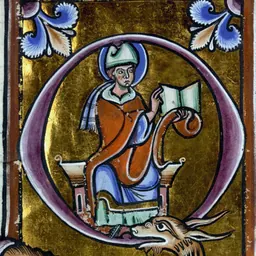
Henry of Poitou (died c. 1149) – not to be confused with Henry of Antioch (c. 1217 – c. 1276) who was also known as Henry of Poitou – thought to be the son of William VII of Poitou. Henry was an ecclesiastic, and, according to the Peterborough Chronicle, held a number of titles throughout his career. He was a sworn witness attesting to the consanguinity of William Clito and Sybilla of Anjou, which led to the annulment of their marriage in 1124 by Pope Calixtus II.
Ecclesiastical career Henry's ecclesiastical career was complex, and spanned both England and what is now France. The titles he held across his career were Bishop of Soissons from c. 1087–1092; he then joined the monastic community of Cluny, and being elevated to prior there; he was prior at Souvigny ; he was abbot of Saint-Jean-d'Angély in the early twelfth century; the Archbishop of Besançon for three days; Bishop of Saintes; and was installed as the abbot of Peterborough Abbey by King Henry I of England in 1127. His appointments to the abbacies of Saint-Jean-d'Angély and of Peterborough were the result of his status as a relative of Henry I and William IX, according to the Anglo-Saxon Chronicle and to the records of the Angély cartulary. He was also the recipient of a papal bull, written by Calixtus II, in 1123, which directly addressed his position and expected duties as abbot of Saint-Jean-d'Angély.
Henry's abbacy was also marked by discontent amongst other abbots, with Geoffrey of Vendôme writing to Henry, Rannulf, William, and Hugh of Cluny, complaining about a territorial dispute between Saint-Jean-d'Angély and Vendôme. The monks of Peterborough Abbey viewed their new abbot as being extremely greedy and ambitious, as well as noting his deceitfulness towards both Henry I and to Peter the Venerable, abbot of Cluny.
Henry, according to the Chronicle, pillaged the monastery of its wealth and sent the bulk of it to his overseas holdings. As a result, the Chronicle relates that there soon appeared (on the 6th of February, 1127) what is now referred to as a "Wild Hunt", a motif that was commonly used by medieval writers to express supernatural displeasure with current events. As Andrew Joynes says, 'To the twelfth-century chronicler and his fellow monks, the monstrous hunters [...] would have signified the disruption of the natural order' caused by Henry's appointment. Henry returned to Poitou in 1128, and, in 1132, he was finally stripped of his rights over Peterborough, when 'finally understanding the perfidiousness of Henry of Poitou', the king removed him from the abbacy. This followed Henry attempting to subjugate the abbey to become a daughter-house of Cluny, but this failed thanks to the intervention of the English clergy. He was succeeded by Martin, formerly of Saint Neot's, which is also in Cambridgeshire.
Orderic Vitalis is one of the few other chroniclers to mention Henry of Poitou, and he does so in a less inflammatory manner, only saying that Henry had been abbot of Saint-Jean-d'Angély, and was later appointed to Peterborough, only to be expelled by the monks there. Henry is also mentioned by Hugo Candidus, although Cecily Clark has argued that this chronicle is too closely based on the Anglo-Saxon Chronicle to be considered untainted by it.
Potential Identifications The British Museum houses MS. 8873, a collection of extracts from the papal registers, which includes a document from the reign of Urban II. This document describes how a Henry of Soissons had been called to a synod by the pope, and forced to promise to refuse connections with those who have been excommunicated, and agreed to refuse to consecrate those bishops or abbots who have been appointed by the laity. While Clark states that there is no way to know that this Henry of Soissons is the Henry of Poitou, these events took place during his reign as bishop.
Death The only surviving record of Henry's death can be found in the writings of Hugo Candidus, who wrote that Henry returned to Saint-Jean-d'Angély, reclaimed his abbacy, and died there not long afterwards.
Don’t just read it —
keep it.
Full-length biographies made to live with: read them, listen on the way to work, watch them tonight.
- E-book
- Audio
- Video
Instant download · yours to keep · every purchase keeps this site free
Important facts
People in Henry of Poitiers's life
Named in this biography and alive at the same time


Related people
Same field, nearest in time



Contemporaries
People whose lives overlapped Henry of Poitiers's

Frequently asked questions
Who was Henry of Poitiers?
(1100-1149)
When was Henry of Poitiers born?
Henry of Poitiers was born in 1100.
When did Henry of Poitiers die?
Henry of Poitiers died in 1149.
What was Henry of Poitiers's occupation?
Henry of Poitiers was a religious person.
What nationality was Henry of Poitiers?
Henry of Poitiers was French.
Sources & further reading
· Wikipedia: Henry of Poitiers
Cite this page
APA: Biography.guide. (2026). Henry of Poitiers. https://biography.guide/henry-of-poitiers/
MLA: "Henry of Poitiers." Biography.guide, https://biography.guide/henry-of-poitiers/.
Chicago: "Henry of Poitiers." Biography.guide. https://biography.guide/henry-of-poitiers/.
Data last updated: 2026-09-20 · Spot an error? Report a correction.
Page generated 2026-09-27 05:22 UTC