
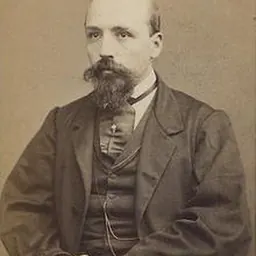
About Henry McCardie
Lived 1869 – 1933 (aged 63). Henry McCardie was a judge and barrister.
Sir Henry Alfred McCardie (19 July 1869 – 26 April 1933) was a controversial British judge. Educated at King Edward's School, Birmingham he left school at 16 and spent several years working for an auctioneer before qualifying as a barrister and being called to the Bar in 1894. Despite his lack of a university degree and the business connections that went with it McCardie built up a successful practice in Birmingham and the Midland and Oxford Circuit through a combination of clear arguments, confident advocacy and intense work; he worked so late in his chambers that they became known as "the lighthouse". He moved to London to continue work in 1904 and was a popular barrister, on one day handling twenty-one cases in twenty-one different courts. At the peak of his career, he was earning £20,000 while still a junior barrister; a large amount for that period.
He was appointed as a judge of the High Court King's Bench Division in 1916 at the personal recommendation of the Prime Minister H. H. Asquith despite only being a junior barrister (his application to become a King's Counsel in 1910 had been withdrawn), a rarity as most High Court judges were KCs. He became known for two things; firstly the quality and detail of his written judgments, and secondly his tendency to rebel against the judicial norm and criticise the system, which prevented him from advancing further up the judicial hierarchy. He was popular with the Bar and became a bencher of the Middle Temple in 1916 and a reader in 1927, but received much criticism from the judiciary for his judgements. After several bouts of illness and depression while on circuit he committed suicide on 26 April 1933 in his flat. Numerous theories have been advanced as to the cause of the fatal act, and it may be that it resulted from a combination of several causes.
Biography
Early life and education McCardie was born on 19 July 1869 in Edgbaston to Joseph McCardie, an Irish merchant and button maker, and as a result he and his six siblings were raised by their mother alone. He was educated at King Edward's School, Birmingham and was noted as intelligent but lazy. Earlier, in the O'Dwyer v. Nair Libel Case, he led the jury's decision in the libel against the Indian politician and lawyer Sir C. Sankaran Nair, by former Lieutenant Governor of the Punjab, Sir Michael O'Dwyer. He made several judgments in areas that previously had no case law; in Cohen v Sellar 1 KB 536 he decided that a fiancée who breaks off the engagement is not entitled to the return of the ring, and his ruling in Hartley v Hymans 3 KB 475 was one of the cases used by Lord Denning in his resurrection of promissory estoppel.
Don’t just read it —
keep it.
Full-length biographies made to live with: read them, listen on the way to work, watch them tonight.
- E-book
- Audio
- Video
Instant download · yours to keep · every purchase keeps this site free
Important facts
People in Henry McCardie's life
Named in this biography and alive at the same time

Related people
Same field, nearest in time


Contemporaries
People whose lives overlapped Henry McCardie's




Frequently asked questions
Who was Henry McCardie?
British judge (1869–1933)
When was Henry McCardie born?
Henry McCardie was born on 19 July 1869 in Edgbaston.
When did Henry McCardie die?
Henry McCardie died on 26 April 1933.
What was Henry McCardie's occupation?
Henry McCardie was a judge and barrister.
Sources & further reading
Cite this page
APA: Biography.guide. (2026). Henry McCardie. https://biography.guide/henry-mccardie/
MLA: "Henry McCardie." Biography.guide, https://biography.guide/henry-mccardie/.
Chicago: "Henry McCardie." Biography.guide. https://biography.guide/henry-mccardie/.
Data last updated: 2026-09-25 · Spot an error? Report a correction.
Page generated 2026-09-27 05:11 UTC