
About Henry de Beaumont, 1st Baron Beaumont
Lived 1280 – 1340 (aged 59–60). Henry de Beaumont, 1st Baron Beaumont was an English politician.
Henry de Beaumont ( – 10 March 1340), jure uxoris 4th Earl of Buchan and suo jure 1st Baron Beaumont, was a French nobleman and a key figure in the Anglo-Scots wars of the thirteenth and fourteenth centuries, known as the Wars of Scottish Independence.
Taken into service at the English court at a young age, Beaumont was a veteran campaigner who participated in every major engagement, from the Battle of Falkirk in 1298 to the Battle of Halidon Hill in 1333. His long experience in the Scottish wars led him to develop a battle technique later used to great effect at Crécy and Agincourt.
Beaumont was one of the most prominent among Anglo-Scots nobles known as the 'Disinherited', nobles whose Scottish lands had been forfeited over their refusal to serve Robert the Bruce. Beaumont supported Edward Balliol in his bid for thre Scottish throne, which would eventually overturn the peace between England and Scotland established by the Treaty of Northampton and bring about the Second War of Scottish Independence.
Early life and career Henry de Beaumont was the son of Louis of Brienne (d. after 1 September 1297) and Agnès de Beaumont, Viscount of Beaumont in Maine, France and Seigneur of Beaumont-le-Vicomte (later Beaumont-sur-Sarthe), Sainte-Suzanne, La Fleche, Fresnay-le-Vicomte, Le Lude. His brother was Lewis de Beaumont, bishop of Durham.
Beaumont was made a household knight of King Edward I in 1297, and took up military service with him in Flanders in 1297 against Philip IV of France shortly thereafter. Beaumont served with Edward the following year when, following the English defeat against the Scots at the Battle of Stirling Bridge, Edward returned to England and led a campaign into Scotland. In the ensuing Battle of Falkirk, Beaumont was one of the young knights who had his horse killed from under him by the spears of William Wallace's schiltrons.
Service under Edward II Beaumont quickly became a favourite of Edward II, following his ascension as king in 1307. Beaumont was given large grants of manors and lands, including Folkingham, Barton-upon-Humber, and Heckington, Lincolnshire. He was summoned to parliament from 4 March 1309 to 20 October 1332, by Writs directed to Henrico de Bellomonte, whereby he is held to have become Lord Beaumont.
Because of the favour shown to Beaumont and his siblings, the next year he and his sister, Isabel de Vesci, were banished from Court by the Ordainers along with Piers Gaveston, though they soon returned. Among the Ordainers demands was that the Isle of Man ought to be revoked from Beaumont and instead be held by "a good Englishman", a dig at Beaumont's French origin, which was another reason for his unpopularity. Consequently, Beaumont claimed the earldom of Buchan and constableship of Scotland jure uxoris. Alice, however, fled to England around the time of her uncle's defeat by Robert the Bruce in 1308, and she never exercised any control over her lands in Scotland. Beaumont was briefly imprisoned for contempt and disobedience at the Privy Council (of which he was a member), after which he retired from Court to continue his intrigues in exile, eventually joining forces with Edward's estranged wife, Queen Isabella, and her lover Roger Mortimer, 1st Earl of March.
Following the deposition of Edward II in 1327, Beaumont was initially well rewarded by the new regime of Isabella and Mortimer.
Beaumont persuaded Balliol to come to England in 1331, and played a key role in coordinating the campaign into Scotland the following year which culminated in Balliol's victory at the Battle of Dupplin Moor. Building on this victory, the army advanced on Scone, where Edward Balliol was crowned King of Scots on 24 September. Beaumont attended the coronation and Balliol's first parliament in October, in which the Disinherited were officially restored to their lands. The priors of St. Andrews wrote of the lordship of Edward Balliol and Henry Beaumont, and their inability to collect the dues from their church at Fordun 'for fear of the said Lord Henry.'
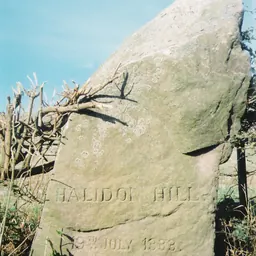
Beaumont would spend the next few years campaigning in Scotland. In January 1333 Edward III finally dropped the pretence of neutrality: Edward Balliol was formally recognised as King of Scotland and promised military aid. Subsidies were now paid to Balliol and the others, to help prepare for a fresh invasion. Beaumont was present in the Battle of Halidon Hill, in which the Scots were defeated once again. Following the battle, Balliol granted the earldom of Moray to Beaumont. He soon was besieged in Dundarg by Sir Andrew de Moray of Avoch and Bothwell, the new Guardian of Scotland. Under continual attack, and running short of supplies, he was compelled to surrender on 23 December 1334. After a brief imprisonment, he was ransomed and returned to England in time for the summer campaign of 1335. When he came back to Scotland it is uncertain if he ever saw Buchan again. Dundarg was destroyed for the second and last time in its history.
Beuamont's son-in-law, David Strathbogie, was killed at the Battle of Culblean in 1335. Not only was this a severe blow to Balliol's kingdom, but Andrew Moray thence proceeded to besiege Beaumont's daughter Katherine (Strathbogie's widow) at Lochindorb. Edward III and Balliol once more launched a campaign, accompanied by Beaumont, and advanced into Aberdeenshire in the summer of 1336. Katherine was duly rescued, while the north-east was subject to widespread destruction. It was in this season that Henry Beaumont embarked on his last actions in Scotland, by seeking vengeance against those whom he held responsible for the death of his son-in-law. The Pluscarden Chronicle describes his actions thus: Henry Beaumont, to avenge his son-in-law, the Earl of Atholl, who was slain at Culblean, either cast into prison or put to cruel death all who had taken part in the engagement in which he was slain; whereby much innocent blood was shed.
Rather than return to Scotland with Balliol for another campaign, Beaumont accompanied King Edward to the Low Countries in 1338, in what would be the earliest campaigns of the Hundred Years' War.
Marriage and children Arms of Comyn: Azure, three garbs or. As quartered on Garter stall plate of John Beaumont, 4th Baron Beaumont (1361–1396), KG Shortly before 14 July 1310 Henry married Alice Comyn, Countess of Buchan, the niece and heiress of John Comyn, Earl of Buchan. He was recognised as Earl of Buchan jure uxoris. By Alice Comyn he had children including: John de Beaumont, 2nd Lord Beaumont (25 December 1317 or 30 November 1318) Thomas de Beaumont (30 November 1324) ) married Fulk VII FitzWarin, 3rd Baron FitzWarin (died 1349), of Whittington Castle in Shropshire and Alveston in Gloucestershire.
Don’t just read it —
keep it.
Full-length biographies made to live with: read them, listen on the way to work, watch them tonight.
- E-book
- Audio
- Video
Instant download · yours to keep · every purchase keeps this site free
Important facts
Family & relationships
People in Henry de Beaumont, 1st Baron Beaumont's life
Named in this biography and alive at the same time



Related people
Same field, nearest in time

Contemporaries
People whose lives overlapped Henry de Beaumont, 1st Baron Beaumont's


Frequently asked questions
Who was Henry de Beaumont, 1st Baron Beaumont?
English noble (1280-1340)
When was Henry de Beaumont, 1st Baron Beaumont born?
Henry de Beaumont, 1st Baron Beaumont was born in 1280.
When did Henry de Beaumont, 1st Baron Beaumont die?
Henry de Beaumont, 1st Baron Beaumont died on 10 May 1340.
What was Henry de Beaumont, 1st Baron Beaumont's occupation?
Henry de Beaumont, 1st Baron Beaumont was a politician.
What nationality was Henry de Beaumont, 1st Baron Beaumont?
Henry de Beaumont, 1st Baron Beaumont was English.
Sources & further reading
· Wikipedia: Henry de Beaumont, 1st Baron Beaumont
Cite this page
APA: Biography.guide. (2026). Henry de Beaumont, 1st Baron Beaumont. https://biography.guide/henry-de-beaumont-1st-baron-beaumont/
MLA: "Henry de Beaumont, 1st Baron Beaumont." Biography.guide, https://biography.guide/henry-de-beaumont-1st-baron-beaumont/.
Chicago: "Henry de Beaumont, 1st Baron Beaumont." Biography.guide. https://biography.guide/henry-de-beaumont-1st-baron-beaumont/.
Data last updated: 2026-09-20 · Spot an error? Report a correction.
Page generated 2026-09-27 05:10 UTC