
About Henry Charles Lea
Lived 1825 – 1909 (aged 84). Henry Charles Lea was an American church historian, historian and writer, known for Publisher.
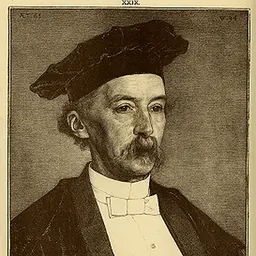
Henry Charles Lea (September 19, 1825 – October 24, 1909) was an American publisher, civic activist, philanthropist and historian from Philadelphia, Pennsylvania.
He took over the family publishing business from his father, Isaac Lea, and implemented several medical and scientific publications. The business operated under various names including Lea Brothers & Co., Lea & Febiger and Blanchard & Lea until his sons took over the business in 1880.
He promoted health projects including the Lea Laboratory of Hygiene at the University of Pennsylvania and the Pennsylvania Epileptic Hospital and Colony Farm. He organized the Citizens' Municipal Reform Association of Philadelphia to fight corruption in city government. He was a founding member of the Union League of Philadelphia during the American Civil War. He managed publications and supported their efforts for recruitment of Union Army soldiers, including African-Americans. He helped found the National Republican League to prevent a third U.S. presidential term for Ulysses S. Grant.
Lea wrote multiple books focused on church history, especially the Spanish Inquisition. He received honorary degrees from Harvard University, Princeton University, University of Giessen, University of Moscow, and University of Pennsylvania. He was a member of multiple learned societies and served as president of the American Historical Association in 1903.
Early life and education Lea was born on September 19, 1825, in Philadelphia, Pennsylvania to Isaac Lea and Frances Anne Carey. His father was a publisher and amateur scientist.
Through private tutors including the mathematician Eugenius Nulty. In 1832, he studied for a brief time at a school in Paris, France. Lea worked too in the Booth & Boy chemical laboratory, and he published his first paper, at age 13, on manganese salts.
Lea received an LLD from Harvard University and the University of Pennsylvania.
Lea followed his father's interest in natural history and wrote several papers on descriptive conchology. He discovered and named 133 new species of mollusks and two new genera. He also displayed drawing talent and illustrated his own early articles about fossil shells that he had collected. His drawings were also used for the engravings illustrating his father's revision of the Synopsis of the Naiades in 1838. Lea developed an interest in poetry and at his mother's suggestion, translated Greek poets and composed original verse. Later, he often wrote satirical parodies of popular songs about politics.
Career Publisher
In 1843, Lea joined his father's publishing business as a clerk and became a junior partner in 1851.
Civic activism and philanthropy
In 1844, Lea stood guard with a musket for two days and two nights in front of a Catholic Church to prevent property damage during the Philadelphia nativist riots.
He was a member of the Union League of Philadelphia at its inception in 1862 and served on the Board of Directors, the Military Committee and the Committee of Publications. He wrote many of the pamphlets published by the organization. Lea received honorary degrees from universities including Harvard, Princeton and the University of Pennsylvania in the United States, and overseas institutions such as the University of Giessen and the University of Moscow. His study of the Inquisition was also criticized for anti-Spanish bias, which Julián Juderías in 1914 termed the 'leyenda negra' (a/k/a Black legend).
He was a member of multiple historical societies including the Royal Academy of Bavaria, the Comenius-Gesellschaft of Berlin, the Reale Accademia dei Lincei of Rome, the Societa Internazionale di Studi Francescani of Assisi, the Reale Societa Roman della Storia Patria, the Royal Society of Arts in London, the Royal Society of Antiquities in Scotland, the Jewish Historical Society of England and a corresponding fellow of the British Academy.
Lea became a member of the newly formed American Historical Association in 1884, contributed several articles to its American Historical Review, and was elected its president in 1903. He was elected a member of the American Antiquarian Society in 1888. When the second annual meeting of the newly formed American Folklore Society was held in Philadelphia in 1889, Lea met with some of the founders, sent an article for publication in the Society's journal, and became the first life-member of the organization.
In 1878, Lea became seriously ill and was almost blind.
In 1914, the Henry C. Lea Elementary School in Philadelphia was named in his honor.
His personal collection of purchased manuscripts and incunabula as well as other early printed books was bequeathed to the University of Pennsylvania. In 1925, the university dedicated a library, which it named in his honor and which includes much of that personal collection of books and manuscripts. Since 1962, the collection has been located in the Van Pelt-Dietrich Library Center which is now a part of the Kislak Center for Special Collections, Rare Books and Manuscripts.
In 1933, Lea's son Arthur donated four Greek vases that belonged to his father to the Penn Museum.
Works Superstition and Force: Essays on the Wager of Law, the Wager of Battle, the Ordeal, Torture Henry C. Lea, 1866. Historical Sketch of Sacerdotal Celibacy, J. B. Lippincott & Co., 1867. Studies in Church History. The Rise of the Temporal Power - Benefit of clergy - Excommunication, Henry C. Lea, 1869. Translations and Other Rhymes, Privately Printed, 1882. A History of the Inquisition of the Middle Ages, Vol. 2, Vol. 3, The Macmillan Company, 1906 [1st Pub. New York, Harper & Brothers, 1887]. Chapters from the Religious History of Spain Connected with the Inquisition, Lea Brothers & Co., 1890. A Formulary of the Papal Penitentiary in the 17th Century, Lea Brothers & Co., 1892. The Absolution Formula of the Templars, The Knickerbocker Press, 1893. A History of Auricular Confession and Indulgences in the Latin Church, Volume II, Volume III, Lea Brothers & Co., 1896. The Indian Policy of Spain, n.p., 1899. The Dead Hand; a Brief Sketch of the Relations between Church and State with Regard to Ecclesiastical Property and the Religious Orders, William J. Dornan, 1900. The Moriscos of Spain; their Conversion and Expulsion, Lea Brothers & Co., 1901. Léo Taxil, Diana Vaughan et l'Église Romaine: Histoire d'une mystification, Paris, France: Sociéte Nouvelle de Librairie et d'édition, 1901. Ethical Values in History, n.p., 1904. A History of the Inquisition of Spain, Volume II, Volume III, Volume IV, 1906–1907. The Inquisition in the Spanish Dependencies, The Macmillan Company, 1922 [1st Pub. 1908]. Memoir, Privately printed, 1910. History of Sacerdotal Celibacy in the Christian Church (fourth edition, 1932) Materials Toward a History of Witchcraft, University of Pennsylvania Press, 1939.
Don’t just read it —
keep it.
Full-length biographies made to live with: read them, listen on the way to work, watch them tonight.
- E-book
- Audio
- Video
Instant download · yours to keep · every purchase keeps this site free
Important facts
People in Henry Charles Lea's life
Named in this biography and alive at the same time


Related people
Same field, nearest in time



Contemporaries
People whose lives overlapped Henry Charles Lea's



Frequently asked questions
Who was Henry Charles Lea?
American historian (1825-1909)
When was Henry Charles Lea born?
Henry Charles Lea was born on 19 September 1825 in Philadelphia.
When did Henry Charles Lea die?
Henry Charles Lea died on 24 October 1909 in Philadelphia.
What was Henry Charles Lea's occupation?
Henry Charles Lea was a church historian, historian and writer.
What was Henry Charles Lea known for?
Henry Charles Lea was known for Publisher.
What nationality was Henry Charles Lea?
Henry Charles Lea was American.
Sources & further reading
· Wikipedia: Henry Charles Lea
Cite this page
APA: Biography.guide. (2026). Henry Charles Lea. https://biography.guide/henry-charles-lea/
MLA: "Henry Charles Lea." Biography.guide, https://biography.guide/henry-charles-lea/.
Chicago: "Henry Charles Lea." Biography.guide. https://biography.guide/henry-charles-lea/.
Data last updated: 2026-09-26 · Spot an error? Report a correction.
Page generated 2026-09-27 05:16 UTC